Views: 0 Author: Wendy Liu Publish Time: 2026-08-06 Origin: JEWSHIN
A large-format bagging machine is an automated packaging system that feeds oversized flat products — such as exam paper bundles, A3 documents, wall calendars, and hardcover books — into pre-opened center-folded film bags and seals them using either self-adhesive peel-and-seal flaps or heat-seal tamper-evident closures. For commercial printers, educational publishers, and secure printing facilities, this technology eliminates manual bagging bottlenecks, reduces edge damage on sensitive paper goods, and delivers consistent output at 15–30 pieces per minute — replacing 4 to 6 manual operators on a single line.
JEWSHIN's JX35-50 Large Format Bagging Machine handles bags up to 350 mm wide and 480 mm long, making it the industry standard for oversized flat packaging in printing and stationery export operations.

Manual packaging of large-format paper products creates compounding inefficiencies that directly impact delivery timelines, material waste, and product integrity. Understanding these bottlenecks is the first step toward justifying an automated investment.
Secure printing facilities and educational publishers typically rely on manual operators to slide test papers, answer sheets, and oversized documents into pre-opened bags by hand. This process requires constant attention to alignment, flap folding, and seal application — tasks that become inconsistent after hours of repetitive motion. High labor turnover in packaging roles means training costs accumulate while quality drifts.
Large-format paper products are especially vulnerable during manual bagging. Operators often crumple corners, bend edges, or create creases while forcing stacks into bags that are barely large enough. For exam papers and premium printed materials, even minor edge damage can render a product unsellable or compromise the professional appearance expected by institutional buyers.
For government exam boards and secure printing facilities, manual handling introduces chain-of-custody vulnerabilities. Every human touch point is a potential breach point. Automated bagging with tamper-evident heat sealing creates a verifiable, consistent seal that visually indicates whether a package has been opened — a critical requirement for exam material integrity.
A single manual operator typically completes 1,000–1,500 bags per 8-hour shift (industry estimate; actual rates vary by product size and operator skill). During peak exam seasons or large publication runs, this throughput ceiling forces facilities to hire temporary workers, increasing both cost and quality variability.
A large-format pre-opened bag packaging line is an integrated system that automatically feeds center-folded film (V-fold), opens it using vacuum suction or air-jet mechanisms, inserts oversized flat products via a smooth horizontal feeding conveyor, and applies either self-adhesive peel-and-seal closures or heat-seal permanent seals — all controlled by a PLC and servo drive system for millimeter-level positioning accuracy.
Film feeding: Center-folded film (V-fold OPP or PE) is drawn from a heavy roll mounted on the machine frame. An automatic deviation correction system keeps the film aligned throughout the run, preventing crooked seals — a feature especially critical when handling wide bags up to 350 mm.
Bag opening: A vacuum suction mechanism opens the pre-folded film into a pocket. Unlike mechanical fingers, vacuum suction provides gentle, adjustable bag-width control with only three calibration points, reducing setup time and eliminating film tearing.
Product insertion: A horizontal feeding conveyor pushes the flat product (test paper stack, hardcover book, calendar, or envelope bundle) into the opened film pocket. The servo-driven push mechanism maintains precise positioning to prevent edge damage during insertion.
Sealing: Depending on the selected mode, the machine either:
Self-adhesive mode: Peels the adhesive strip and folds the flap down, creating a resealable bag ideal for retail display products like calendars and stationery sets.
Heat seal mode: Hot-cuts the film edge, creating a permanent, tamper-evident seal suitable for secure document shipping and exam material packaging.
Quality control: An intelligent "No Product, No Bag" sensor system detects whether a product is present on the conveyor. If a gap occurs — due to a feeding miss or manual intervention — film feeding pauses instantly, preventing empty bags from entering the output stream and saving thousands of dollars in wasted film annually.
Parameter | Specification |
Model | JX35-50 |
Bag width range | 280–350 mm |
Bag length range | 300–480 mm |
Maximum speed | 15–30 pcs/min (size-dependent) |
Product height | 1–10 mm |
Film type | Center-Folded Film (V-Fold), OPP self-adhesive or PE |
Sealing modes | Self-adhesive (resealable) + Heat seal (tamper-proof) |
Control system | Inovance PLC + Servo |
Film alignment | Automatic deviation correction |
Labeling integration | Optional, accuracy <2 mm |
Power | 15 kW, 380V, 50Hz |
Machine dimensions | 5000 × 5000 × 800 mm |
Designed service life | 10 years |
Warranty | 1 year + lifetime maintenance |
Component quality summary: Inovance PLC and servo system (China's top automation brand), Omron sensors and relays (Japan), NSK bearings (Japan), AirTAC pneumatics (Taiwan), Weinview touch screen, JSCC precision motor.
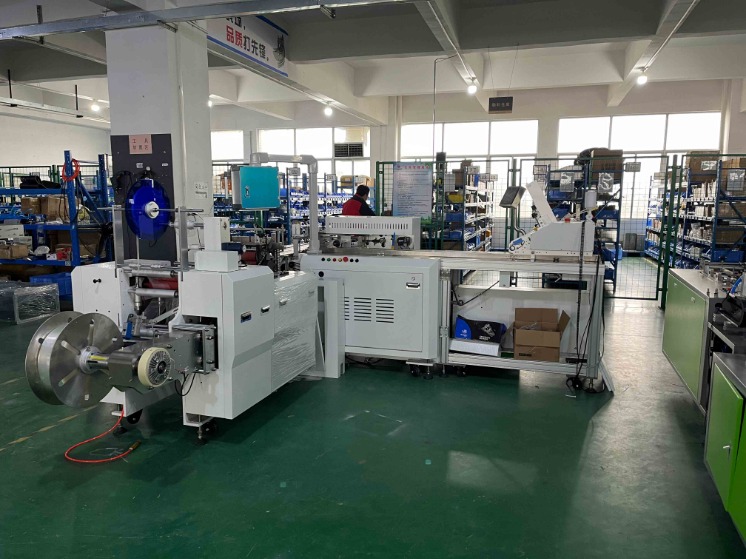
The servo-driven horizontal feeding mechanism is engineered specifically for flat, rigid products that cannot tolerate bending or compression during insertion. Unlike flow wrappers that form film around a product — which can apply lateral pressure — the pre-opened bag approach inserts the product into a pre-formed pocket, eliminating the mechanical forces that cause corner crumpling and surface scratching.
For test paper bundles, where even slight edge deformation can affect automated scanning and grading systems, this gentle handling is a functional requirement, not just a cosmetic preference.
OPP and PE films generate static electricity during high-speed feeding and opening, causing film sheets to cling together, jam feeding mechanisms, and create inconsistent bag openings. The JX35-50 addresses this through:
Vacuum suction opening that physically separates film layers regardless of static charge
Controlled film tension via the servo system, preventing the rapid movement that generates static buildup
Compatibility with anti-static treated OPP film for facilities operating in low-humidity environments
This is particularly critical for large-format bags, where the wider film surface area amplifies static-related feeding problems compared to small-format bagging.
Educational publishers and secure printing facilities handle a wide range of product sizes — from A4 answer sheets to oversized exam packages to heavy envelope bundles. The JX35-50's memory function stores parameters for dozens of product configurations, enabling changeover in seconds rather than minutes.
Key changeover features:
One-button reset: Recalls stored parameters for a previously configured product
Bi-directional control: Enables quick jam clearing without disassembly
Three-point bag-width adjustment: Simplified mechanical setup for new bag dimensions
Weinview touch screen: Intuitive interface for operators transitioning between product runs
Typical changeover scenario: transitioning from a 300 × 420 mm wall calendar format to a 280 × 300 mm exam paper bundle takes under 10 minutes, including film roll change and parameter recall.
Metric | Manual Bagging (per operator) | JX35-50 Automated | Improvement |
Output per 8-hour shift | 1,000–1,500 pcs | 7,200–14,400 pcs (at 15–30 ppm) | 5–10× increase |
Error rate (damaged/wasted bags) | 3–5% | <0.5% (with No Product No Bag system) | 85%+ reduction |
Required operators | 4–6 per line | 1–2 (feeder + supervisor) | 60–75% reduction |
Film waste | 5–8% | <1% (sensor-controlled feeding) | 85%+ reduction |
Payback period (estimated) | — | 12–18 months (typical, varies by volume) | — |
Note: ROI figures are estimates based on typical industry operation patterns. Actual results vary by product mix, shift configuration, film material costs, and labor rates in your region. Contact JEWSHIN for a customized ROI calculation based on your specific production volume and product dimensions.
For facilities running 2 or 3 shifts, the theoretical daily output ranges from 14,400 to 43,200 pieces (based on 15–30 ppm × 16–24 hours, before maintenance downtime). Multi-shift operation requires appropriate staffing for material replenishment and periodic maintenance intervals.
Yes. The JX35-50 Large Format Bagging Machine handles products up to 10 mm in height and 480 mm in length, accommodating most hardcover books, multi-volume sets, and thick calendar pads. The servo-driven feeding mechanism and vacuum suction bag opening provide precise, controlled insertion that prevents jamming even with heavier products. For books exceeding 10 mm thickness, JEWSHIN offers customization consultation to determine the optimal configuration.
Anti-static film handling prevents OPP and PE film layers from clinging together during the bag-opening phase. The JX35-50 uses vacuum suction to physically separate film layers, while the Inovance servo system maintains controlled film tension to minimize static generation. For facilities in low-humidity environments, the machine is also compatible with anti-static treated films, ensuring consistent bag opening and feeding during high-volume production runs.
The JX35-50 accommodates bag widths from 280 to 350 mm and bag lengths from 300 to 480 mm, using center-folded film (V-fold). This covers A3-size documents (297 × 420 mm), oversized exam papers, wall calendars, and large envelope bundles. Products exceeding these dimensions require a custom machine configuration.
Yes. The dual sealing system allows operators to switch between self-adhesive (resealable, for retail display) and heat-seal (tamper-evident, for secure shipping) modes via the Weinview touch screen. However, switching modes may require a brief mechanical adjustment. For production runs requiring both seal types, JEWSHIN recommends planning batch sequences to minimize mode switches.
The machine is designed for center-folded film (V-fold), compatible with OPP self-adhesive film, PE film, and CPP film. For biodegradable film options, consult with JEWSHIN's engineering team to verify material compatibility and adjust machine parameters accordingly.
If your facility handles test papers, exam materials, oversized documents, wall calendars, or large stationery sets, the JX35-50 Large Format Bagging Machine offers a proven path from manual inefficiency to automated precision.
What you can do next:
Request a customized layout proposal: Send your facility dimensions and we will provide a line layout with conveyor integration, film roll positioning, and operator workflow design.
Send your sample dimensions for a free packing test video: Mail your actual products (test paper bundles, hardcover books, calendars, or envelopes) to JEWSHIN's facility. Our engineering team will run them on the JX35-50 and send you a video demonstrating the "No Product, No Bag" system, film alignment, and seal quality.
Schedule a technical consultation: Discuss your product range, target output, and integration requirements with our 15-year experienced engineering team.
Contact: WhatsApp +86-13128136672 | Email: wendy@jewshin.com


