Views: 0 Author: Wendy Liu Publish Time: 2026-07-15 Origin: Jewshin
I get this question almost as often as "how fast is it": should I get semi-automatic or fully automatic?
And I'll tell you something that might surprise you coming from someone who sells both: the answer is usually not "buy the more advanced one." I've talked to plenty of buyers who assumed fully automatic was simply the better choice — more advanced, more future-proof — and a good number of them genuinely didn't need it yet. Selling someone equipment they don't need yet isn't good business for either of us; a buyer who feels oversold rarely comes back for their next line upgrade.
So let's actually work through how to tell which one fits where you are right now.
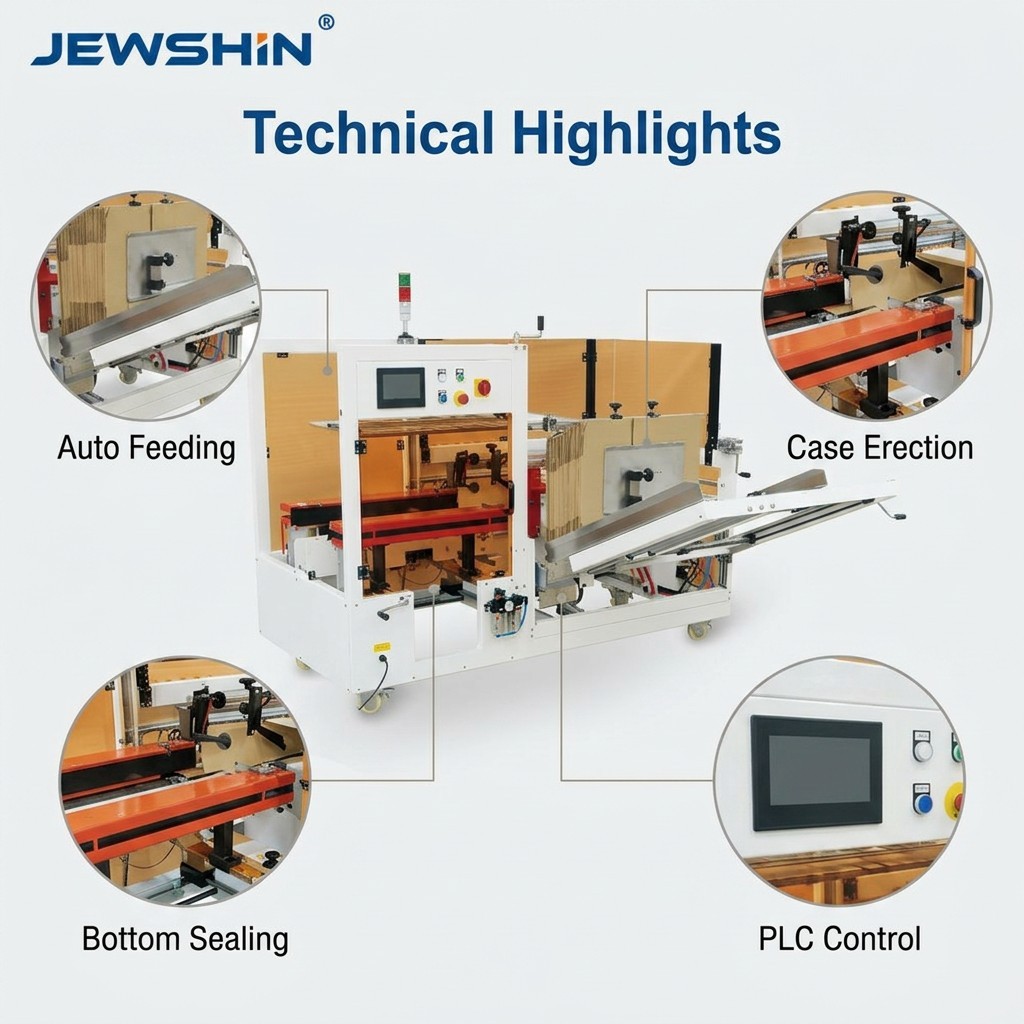
A semi-automatic carton erector still needs an operator to place flat cartons into the machine one at a time; the machine then forms and seals each one. A fully automatic erector pulls flat cartons from a magazine (a stacked carton storage feeder) on its own — no manual feeding step at all.
Both are still far faster and more consistent than hand-folding. The real question isn't "automatic vs. manual," it's: does removing that one remaining manual feeding step matter enough at your current volume to justify the cost difference?
Here's the general pattern I see across the buyers I talk to, and it lines up with what most of the industry has converged on: once your case-forming need crosses roughly 3 cartons per minute, doing it by hand — or even semi-automatically at low volume — starts to become the actual bottleneck in your line, not just an inconvenience (Lantech).
But that 3-per-minute figure is about when you need some form of case erector at all — it doesn't tell you semi vs. fully automatic. For that distinction, the more useful question is about your daily volume and how consistent it is:
If you're running a few hundred cartons per day, and your line has one operator who already has some downstream task with idle moments (like monitoring a sealer or labeler), a semi-automatic machine often makes more sense. You're not paying for a magazine-feed system you won't fully utilize, and having a person still lightly involved in the process gives you a natural quality-check point.
If you're running well over a thousand cartons per day, or running multiple shifts, the labor cost of dedicating someone specifically to manual carton feeding — even if it's "just placing flat cartons" — adds up fast, and a fully automatic magazine-fed system starts paying for the cost difference quickly through labor savings alone.
If your volume is growing but not there yet, this is the harder case, and it's the one I spend the most time talking through with buyers directly, because the honest answer depends on your growth trajectory, not just your current number.
Semi-automatic machines have a lower upfront cost, but a real ongoing labor dependency — you're paying a person's wage every shift you run, indefinitely. Fully automatic machines cost more upfront, but that labor cost mostly disappears after installation; your ongoing cost becomes mostly maintenance and consumables.
This means the comparison isn't really "which is cheaper" — it's "at what volume does the labor cost you'd keep paying with semi-automatic exceed the extra upfront cost of going fully automatic." That's the same payback logic I walked through in our ROI framework article — I'd encourage you to run your own numbers there once you have a rough sense of which category you're in.
A rough way to think about it: take the wage cost of the operator you'd need for manual feeding, multiply by your expected years of use, and compare that total to the price difference between the semi-automatic and fully automatic models you're considering. If that multi-year labor total is larger than the price gap, fully automatic usually wins financially — even before counting consistency and speed benefits.
Buying fully automatic too early. I've talked to buyers — often growing but still mid-size operations, frequently in markets where they're scaling up from a smaller manual setup — who wanted the fully automatic system because it felt like the "serious" choice, before their actual volume justified it. They end up with a machine running well under its designed throughput, which isn't wrong exactly, but it does mean they paid for capacity and automation they won't use for another year or two.
Staying on semi-automatic too long. The opposite mistake is just as common: a factory's volume has quietly grown past the point where semi-automatic still makes sense, but nobody re-ran the numbers because the current setup "still works." The labor cost creeps up gradually rather than showing up as one obvious trigger point, so it's easy to miss.
Both mistakes come from the same root cause: making the decision based on what feels more advanced, rather than recalculating based on actual current volume.

We build both configurations, and I'd rather have that conversation honestly with you than push you toward whichever one has a better margin for us:
Our semi-automatic configuration (JX-K20TX, pneumatic-driven) is built for factories running at lower, steadier volumes — up to roughly 8-10 cartons per minute — where a lower upfront investment and simpler mechanics fit the actual production need.
Our fully automatic configuration (JWS-KXJ-4012) runs 8-12 cartons per minute with a 100-carton magazine capacity and a roughly 3-minute changeover between carton sizes — built for factories that have crossed into steady, higher-volume production and want the labor cost mostly out of the equation.
If you're in the growing-but-not-sure-yet category, that's exactly the conversation to have with us directly rather than guessing from a spec sheet. Tell us your current daily volume and where you expect to be in 12-18 months, and we'll tell you honestly which configuration actually fits — including if the answer is "you don't need to upgrade yet."
[Talk to Our Team About Your Actual Volume →]
And if you haven't worked through the technical specs that matter beyond just speed and automation level, our selection guide covering 6 key specs is the natural next read.


