Views: 0 Author: Wendy Liu Publish Time: 2026-06-09 Origin: Jewshin
What you'll learn in 12 minutes:
✓ Why manual poly mailer packing costs 8–12 workers you could replace with one machine
✓ Full JX-700X specs + 3 production line configurations (500 / 15,000 / 50,000 orders/day)
✓ Real ROI math: payback in 8–14 months for a mid-size apparel brand
✓ WMS integration architecture, film selection, and 90-day implementation roadmap
If you run an e-commerce fulfillment operation — whether you're a brand, a 3PL, or a marketplace seller — there's a good chance that poly mailer packing is still one of the most labor-intensive steps in your warehouse.
And it's easy to understand why it stays manual for so long. Each order is different. Products vary in size. Labels need to match the right bag. It feels like a problem that requires human judgment.
But that assumption is increasingly wrong.
Modern e-commerce packaging machines — specifically designed for the PE poly mailer films, variable product sizes, and inline label application that e-commerce fulfillment requires — can automate 80–95% of the packing process for a typical apparel, soft goods, or general merchandise fulfillment operation.
The economics are compelling: a single automated poly mailer line running at 30 bags/min replaces 8–12 manual packers. At typical warehouse labor costs in North America or Europe, the payback period is 8–14 months.
This guide gives you the complete framework: the machine types available, the line configurations that work for different operation sizes, the ROI calculation methodology, and the practical implementation considerations that determine whether an automation project succeeds or fails.

E-commerce packaging automation is fundamentally different from manufacturing packaging automation — and machines designed for one rarely work well for the other. Understanding the differences is essential for specifying the right solution.
Dimension | Manufacturing Packaging | E-commerce Packaging |
Product consistency | Same product, same dimensions, high repeatability | Variable products, variable dimensions, low repeatability |
Order size | Large batches (hundreds to thousands of identical packs) | Small batches (often 1 unit per order) |
Film type | OPP, shrink film, food-grade film — relatively stiff | PE poly mailer film — soft, stretchy, difficult to handle at speed |
Label requirement | Production batch label (same label, high volume) | Individual shipping waybill (unique label per bag, must match correct order) |
Throughput pressure | Consistent daily volume | Extreme peaks (sales events, holidays) with low base volume |
These differences explain why standard flow wrappers and bagging machines — which work excellently for manufacturing packaging — are not suitable for e-commerce fulfillment. E-commerce packaging requires machines specifically engineered for:
PE poly mailer film handling: PE film is soft, stretchy, and prone to wrinkling — standard film tension systems designed for OPP or shrink film don't work
Variable product height: E-commerce orders include products of wildly varying heights — the machine must accommodate this without reconfiguration
Inline label integration: The shipping waybill must be applied to the correct bag for the correct order — requiring integration with the WMS (Warehouse Management System)
Operator-friendly loading: Unlike manufacturing lines where product feeding is automated, e-commerce lines typically require operators to manually place each order into the machine
Before specifying a machine, identify which scenario describes your operation:
Scenario A: Soft Goods / Apparel FulfillmentProducts: Clothing, accessories, textiles, shoes (in boxes)
Packaging requirement: PE poly mailer bag, sealed, shipping label applied
Key challenge: Wide range of product sizes (from a single sock to a winter coat); PE film handling→ Primary machine: JX-700X Automatic Express Bag Packaging Machine
Scenario B: Fragile / Electronics FulfillmentProducts: Electronics, glassware, ceramics, lamps, hardware
Packaging requirement: Bubble wrap bag, sealed, protective cushioning
Key challenge: Bubble film is bulky and difficult to handle; products are fragile and damage-sensitive→ Primary machine: JX-700XQ Automatic Bubble Bag Packaging Machine
Scenario C: Mixed Fulfillment (General Merchandise)Products: Mixed SKUs — some soft goods, some hard goods, some fragile
Packaging requirement: Combination of poly mailer and bubble wrap, with inline labeling
Key challenge: Flexibility across packaging types; WMS integration; high peak volumes→ Solution: Multi-line configuration with JX-700X + JX-700XQ + inline labeling
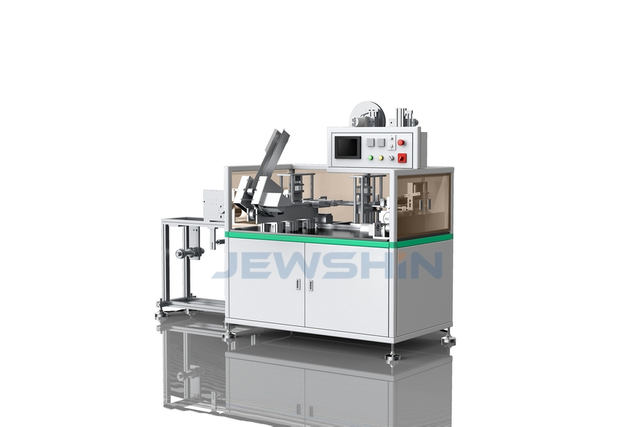
The JX-700X Automatic Express Bag Packaging Machine is JEWSHIN's purpose-built solution for e-commerce poly mailer packing. It was designed specifically to address the two reasons standard packaging machines fail in e-commerce environments: PE film handling and variable product height.
Key specifications:
Specification | JX-700X |
Film type | PE (Polyethylene) express bag film — the standard grey/white poly mailer material |
Film width | Up to 700mm (accommodates bags up to ~330mm wide) |
Product height capacity | Up to 120mm |
Output speed | Up to 30 bags/min (operator-paced loading) |
Seal type | Heat seal (PE film) |
Label integration | Compatible with inline automatic labeling machine |
Power supply | 220V / 50-60Hz, single phase |
Machine dimensions | Approx. 2,200mm (L) × 900mm (W) × 1,400mm (H) |
What makes the JX-700X different from a standard flow wrapper:
Standard flow wrappers are designed for OPP or shrink film — materials that are stiff, dimensionally stable, and have predictable tension characteristics. PE poly mailer film is the opposite: it's soft, stretchy, and prone to sagging and wrinkling. Running PE film through a standard flow wrapper produces wrinkled, inconsistent bags that are unacceptable for retail-facing e-commerce shipments.
The JX-700X uses a PE-specific film tension and feeding system that maintains consistent film tension across the full width of the 700mm film web — eliminating the wrinkling and misalignment that occurs when PE film is run through standard machines.
Product height accommodation:
The JX-700X accommodates products up to 120mm in height without mechanical adjustment — the bag depth adjusts automatically based on the product placed on the infeed conveyor. This means an operator can pack a thin envelope immediately followed by a bulky winter coat without any machine reconfiguration.
Label integration:
The JX-700X integrates with JEWSHIN's Automatic Friction Feeder Conveyor and inline labeling head to apply shipping waybills automatically as each bag exits the machine. The labeling system can be connected to your WMS via standard interface to ensure the correct label is applied to each bag.
The JX-700XQ Automatic Bubble Bag Packaging Machine addresses one of the most labor-intensive manual processes in e-commerce fulfillment: wrapping fragile items in bubble wrap.
Manual bubble wrap packing is slow (typically 4–8 items/min per operator), inconsistent (protection level varies by operator), and wasteful (operators tend to over-wrap to compensate for uncertainty). The JX-700XQ automates this process, creating sealed bubble wrap bags in a single pass at consistent protection levels.
Key specifications:
Specification | JX-700XQ |
Film type | Air bubble film (bubble wrap) |
Film width | Up to 700mm |
Product height capacity | Up to 120mm |
Frame construction | Carbon steel (heavy-duty for bulky bubble film rolls) |
Film support mechanism | Dedicated roll support system for large bubble film rolls |
Seal type | Heat seal |
Output speed | Up to 20 bags/min |
The bubble film handling challenge:
Bubble wrap film is fundamentally different from flat poly mailer film — it's bulky, has significant air resistance, and the bubble structure creates uneven tension across the film width. Standard film feeding mechanisms cannot handle bubble film reliably. The JX-700XQ features a dedicated film support mechanism and carbon steel frame specifically designed to manage the weight and bulk of large bubble film rolls, and a film feeding system that maintains consistent tension across the bubble film structure.
Individual machines are only part of the solution. A complete e-commerce packaging line integrates the packing machine with upstream product presentation, inline labeling, and downstream sortation. Here are three complete line configurations for different operation sizes:
Target operation: Small-to-mid e-commerce brand or 3PL; currently packing manually; first automation investment
Line components:
Station | Equipment | Function |
Product presentation | Operator workstation with order tote conveyor | Operator picks order, places product on infeed |
Packing | Automatic poly mailer bag forming and sealing | |
Label application | Inline labeling head | Shipping waybill applied to sealed bag |
Discharge | Gravity roller conveyor | Packed bags slide to sortation area |
Performance:
Output: 20–25 bags/min (operator-paced)
Operators required: 2 (1 product loader, 1 discharge handler)
Daily capacity (8-hour shift): 9,600–12,000 bags
Replaces: 5–6 manual packers
Footprint: 4m × 1.5mROI timeline: 8–14 months (North America/Europe labor rates)
Target operation: Mid-size e-commerce brand or regional 3PL; running 2 shifts; peak volume management is a key challenge
Line components:
Station | Equipment | Function |
Product presentation | Powered belt conveyor from pick zone | Continuous product flow from picking to packing |
Packing | 2× JX-700X (parallel lines) | Dual-line packing for higher throughput |
Fragile item packing | 1× JX-700XQ | Dedicated bubble wrap line for fragile items |
Label application | Inline labeling head on each line | Per-line label application |
Coding | Automatic Friction Feeder Conveyor with inkjet coder | Batch code / date code on each bag |
Discharge | Powered belt conveyor to sortation | Bags conveyed to sortation area |
Performance:
Output: 55–65 bags/min (combined, 2 poly mailer lines + 1 bubble line)
Operators required: 5 (2 loaders per poly mailer line, 1 bubble wrap line operator)
Daily capacity (16-hour operation): 52,800–62,400 bags
Replaces: 18–22 manual packers
Footprint: 12m × 4mROI timeline: 10–16 months
Target operation: Large e-commerce fulfillment center or major 3PL; running 24/7; labor cost and peak capacity are primary drivers
Line components:
Station | Equipment | Function |
Product presentation | Automated conveyor from WMS-directed pick zones | WMS-directed product routing to correct packing line |
Packing | 4–6× JX-700X (parallel lines) | High-volume poly mailer packing |
Fragile item packing | 2× JX-700XQ | Dedicated bubble wrap lines |
Label application | WMS-integrated inline labeling (one per line) | Correct label per order, WMS-verified |
QC | Checkweigher on each line | Weight verification — catches missing items |
Discharge | Powered sortation conveyor | Bags sorted by carrier / destination zone |
Performance:
Output: 150–180 bags/min (combined, all lines)
Operators required: 10–14 (line loading and supervision)
Daily capacity (24-hour operation): 216,000–259,000 bags
Replaces: 60–80 manual packers
Footprint: 30m × 8mROI timeline: 12–18 months
The ROI calculation for e-commerce packaging automation follows the same five-driver framework as manufacturing packaging automation — but with e-commerce-specific inputs. For the complete ROI methodology, see our Packaging Automation ROI Calculator guide.
Here we apply that framework specifically to e-commerce packing:
This is the primary ROI driver for e-commerce automation.
Manual packing benchmark: An experienced manual packer in a typical e-commerce warehouse packs 8–15 poly mailer bags per minute, depending on product type and bag size. For calculation purposes, use 10 bags/min as a conservative benchmark.
Automated line output: The JX-700X runs at up to 30 bags/min (operator-paced). With one operator loading product, the effective output is 20–25 bags/min — 2–2.5× the manual rate.
Labor savings calculation (single JX-700X line):
Manual packers replaced=Machine output (bags/min)Manual packer rate (bags/min)−Operators required on machineManual packers replaced=Manual packer rate (bags/min)Machine output (bags/min)−Operators required on machine
=2210−1=1.2 net packers replaced per line=1022−1=1.2 net packers replaced per line
Wait — that seems low. The key insight is that manual packing requires additional labor beyond the packer: someone to bring product to the packer, someone to take packed bags away, someone to print and apply labels. When you account for the full labor cost of a manual packing station (packer + label printer + material handler), the automated line typically replaces 3–4 full labor equivalents per shift.
Full labor cost comparison (per shift, 8 hours):
Manual packing station | Automated JX-700X line |
1× packer: $18/hr × 8hr = $144 | 1× machine operator: $18/hr × 8hr = $144 |
1× label printer/applier: $16/hr × 8hr = $128 | Machine applies labels automatically: $0 |
0.5× material handler: $16/hr × 4hr = $64 | Conveyor handles material: $0 |
Total: $336/shift | Total: $144/shift |
Output: ~4,800 bags/shift | Output: ~10,560 bags/shift |
Cost per bag: $0.070 | Cost per bag: $0.014 |
Labor cost saving per bag: $0.056Annual saving (5M bags/year): $280,000
Manual poly mailer packing typically uses pre-made poly mailer bags — purchased at a per-bag cost. Automated packing uses roll film, which is significantly cheaper per bag.
Material | Cost per bag (typical) |
Pre-made poly mailer bag (purchased) | $0.08–$0.25 per bag |
Roll film (JX-700X, formed on machine) | $0.03–$0.08 per bag |
Saving per bag | $0.05–$0.17 |
For an operation packing 5 million bags per year, even a $0.05/bag saving represents $250,000 in annual material cost reduction.
Manual packing errors in e-commerce fulfillment include:
Wrong label on bag (wrong order shipped to wrong customer)
Bag not properly sealed (product arrives damaged)
Wrong product in bag (pick error not caught at packing)
Each of these errors has a cost: return shipping, replacement product, customer service time, and brand damage. Automated packing with inline label verification and checkweigher weight checking significantly reduces error rates.
Conservative error cost estimate: $8–$15 per error (return shipping + replacement + customer service)Typical manual error rate: 0.3–0.8% of ordersAutomated error rate: 0.05–0.1% of ordersSaving on 5M orders/year at 0.3% error reduction: 15,000 fewer errors × $10 average cost = $150,000/year
E-commerce operations face extreme volume peaks — Black Friday, Cyber Monday, holiday seasons — where the inability to scale packing capacity directly results in delayed shipments, customer complaints, and lost sales.
Manual packing capacity scales linearly with headcount — and temporary warehouse workers during peak season are expensive, unreliable, and slow (new workers pack at 50–70% of experienced worker rates).
Automated lines provide consistent output regardless of season — and can be run at extended hours during peaks without the recruitment and training overhead of temporary labor.
Peak capacity value: Quantify this as the revenue at risk from delayed shipments during your peak period. For most mid-size e-commerce operations, this is $50,000–$500,000 per peak season.
Operation profile:
Annual order volume: 3,000,000 bags/year
Current method: Manual packing, 8 packers per shift, 2 shifts
Current labor cost: $18/hr average (US Midwest)
Current material cost: $0.12/bag (pre-made poly mailers)
Machine investment: 2× JX-700X + inline labeling = $85,000 (FOB Dongguan)
Landed cost (US, including shipping, duties, installation): ~$105,000
Annual savings:
Saving Category | Annual Value |
Labor (12 packers → 4 operators, 2 shifts) | $230,400 |
Material (roll film vs. pre-made bags, $0.06/bag saving) | $180,000 |
Error reduction (0.3% → 0.08%, $10/error) | $66,000 |
Total annual saving | $476,400 |
Simple Payback Period=$105,000$476,400=0.22 years≈2.6 monthsSimple Payback Period=$476,400$105,000=0.22 years≈2.6 months
This is an unusually fast payback — driven primarily by the combination of high labor cost (US rates) and the material saving from switching to roll film. Even with more conservative assumptions (lower labor rates, smaller material saving), payback periods of 8–14 months are typical for North American and European operations.
For a detailed, customized ROI calculation for your specific operation, use our Packaging Automation ROI Calculator or contact our team for a free analysis.

For e-commerce operations, the shipping label is not just a packaging element — it's the critical link between the physical bag and the order management system. Getting label application wrong means the wrong order goes to the wrong customer.
Method | How It Works | Suitable For |
Manual label application | Operator prints label, peels, applies to sealed bag | Very low volume; not suitable for automation |
Inline label applicator | Label printer-applicator mounted at machine discharge; applies label automatically as bag exits | Standard for JX-700X integration; 20–30 bags/min |
Print-and-apply with WMS integration | Label printer-applicator receives order data from WMS in real time; prints and applies correct label for each bag | High-volume operations; ensures correct label per order |
For operations where label accuracy is critical (i.e., all e-commerce operations), the label application system should be integrated with the WMS:
WMS sends order data tolabel printer
↓
Label printer prints correct shipping label
↓
Bag exits JX-700X sealed
↓
Label applicator applies labelto bag
↓
Barcode scanner verifies label scan
↓
WMS confirms bag packed and labeled
↓
Bag conveyed to sortation
JEWSHIN's inline labeling system integrates with standard WMS platforms via TCP/IP interface. The Automatic Friction Feeder Conveyor provides the controlled, consistent bag presentation that the label applicator requires for accurate placement.
Different carriers have specific requirements for label placement on poly mailer bags:
Carrier | Label Position Requirement |
FedEx | Top-right of bag face; minimum 25mm from any edge |
UPS | Top-right of bag face; minimum 19mm from any edge |
USPS | Top-right of bag face; barcode must be horizontal |
DHL | Top-right of bag face; minimum 20mm from any edge |
Amazon Logistics | Specific placement per Amazon carrier guidelines |
JEWSHIN's inline labeling system is configurable for all major carrier label placement requirements. Specify your carrier requirements when ordering.
Film selection for e-commerce packaging has different priorities from manufacturing packaging — appearance, strength, and cost-per-bag are the primary drivers.
Film Type | Thickness | Strength | Appearance | Best For |
Standard PE grey/white | 50–60μm | Good | Opaque grey or white | General merchandise, apparel |
Co-extruded PE (black inside, white outside) | 60–70μm | Excellent | White exterior, light-blocking interior | Apparel, light-sensitive products |
Biodegradable PE (PBAT/PLA blend) | 55–65μm | Good | Opaque, various colors | Eco-certified brands; EU market |
Printed PE film | 60–70μm | Good | Custom printed with brand logo/colors | Brand-forward packaging; unboxing experience |
Film width selection: Film width = (2 × bag width) + (2 × bag depth) + 20mm overlap allowance. For a typical apparel operation with bags ranging from 200mm to 350mm wide and up to 120mm deep, a 700mm film width covers the full range — which is why the JX-700X's 700mm film capacity is the e-commerce standard.
Film Type | Bubble Size | Protection Level | Best For |
Standard bubble wrap (10mm bubbles) | 10mm | Medium | Electronics, small hardware, cosmetics |
Large bubble wrap (25mm bubbles) | 25mm | High | Fragile items, glassware, ceramics |
Anti-static bubble wrap | 10mm or 25mm | Medium | Electronics, circuit boards |
Biodegradable bubble wrap | 10mm | Medium | Eco-certified operations |
Phase | Duration | Key Activities |
Phase 1: Specification | 1–2 weeks | Define order volume, product range, film type, label requirements, WMS integration needs |
Phase 2: Quotation and order | 1–2 weeks | Receive quotation, review specifications, place order and deposit |
Phase 3: Production and FAT | 25–35 days | Machine production at JEWSHIN factory; Factory Acceptance Testing |
Phase 4: Shipping | 15–30 days | Sea freight (China to North America/Europe); customs clearance |
Phase 5: Installation and commissioning | 3–5 days | Machine installation, utility connection, operator training, first production run |
Phase 6: Ramp-up | 1–2 weeks | Operators reach full proficiency; line reaches target output speed |
Total: Decision to full production | ~10–14 weeks |
Plan your implementation timeline to ensure the line is operational before your next peak season. For most Northern Hemisphere e-commerce operations, this means placing orders no later than August for a pre-Christmas peak readiness.
Before the machine arrives, prepare your facility:
Electrical:
JX-700X: 220V / 50-60Hz / single phase / 15A dedicated circuit
JX-700XQ: 220V / 50-60Hz / single phase / 15A dedicated circuit
Inline labeling system: 220V / 50-60Hz / single phase / 10A
Floor space (minimum, per line):
JX-700X + inline labeling + 2m infeed + 2m discharge conveyor: 7m × 2m
JX-700XQ + 2m infeed + 2m discharge: 6m × 2m
Network:
Ethernet connection at machine location for WMS integration
Static IP address for label printer-applicator
Film storage:
Film rolls should be stored at 15–25°C, away from direct sunlight
Minimum 2 weeks' film inventory on-site at all times
The JX-700X and JX-700XQ are designed for operation by warehouse staff — not specialist machine operators. JEWSHIN provides:
Operation manual (English): Complete operating procedures, including film loading, parameter adjustment, and fault clearance
Video training: Step-by-step video covering machine startup, film loading, label system operation, and daily maintenance
Remote commissioning support: JEWSHIN engineer available via video call during installation and first production run
On-site commissioning (optional): Available for complete line installations
Most operators reach full proficiency within 3–5 days. For operations with high staff turnover, we recommend laminating the key operating procedures and posting them at the machine.
For a complete guide to after-sales support, spare parts management, and maintenance schedules, see: Packaging Machine After-Sales Service Guide
Poly mailer automation is typically the first step in e-commerce packaging automation — but it's rarely the last. As operations scale, additional automation opportunities emerge:
Not all e-commerce orders can go in a poly mailer. Larger items, fragile items, and multi-item orders often require cartons. JEWSHIN's industry solutions include carton erectors, auto-cartoners, and carton sealers for operations that need to automate both poly mailer and carton packing.
For operations that use pre-made poly mailers or cartons (rather than machine-formed bags), standalone labeling machines apply shipping waybills at high speed without a packing machine. The Automatic Friction Feeder Conveyor is specifically designed for this application — it separates flat bags or cartons and conveys them under an inkjet coder or label applicator at consistent speed.
For operations that frequently ship multi-unit orders (e.g., 3-pack or 6-pack bundles), shrink wrapping automates the bundling process. See our complete comparison of packaging methods in: Shrink Wrap vs. Flow Wrap vs. Bagging: Which Method Is Right for Your Product?
At high volumes (10,000+ orders/day), manual sortation of packed bags by carrier or destination zone becomes a bottleneck. Automated sortation conveyors — integrated with the WMS — route each bag to the correct carrier lane automatically. JEWSHIN designs complete end-of-line systems including sortation for high-volume fulfillment centers.
E-commerce packaging machines sold into North American and European markets must meet the same compliance requirements as manufacturing packaging machines:
Market | Requirement | JEWSHIN Status |
European Union | CE Marking (Machinery Directive, Low Voltage Directive, EMC Directive) | ✅ Standard on all models |
United States | UL-listed electrical components (preferred) | ✅ Available on request |
Australia / NZ | RCM Mark | ✅ Available on request |
Canada | CSA certification | ✅ Available on request |
For a complete guide to packaging machine compliance requirements, see: Meeting FDA, CE, and GMP Standards: A Packaging Machine Compliance Guide

A: The JX-700X handles products up to 700mm film width and 120mm product height — which covers the majority of soft goods from small accessories to folded outerwear. For products wider than ~330mm in bag width, a custom film width configuration may be required. For products taller than 120mm, the JX-700XQ or a custom configuration is needed. Share your complete product size range with our engineering team and we'll confirm whether a standard configuration covers your range, or design a custom solution.
A: Yes. The JX-700X runs printed PE roll film — the same material as pre-made printed poly mailers, but in roll form. Printed roll film is available from film suppliers in minimum order quantities of typically 500–1,000kg. The cost per bag using printed roll film is significantly lower than pre-made printed poly mailers — typically 40–60% lower. We can recommend film suppliers in your region and provide film specifications for your printer. Contact wendy@jewshin.com for film sourcing guidance.
A: The JX-700X forms the bag around the product as it passes through the machine — so the bag length is determined by the product length, not a fixed bag size. For products that are thin (low height), the bag depth automatically adjusts to minimize empty space. However, for products that are significantly shorter than the film width, there will be some empty space at the sides — this is inherent to the poly mailer format and is standard practice in e-commerce packaging. If minimizing void space is a priority, consider a flow wrap configuration for your smallest SKUs.
A: Yes — the JX-700X is well-suited to 3PL operations. Film roll changes take 2–3 minutes (switching between client-specific printed films or different film widths). Parameter changes (bag dimensions) are stored as named recipes in the HMI and recalled with a single touchscreen selection. For 3PLs with high changeover frequency between clients, we recommend the multi-recipe HMI configuration with up to 40 stored client profiles. For a detailed guide to changeover optimization, see: Packaging Line Changeover Guide: How to Cut Format Change Time by 80%
A: The breakeven point depends primarily on your local labor cost. At US/European labor rates ($15–$25/hr), automation typically becomes cost-justified at around 500–800 orders/day on a single shift. Below that volume, the labor saving doesn't cover the machine investment within a reasonable payback period. At Asian labor rates ($3–$8/hr), the breakeven is higher — typically 2,000–5,000 orders/day — because the labor saving per bag is smaller. Use our Packaging Automation ROI Calculator to calculate the specific breakeven for your labor cost and order volume.
A: Yes. JEWSHIN supplies the JX-700X and JX-700XQ on an OEM basis to fulfillment technology distributors and systems integrators in North America, Europe, and Australia. OEM supply includes custom branding, modified specifications for specific market requirements, and integration support for WMS connectivity. Our OEM partners typically serve e-commerce brands and 3PLs who prefer to source through a local distributor with local support. Contact Wendy Liu directly at wendy@jewshin.com to discuss OEM partnership terms.
Your Situation | Recommended First Step |
Packing soft goods / apparel manually | JX-700X single line + inline labeling |
Packing fragile items in bubble wrap manually | |
Mixed soft goods + fragile items | |
3PL with multiple clients | JX-700X with multi-recipe HMI + quick film changeover |
High volume (15,000+ orders/day) | Multi-line configuration + WMS integration + sortation |
Unsure of ROI | Packaging Automation ROI Calculator + free analysis from JEWSHIN team |
JEWSHIN's engineering team designs e-commerce packaging automation solutions from single machines to complete fulfillment line integrations — with CE certification, WMS integration support, and commissioning assistance.
To request a proposal, share:
Daily order volume (current and peak)
Product types and size range (L × W × H)
Current packaging method (pre-made bags / manual wrap / other)
Label requirements (carrier, WMS platform)
Target market (for compliance requirements)
We'll respond within 48 hours with a line configuration recommendation, machine specifications, and a complete quotation (FOB / CIF / DDP).
Email: wendy@jewshin.com WhatsApp: +86-13128136672
Submit your inquiry: www.jewshin.com
Related Reading:
Shrink Wrap vs. Flow Wrap vs. Bagging: Which Method Is Right for Your Product? →
Packaging Automation ROI Calculator: Build Your Business Case →
Packaging Line Changeover Guide: How to Cut Format Change Time by 80% →
Meeting FDA, CE, and GMP Standards: A Packaging Machine Compliance Guide →
About the Author: Wendy Liu is the CEO of Dongguan Jewshin Intelligent Machinery Co., Ltd., a manufacturer and global exporter of automated packaging machines and turnkey line solutions. JEWSHIN's founding team brings 15+ years of packaging machinery engineering experience, with 200+ machine models exported to 80+ countries across North America, Western Europe, Southeast Asia, the Middle East, South America, and Africa. Explore our full product range →