Views: 0 Author: Wendy Liu Publish Time: 2026-08-09 Origin: JEWSHIN
The fundamental difference between high-speed and large-format bagging machines is that high-speed models (like the JEWSHIN JX30-35) prioritize throughput for small, lightweight, flat products at 40–60 pieces per minute with bag widths up to 280 mm, while large-format models (like the JX35-50) prioritize capacity for oversized, heavier, or thicker products at 15–30 pieces per minute with bag widths up to 350 mm and lengths up to 480 mm. Choose a high-speed machine when your products are small and volume is the priority; choose a large-format machine when your products exceed standard dimensions and gentle handling of heavy or oversized items is the priority.
Both machines share the same core technology — Inovance PLC and servo system, "No Product, No Bag" detection, dual sealing modes (self-adhesive and heat seal), vacuum suction bag opening, and optional labeling integration — but differ in bag size range, speed, footprint, and power requirements.

Before comparing machine models, identify your operation's critical requirements across five dimensions:
Measure your largest and smallest products:
Width: The widest product determines the minimum bag width capacity required
Length: The longest product determines the minimum bag length capacity required
Height/thickness: The thickest product (including multi-packs and bundles) determines the height clearance required
If your widest product exceeds 280 mm, you need the large-format JX35-50. If all products fit within 280 mm width and 300 mm length, the high-speed JX30-35 offers significantly higher throughput.
Calculate your required output:
Per shift: Daily target ÷ shifts ÷ 60 minutes = required PPM (add 20% buffer for changeover and maintenance)
Peak season: Use peak demand, not average, to size your machine capacity
If your required PPM exceeds 30, the JX30-35 (40–60 ppm) is your only option. If 15–30 ppm is sufficient, either machine can work — the JX35-50 becomes the choice if your product dimensions require it.
If you handle many different product sizes:
Both machines support memory functions for rapid changeover
The JX30-35 stores parameters for dozens of products with one-button reset
The JX35-50 offers the same memory function but with wider bag capacity range
Both machines support center-folded film (V-fold) with:
Self-adhesive sealing (resealable, retail display)
Heat sealing (tamper-evident, secure shipping)
OPP, PE, and CPP film compatibility
JX30-35 footprint: 5000 × 4000 × 800 mm
JX35-50 footprint: 5000 × 5000 × 800 mm
Power: JX30-35 requires 13 kW; JX35-50 requires 15 kW (380V, 50Hz)
The high-speed JX30-35 is engineered for small, lightweight, flat products requiring high throughput. It excels in applications where:
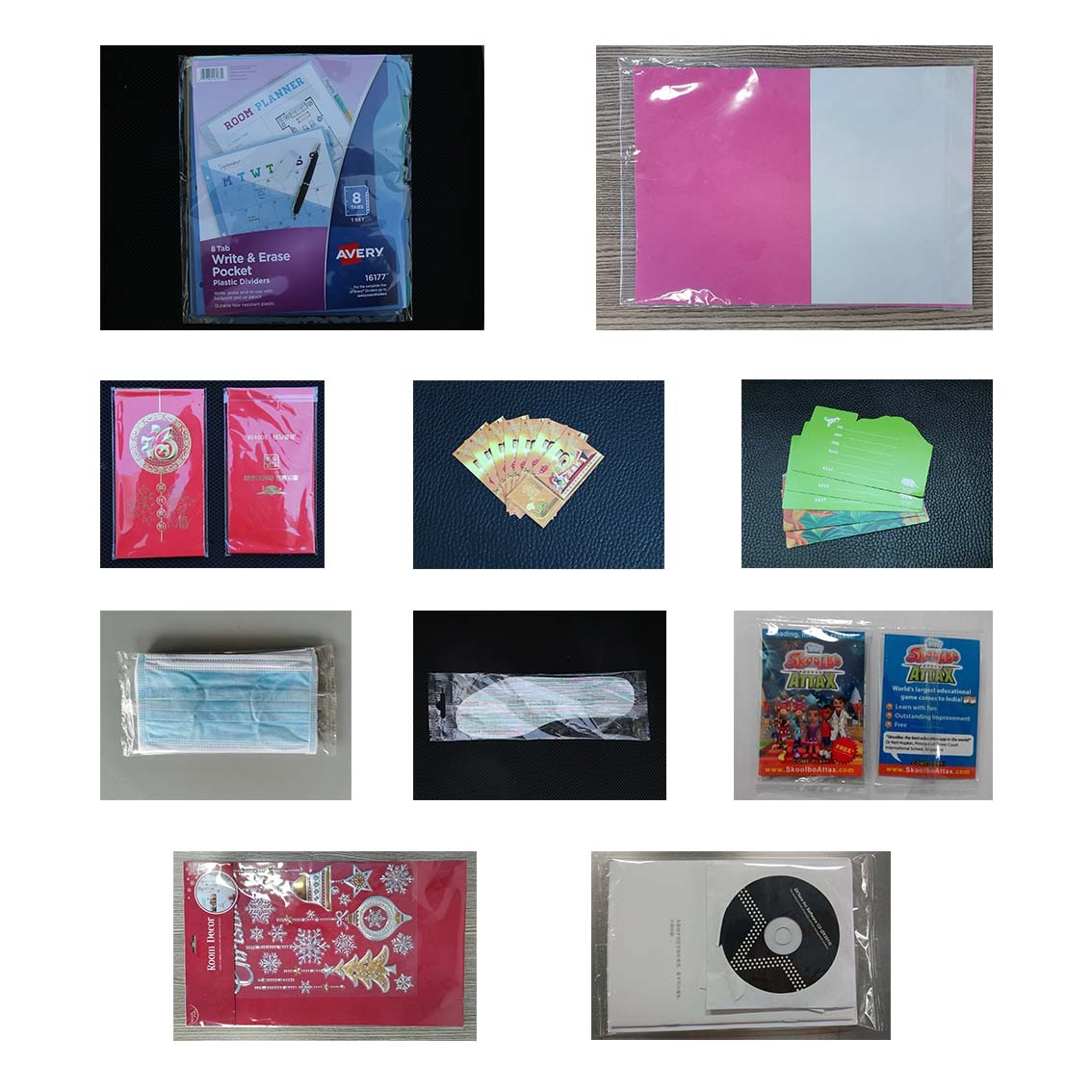
Products are small: Phone cases, gift cards, greeting cards, postcards, red packets (hongbao), warranty cards, instruction manuals, flat blister cards, hanging tags, small envelopes, and individual stationery items
Volume is the primary metric: Operations requiring 19,200–28,800 pieces per 8-hour shift (theoretical maximum at rated speed)
Multi-SKU operations: Facilities handling many product types benefit from the memory function's rapid changeover (seconds, not minutes)
Fingerprint-free packaging is required: Phone case and clear plastic product manufacturers who need vacuum suction bag opening to eliminate human contact with product surfaces
Strength | Detail |
Ultra-fast cycle times | 40–60 pieces per minute — the fastest in JEWSHIN's bagging machine series |
Compact footprint | 5000 × 4000 mm (1 m² less width than large-format model) |
Automated adhesive liner removal | Self-adhesive peel-and-fold mechanism eliminates the slowest manual operation |
Lower power consumption | 13 kW vs 15 kW for large-format model |
Multi-product memory | Stores parameters for dozens of products; one-button reset changeover |
Mobile phone cases and screen protectors
Gift cards, membership cards, and trading cards
Greeting cards, postcards, and red packets
Instruction manuals and warranty cards
Document bags and flat envelopes
Small flat blister cards and hanging tag products
Hosiery (socks, gloves) and flat-packed underwear
The large-format JX35-50 is engineered for large, heavy, or thick products that exceed standard bagging machine dimensions. It excels in applications where:
Products are oversized: A3 documents, wall calendars, desk pads, large sketchbooks, blueprints, oversized exam paper bundles, large greeting cards, and heavy envelope bundles
Products require gentle handling: Hardcover books, premium stationery sets, and products with sensitive cover materials (leatherette, foil stamping) where the servo-driven feeding mechanism prevents edge damage
Multi-item bundling is needed: Gift sets, multi-volume collections, and bundled document kits that require wider bag capacity
Large film rolls require deviation correction: The automatic film deviation correction system keeps wide, heavy film rolls aligned during high-volume runs
Strength | Detail |
Wide bag capacity | 280–350 mm width, 300–480 mm length — covers A3 size and larger |
Reinforced transport bed | Heavy-duty frame supports the weight and movement of large products |
Wider sealing bars | Handles wider film without seal quality degradation |
Automatic film deviation correction | Keeps large, heavy film rolls aligned — prevents crooked seals |
Multi-item bundling capability | Handles multi-pack configurations and bundled document sets |
Wall calendars and desk pads
A3 documents, blueprints, and oversized prints
Hardcover books and premium notebooks
Large red packets and oversized greeting cards
Gift sets and multi-volume box collections
Pillowcases, folded shirts, towels, and home textiles
Large gasket sets and instruction manual kits
Exam paper bundles and answer sheet packages
Specification | JX30-35 (High-Speed) | JX35-50 (Large-Format) |
Bag width range | 100–280 mm | 280–350 mm |
Bag length range | 100–300 mm | 300–480 mm |
Max product height | 1–10 mm | 1–10 mm |
Maximum speed | 40–60 ppm | 15–30 ppm (size-dependent) |
Film type | Center-Folded (V-Fold) | Center-Folded (V-Fold) |
Sealing modes | Self-adhesive + Heat seal | Self-adhesive + Heat seal |
Control system | Inovance PLC + Servo | Inovance PLC + Servo |
Bag opening | Vacuum suction | Vacuum suction |
No Product No Bag | Yes | Yes |
Memory function | Yes (dozens of products) | Yes (dozens of products) |
Film deviation correction | Standard | Automatic (enhanced) |
Labeling integration | Optional (<2 mm accuracy) | Optional (<2 mm accuracy) |
Power | 13 kW | 15 kW (380V, 50Hz) |
Machine dimensions | 5000 × 4000 × 800 mm | 5000 × 5000 × 800 mm |
Changeover time | Seconds (one-button reset) | Seconds (one-button reset) |
Designed service life | 10 years | 10 years |
Warranty | 1 year + lifetime maintenance | 1 year + lifetime maintenance |
Target industries | 3C accessories, cards, stationery, textiles, e-commerce | Printing, publishing, calendars, textiles, gift sets, secure printing |
If your product width is ≤ 280 mm and you need > 30 ppm → JX30-35 (High-Speed)
If your product width is > 280 mm or length > 300 mm → JX35-50 (Large-Format)
If your product fits both machines but speed is your priority → JX30-35
If your product fits both machines but gentle handling of large/heavy items is your priority → JX35-50
If you handle both small and large products → consider both machines on the same line, or consult JEWSHIN for a multi-format configuration
Both the JX30-35 and JX35-50 use center-folded film (V-fold). Verify compatibility with:
OPP self-adhesive film: For resealable retail packaging (standard for both models)
PE film: For general-purpose bagging (standard for both models)
CPP film: For applications requiring higher heat resistance
Biodegradable film options: Consult JEWSHIN's engineering team to verify material compatibility and adjust machine parameters
Film thickness, stiffness, and static properties all affect bag-opening reliability. If you are switching from one film supplier to another, request a material test to verify compatibility before committing to a production run.
Static electricity is the most common cause of bag-opening failures in OPP film bagging. Both JEWSHIN models address static through:
Vacuum suction bag opening: Physically separates film layers regardless of static charge — more reliable than air-jet opening for thin films
Controlled film tension via servo system: Minimizes the rapid film movement that generates static charge
Compatibility with anti-static treated films: For facilities in low-humidity environments where static is severe
If your facility operates in a dry climate (relative humidity below 30%), discuss anti-static film requirements with your film supplier and JEWSHIN's engineering team during the consultation phase.
A bagging machine rarely operates in isolation. Consider how it connects to:
Upstream feeding: Friction feeders, manual loading stations, or conveyor systems that deliver products to the bagging machine infeed
Downstream handling: Output conveyors, carton erectors, case sealers, or palletizing systems that receive bagged products
Labeling integration: Optional inline labeling module applies barcodes and promotional labels during bagging — eliminates a separate labeling station
Printing/coding integration: For products requiring date codes, batch numbers, or traceability marks
JEWSHIN's bagging machines are designed for inline integration. Discuss your full line architecture with the engineering team to ensure proper conveyor heights, infeed timing, and product flow synchronization.
For high-SKU operations, changeover time directly affects daily output. Both JEWSHIN models feature:
One-button reset: Recalls stored parameters from the memory function
Three-point bag-width adjustment: Simplified mechanical setup via vacuum suction mechanism
Bi-directional control: Quick jam clearing without disassembly
Weinview touch screen: Intuitive interface for operators
However, if your operation involves frequent format changes (more than 5–10 per shift), the JX30-35's faster cycle speed means that changeover time represents a smaller percentage of total production time, making it more efficient for high-mix operations with small products.
If your product exceeds the standard specifications of either model — for example, product height above 10 mm, bag width above 350 mm, or bag length above 480 mm — you may require a custom configuration. Additionally, if your product has unusual properties (extreme weight, irregular shape, temperature sensitivity, or unusual film requirements), a custom consultation is recommended. Contact JEWSHIN with your product dimensions and requirements for an engineering assessment.
Routine maintenance includes: daily inspection of film feed path and vacuum suction cups; weekly cleaning of sensors and sealing elements; monthly inspection of servo drive system and pneumatic components; and periodic replacement of wear parts (sealing bars, vacuum cups, cutting blades) based on production volume. JEWSHIN provides a 1-year warranty, lifetime maintenance support, and free training until your engineers are fully proficient. The machines use premium components (Inovance, Omron, NSK, AirTAC) designed for 24/7 operation with a 10-year service life.
The JX30-35 handles bag widths from 100–280 mm, and the JX35-50 handles 280–350 mm. There is no overlap — the JX35-50 cannot handle bags narrower than 280 mm, and the JX30-35 cannot handle bags wider than 280 mm. If your product range spans both small (under 280 mm) and large (over 280 mm) items, you have two options: (1) install both machines on the same line for different product sizes, or (2) consult JEWSHIN about a custom configuration that covers a wider range. In practice, most facilities specialize in either small-format or large-format products, making one machine sufficient.
Self-adhesive bagging uses pre-applied adhesive on the film flap — the machine peels the protective strip and folds the flap down to create a resealable closure. This is ideal for retail products where customers may want to inspect and re-close the package (greeting cards, calendars, stationery). Heat-seal bagging uses a heated element to hot-cut and seal the film edge, creating a permanent, tamper-evident closure that cannot be resealed once opened. This is ideal for secure shipping, gift cards, and products requiring tamper indication. Both JEWSHIN models support both sealing modes, switchable via the touch screen.
JEWSHIN provides installation, commissioning, and operator training as part of the after-sales service. Typical installation takes 3–5 days for a standard configuration. Free training continues until customer engineers are fully proficient in operation, routine maintenance, and format changeover. Remote support is available 24/7 in English. The 1-year warranty covers parts and labor, with lifetime maintenance support thereafter.
Choosing between a high-speed and large-format bagging machine depends on your product dimensions, target throughput, and production mix. The decision matrix above provides a framework, but the best choice comes from a consultation with engineers who understand your specific requirements.
What you can do next:
Send your product dimensions and target output: Provide your product sizes (width × length × height), daily volume targets, and current packaging method. JEWSHIN's technical team will recommend the optimal machine model and configuration.
Request a material test: Send your actual products to JEWSHIN's facility. Our engineers will run them on the appropriate machine and send you a video demonstrating bagging quality, sealing performance, and the "No Product, No Bag" system.
Explore both models:
JX30-35 High-Speed Bagging Machine — for small flat products at 40–60 ppm
JX35-50 Large Format Bagging Machine — for oversized products up to 350 × 480 mm
Contact: WhatsApp +86-13128136672 | Email: wendy@jewshin.com


