Views: 0 Author: Wendy Liu Publish Time: 2026-03-13 Origin: Jewshin
Hi, I am Wendy Liu, CEO of Dongguan Jewshin Intelligent Machinery Co., Ltd. Over my career in the packaging industry, I have seen many growing businesses struggle with the bottleneck of manual labeling. When choosing a labeling machine, the best option depends on your production volume, container type, and required accuracy.
Today, buying a labeling machine from China is the smartest move for small to medium-sized enterprises (SMEs) seeking high-precision automation at a competitive price. For small batches, semi-automatic models offer precision at an affordable cost. For high-volume operations, fully automatic systems integrated with conveyors can apply hundreds of labels per minute. This guide covers everything you need to know about choosing the right labeling machine, vetting Chinese suppliers, and scaling your workflow.

Manual labeling is time-consuming, inconsistent, and highly prone to human error—especially in high-volume environments. Modern labeling systems replace this tedious task, handling various container shapes such as round bottles, flat boxes, oval cosmetics, or irregular packages .
The demand for these machines has surged due to rising e-commerce activity and stricter regulatory requirements for product traceability. Consumers now expect clear, professional packaging with zero wrinkles or bubbles. By upgrading to an automated machine, you reduce labor costs, minimize label waste, and elevate your brand image instantly.
Understanding the different types of labeling machines helps match functionality with your operational needs. Here are the core variants we build and export daily:
These require an operator to load the container, but the machine applies the label automatically. They are incredibly cost-effective and perfect for 50–300 units per hour.
Pros: Fast setup, consistent placement, and affordable.
Jewshin Highlight: For ultimate precision, our JX-T303 High-Precision Semi-Auto Flat Labeling Machine offers an impressive ±0.2mm accuracy for flat surfaces, while our JX-T413 Semi-Automatic Round Bottle Labeler perfectly handles single and double-sided application .

Designed for cylindrical containers (bottles, cans, vials), these apply full-body or partial wrap labels using rotating belts or vacuum drums at high speeds.
Pros: Minimal labor, high speed (200+ units/minute), and repeatable accuracy.
Jewshin Highlight: The JX-T212 Automatic Round Bottle Labeling Machine supports single-side, double-side, and specific positioning, making it ideal for the beverage and pharmaceutical sectors .
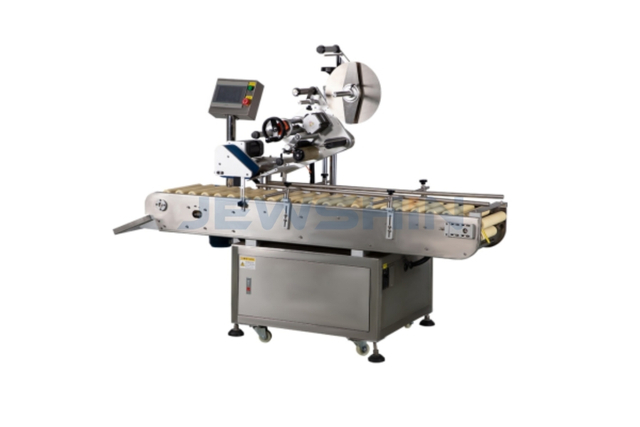
Integrated directly into production lines, these machines use conveyors and sensors to feed, align, and label flat items like cartons, express bags, or cards without human intervention.
Jewshin Highlight: Our JX-T115 Automatic Paging & Flat Labeling Machine is a top-seller for e-commerce fulfillment, applying labels to flat cards and folded cartons flawlessly at rapid speeds .
When evaluating specifications with your supplier, focus on these critical parameters:
Accuracy Tolerance: Look for a minimum of ±1 mm alignment consistency, especially if you are applying barcodes that must be scanned.
Motor Type: Ensure the manufacturer uses servo motors (or high-quality stepper motors) for precise control and longevity.
Container Compatibility: Check diameter, height, and shape limitations. Some machines require change kits for different sizes.
Durability: The machine frame should be constructed from 304 or 316 stainless steel to resist corrosion, which is mandatory for food and pharma regulations.
User Interface: A PLC touchscreen panel simplifies setup, allows you to store different product "recipes", and significantly reduces operator training time.
Sourcing from China offers unmatched ROI, but you must vet your supplier carefully. Here is how to ensure you are buying from a reliable partner:
Look for Verified Credentials: Buy from manufacturers with proven track records. At Jewshin, we are a 4-Year Verified Supplier on Alibaba, meaning our Dongguan factory and quality control processes have been audited by third-party agencies.
Request Live Testing: Never buy based on photos alone. A reputable manufacturer will encourage you to send your empty bottles and label rolls to their factory. They should record a video of the machine running your exact product to prove compatibility.
Confirm After-Sales Support: The biggest risk of importing machinery is a lack of maintenance support. Ask if the supplier provides English manuals, electrical schematics, and video troubleshooting.
Prices vary significantly based on automation levels. Here is a general breakdown when buying directly from a high-quality Chinese manufacturer:
Semi-Automatic Round/Flat Labelers: $1,500 – $4,000.
High-Speed Automatic Wrap-Around Labelers: $5,000 – $15,000.
Fully Integrated Paging & Flat Labeling Lines: $8,000 – $20,000+.
While some platforms offer cheaper desktop models for under $1,000, these entry-level units often lack the durability required for industrial 24/7 use. Mid-range systems offer the best value for growing businesses seeking reliability.
Choosing the right labeling machine involves balancing speed, accuracy, and budget. For small-scale producers, semi-automatic tabletop models provide an excellent entry point. Larger operations benefit massively from fully automatic systems that integrate seamlessly into existing production lines.
At Jewshin, we design and manufacture high-performance labeling equipment tailored to your exact bottle shapes and speed requirements.
Stop wrestling with hand-applied labels and let our automation experts help you scale. Visit our full catalog at www.jewshin.com or email me directly at wendy@jewshin.com . Contact us today with your container dimensions, and we will provide a free customized machinery solution!
Q: Can one labeling machine handle multiple bottle sizes?
A: Yes. Most of our automatic models feature adjustable guide rails and peeling plates. You can switch between different bottle diameters in just a few minutes without needing complex tooling.
Q: Do labeling machines work with any label material?
A: Most machines handle standard pressure-sensitive paper, PET, or transparent labels. However, if you are using transparent labels, you must inform us beforehand so we can install a specialized ultrasonic label sensor instead of a standard optical one.
Q: What is the average lifespan of a Jewshin labeling machine?
A: With proper routine maintenance (like cleaning sensors and lubricating moving parts), our industrial labeling machines operate reliably for 7 to 10 years.
Q: How much training is needed to operate the equipment?
A: Very little. Our semi-automatic models require about 30 minutes of training. Fully automatic systems take 1–2 hours to master. We provide detailed English video tutorials to guide your operators step-by-step.