

A flow wrapper changeover should be evaluated as a product-mix decision, not as a single advertised changeover time: define the SKU range, film and pack formats, infeed behavior, sealing and cutting needs, downstream handoff, safety controls, and acceptance-test evidence before comparing quotations.
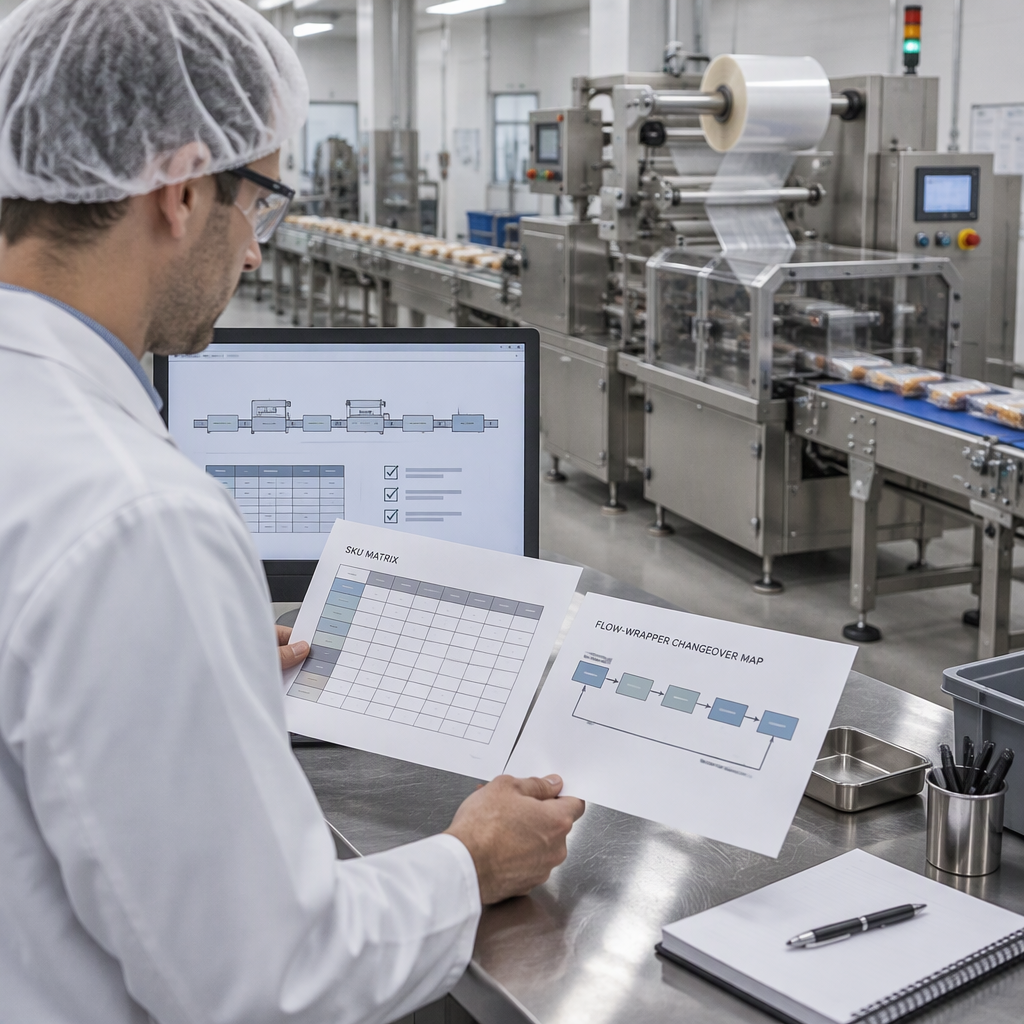
Map the product mix before comparing flow wrappers
For a multi-SKU line, a flow wrapper changeover means every adjustment needed to move from one sellable product-and-pack combination to the next, including product handling, film path, forming, sealing, cutting, coding, inspection, and downstream transfer.
Start with the full production family rather than the easiest pack. Engineering and purchasing teams should describe the smallest, largest, most fragile, most irregular, and highest-volume SKUs, because the changeover method has to serve the whole mix the plant intends to run.
- List each product’s length, width, height, weight range, shape, surface condition, and fragility.
- Record required orientation, spacing, grouping, and whether products arrive manually, from a feeder, or from an upstream machine.
- Define each pack style, film width, print registration need, label or coder position, and finished-pack tolerance to be checked in trials.
- Separate routine SKU changes from new-product introductions, because they may need different validation and operator involvement.
- Identify who performs the changeover: operators, maintenance, engineering, or a supplier technician.
Identify which product changes drive the changeover
The most important product variables are the ones that force physical adjustment, recipe changes, product re-orientation, quality re-checks, or extra handling between upstream and downstream equipment.
A useful supplier discussion does not begin with “How fast is the changeover?” It begins with “Which change in my product mix causes which machine area to move, be checked, or be revalidated?” Use the table as a screening tool before sample testing.
| Product difference | Changeover question to ask | Buyer risk if ignored |
|---|---|---|
| Large size range | Which guides, belts, forming parts, or seal positions must be adjusted? | A quoted configuration may suit the average product but struggle at the extremes. |
| Shape or orientation changes | How is product presentation controlled before the forming area? | Misfeed, rotated packs, or manual correction can become the real changeover bottleneck. |
| Fragility or sticky surfaces | How will transfer, accumulation, and spacing be tested with real samples? | Damage and inconsistent spacing may appear only after line-speed trials. |
| Different pack lengths | Which parameters and mechanical positions are changed for cut length and registration? | Finished-pack quality may vary even when the wrapper can physically run the SKU. |
Treat film and packaging material as changeover variables
Film changes should be evaluated as part of the flow wrapper changeover because reel handling, tracking, forming, sealing, print registration, and pack appearance can all change with material choice.
Do not treat “same product, different film” as a minor change until it has been tested. Ask suppliers to run the actual or representative film structures, print marks, reel widths, and core sizes expected in production.
- Confirm which film structures, thickness ranges, print directions, and reel dimensions the supplier will test with your samples.
- Ask how material changes affect forming set-up, film tracking, sealing-window development, and scrap at start-up.
- Include plain film, printed film, promotional variants, and seasonal packs if those are part of the SKU mix.
- Define what counts as an acceptable pack: seal appearance, cut position, leak or burst test method, barcode readability, and finished-pack presentation.
Review the machine zones that can create changeover work
Hidden changeover work often sits at the boundaries between the wrapper and the rest of the line: product feeding, spacing, forming, sealing and cutting, coding, inspection, reject handling, and downstream transfer.
Walk through the line zone by zone. The goal is to identify where the supplier’s quoted machine, tooling, and controls must match your actual production method.
| Machine zone | What to evaluate | Evidence to request before purchase |
|---|---|---|
| Infeed and spacing | Manual loading, automatic feeding, pitch control, product orientation, and accumulation behavior. | Sample trial video, trial report, layout drawing, and operator tasks during SKU change. |
| Forming and film path | Film width changes, former adjustments, tracking stability, and access for reel replacement. | Format-change procedure and list of parts or settings changed by SKU. |
| Sealing and cutting | Seal location, pack length, registration, jaw or knife settings, and seal-quality checks. | Acceptance criteria for sample packs and method for recording settings. |
| Coding and inspection | Date-code position, mark verification, checkweigher or vision-system coordination, and reject logic. | Interface list and changeover checks for each connected device. |
| Downstream handoff | Pack orientation, spacing, accumulation, cartoning, case packing, or manual collection. | Line-layout review and handoff test using the largest and most difficult packs. |
Set safety boundaries for setup, adjustment, and cleaning
A changeover plan should define which tasks are normal operator adjustments, which tasks require maintenance control, and which tasks require the machine to be switched off and disconnected from the applicable power source before manual access.
PMMI describes ANSI/PMMI B155.1-2023 as an American National Standard for packaging and processing machinery safety that uses a formal, documented risk-assessment process and addresses responsibilities for suppliers, users, modifiers, purchasers of used machinery, and other stakeholders.
Use that risk-assessment mindset when comparing changeover proposals. Ask the supplier and your internal safety team to classify each task: parameter selection, guided adjustment, film loading, cleaning, jam clearing, format-part replacement, blade or jaw-area access, and troubleshooting.
Use FAT and SAT planning to verify changeover claims
Verify flow wrapper changeover claims with a written test plan that links each SKU family to samples, settings, operator actions, quality checks, safety checks, and acceptance criteria at factory and site stages.
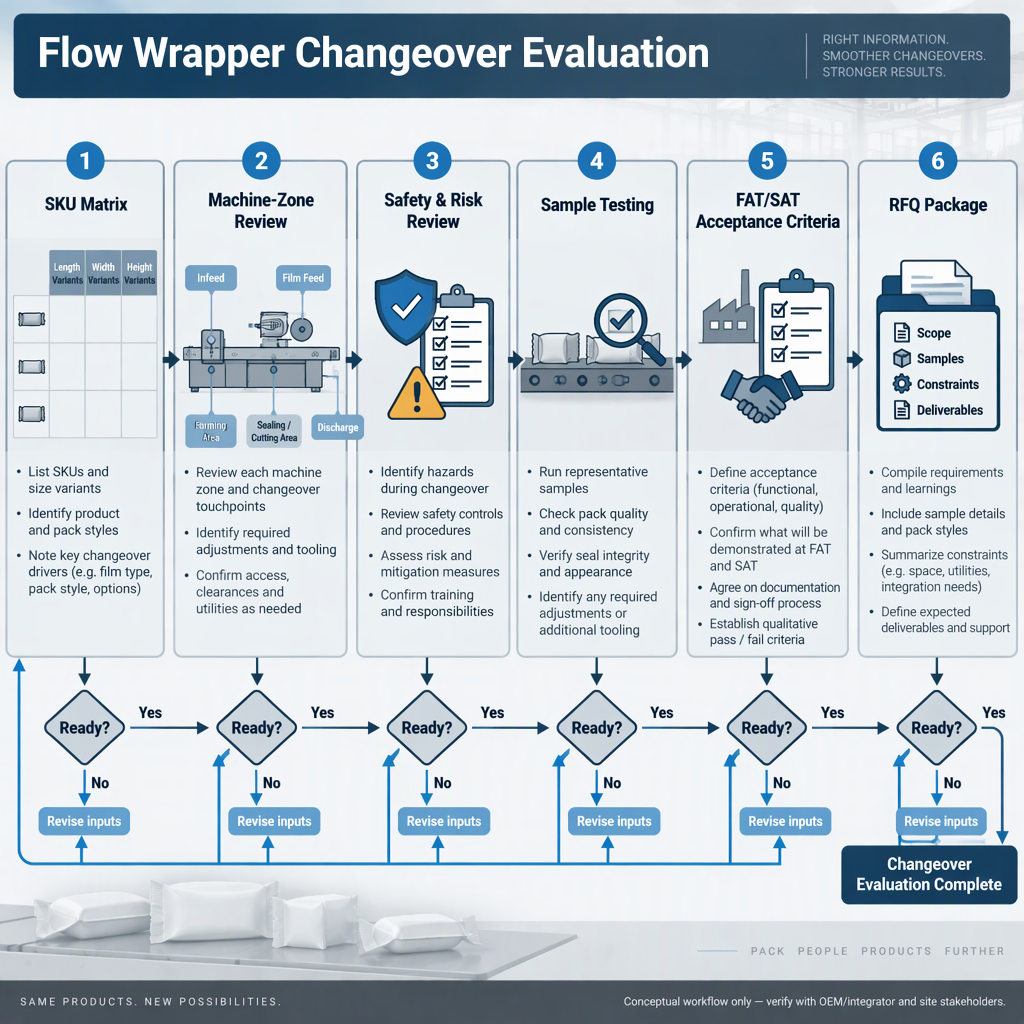
- Group the SKU mix into test families: size extremes, material changes, fragile products, printed-film variants, and the most frequent production sequence.
- Define a starting condition for each changeover, such as previous SKU, film loaded, former installed, recipe selected, and line connected to upstream or downstream equipment.
- Run sample tests with agreed quality checks for seal, registration, pack length, product position, appearance, coding, rejects, and downstream handoff.
- Record the tasks performed, settings changed, parts exchanged, safety steps followed, personnel required, scrap generated, and issues found.
- Repeat critical checks at the installation site, because upstream feeding, utilities, operators, and downstream equipment can differ from the factory test environment.
The IEC 62381:2024 page describes requirements and checklists for factory acceptance testing, factory integration testing, site acceptance testing, and site integration testing in process-industry automation systems, with activities that can be adapted into project-specific test plans for process, plant, or equipment requirements.
For a flow wrapper purchase, use that framework as a planning model, not as a flow-wrapper product standard: the buyer still needs agreed product samples, throughput assumptions, quality criteria, safety criteria, and line-integration checks for the specific project.
Build an RFQ checklist for flow wrapper changeovers
A strong RFQ turns the changeover discussion into comparable evidence: the same SKU matrix, test products, safety expectations, acceptance criteria, and requested documents should go to each shortlisted supplier.
- Provide a product matrix with dimensions, weights, tolerances, fragility, temperature, surface condition, and required orientation.
- Provide packaging requirements: film structures, reel details, print registration, pack dimensions, seal-quality method, labeling, coding, and inspection needs.
- Describe infeed and discharge conditions, including upstream equipment, manual loading, accumulation, reject handling, downstream packing, and available floor space.
- Ask for a changeover task list showing settings, format parts, operator actions, maintenance actions, tools, safety steps, and documentation.
- Request a trial protocol covering representative SKUs, starting conditions, acceptance criteria, sample quantity, quality checks, and report format.
- Ask which documents will be delivered: manual, layout, electrical and pneumatic information, spare and format-part list, risk-assessment-related documentation, and training scope.
| If your mix has... | Prioritize this RFQ question | Ask suppliers to show |
|---|---|---|
| Many similar products | How are repeat settings selected and verified? | Recipe and checklist method without claiming a universal time. |
| Wide product-size spread | Which physical parts or positions change at the extremes? | Trial results for smallest and largest packs. |
| Frequent film changes | How is film loading, tracking, and registration controlled? | Material-specific trial notes and operator steps. |
| Integrated upstream/downstream equipment | How will handoff, signals, rejects, and restart be tested? | A FAT/SAT-style integration checklist and site-test plan. |
Conclusion
The practical buyer decision is whether a proposed flow wrapper changeover approach fits the real SKU sequence, materials, safety controls, and verification method your plant will use.
- Do not compare suppliers on changeover speed until the SKU matrix and test method are consistent.
- Include product, film, infeed, sealing, cutting, downstream, safety, and acceptance-test data in the RFQ.
- Use factory and site tests to confirm what operators must actually do during a changeover.
FAQs about flow wrapper changeover evaluation
The best follow-up questions focus on what changes, who performs the task, how quality is verified, and what evidence the supplier will provide before the purchase decision.
What is a flow wrapper changeover?
It is the controlled transition from one product-and-pack format to another on a horizontal flow wrapper, including mechanical settings, control settings, film handling, product presentation, checks, and restart conditions.
Should I ask for one guaranteed changeover time?
Ask for measured results under defined starting conditions instead. A single time is hard to compare unless the SKU, film, operator role, tooling state, quality checks, and restart criteria are the same.
Which SKU should I use for supplier trials?
Use a representative set, not only the easiest product. Include the smallest and largest packs, difficult materials, fragile products, frequent production transitions, and any SKU that could disrupt feeding or sealing.
How does film choice affect changeover?
Film choice can change loading, tracking, forming, sealing, registration, and appearance checks. Treat each important film family as part of the test plan rather than assuming one setting will fit all materials.
What safety information should I request?
Request task classification, guard and access information, permitted operator adjustments, maintenance-only tasks, risk-assessment-related documentation, and required isolation steps before manual access to hazardous areas.
How should FAT and SAT be used?
Use factory testing to check representative samples and documented changeover tasks, then use site testing to confirm performance with your utilities, operators, upstream equipment, downstream equipment, and production environment.
What should purchasing compare between quotations?
Compare the defined SKU scope, included format parts, changeover task list, sample-test evidence, safety documentation, integration responsibilities, training scope, and acceptance criteria rather than only the machine price.


