Views: 0 Author: Wendy Liu Publish Time: 2026-10-27 Origin: Jewshin
Quick answer: To request a useful packaging machine quotation, send the supplier your product dimensions and weight, desired finished package, packaging material, target output, SKU range, and available line space. Add product photos, packaging samples, and a short process video if possible. These details help the supplier recommend a machine configuration—not just send a price for a model that may not fit your application.
You do not need a finished engineering specification to start an inquiry. But a message that says only “Please quote an automatic packaging machine” leaves important questions unanswered: What will the machine package? How should the finished pack look? How fast must the line run? And what equipment will it connect to?
This checklist explains what to prepare, which details matter most for different machine types, and what to check when comparing quotations.
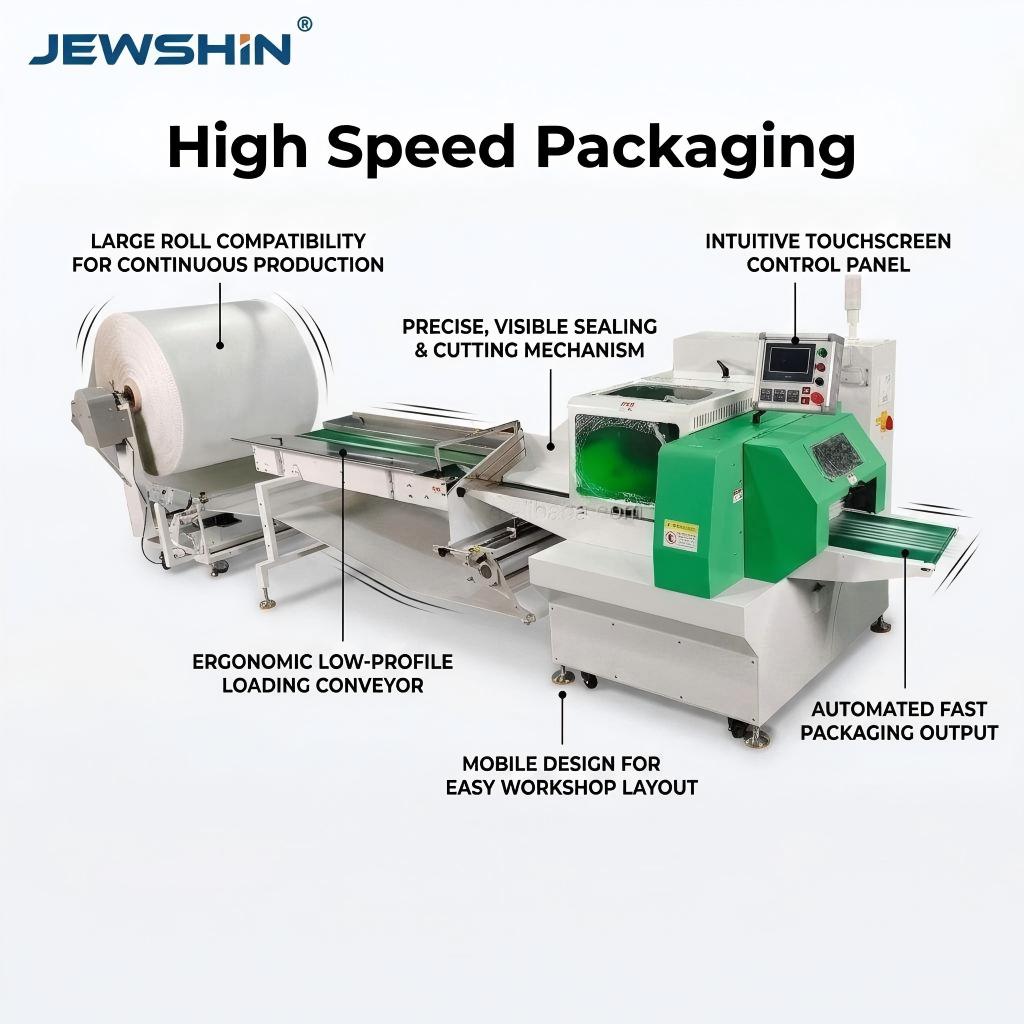
Two buyers may both ask for a “shrink wrapping machine” but need different systems.
One may package small cosmetic cartons in a clear retail wrap. The other may bundle large, heavy products using PE film. Their products, film, sealing equipment, shrink tunnels, conveyors, and output requirements may all differ.
Likewise, a request for a “card packaging machine” could mean:
feeding individual cards into an existing line;
wrapping a stack of cards in a pillow pack;
shrink wrapping a boxed card set; or
counting, feeding, wrapping, and cartoning in one connected line.
A useful quotation starts by defining the packaging task, not by choosing a machine name too early.
If you have limited time, start with these six categories.
Information to provide | What to include | Why it matters |
Product | Photos, dimensions, weight, shape, and surface sensitivity | Determines machine size and handling method |
Finished package | Photo, drawing, or physical sample of the desired pack | Clarifies whether you need a pillow pack, shrink wrap, pouch, label, or another format |
Packaging material | Film, bag, pouch, label, or sleeve specification, if known | Affects sealing, feeding, shrinking, and machine configuration |
Output | Target good packs per minute or hour; shifts per day | Helps size the equipment and identify line bottlenecks |
SKU range | Smallest and largest products; number of sizes; changeover frequency | Shows whether the proposed machine can handle your full product range |
Factory and line conditions | Available space, voltage, and equipment before and after the proposed machine | Helps determine layout and integration requirements |
Not sure about a film grade or machine speed? Say so. Share what you know and mark the remaining items as “to be recommended”. A supplier can then discuss realistic options rather than assuming details you have not confirmed.
Start with the physical product. Provide the dimensions as length × width × height, using millimeters or another clearly stated unit, and include its weight.
Also explain anything that could affect feeding or handling:
Is it rigid, flexible, flat, or irregular?
Is it slippery, fragile, or easy to scratch?
Does it have sharp edges or protruding parts?
Will it be packed individually or in groups?
Does its size or thickness vary within one SKU?
Can the product tolerate heat if shrink packaging is being considered?
For flat printed materials, thickness, static, and whether items tend to stick together may be as important as length and width. For large products, the maximum weight matters alongside the maximum dimensions.
Helpful attachment: Place a ruler next to a representative product in a photo, or send a dimensioned drawing.
The clearest way to communicate packaging requirements is to show the intended result. Send a photo of a current pack, a competitor reference, a sample from a customer, or a simple sketch.
Explain whether you want:
a pillow-style pack made from roll film;
a clear shrink wrap around a carton;
a bundled multipack;
a filled and sealed premade pouch;
a label or shrink sleeve on a container; or
a product packed into a shipping case.
Also mention requirements that may affect the equipment choice. For example, must the printed front panel remain unobstructed? Should a barcode stay readable? Is the primary purpose shelf presentation, bundling, or transport handling?
Be specific about the packaging step you want to automate. A labeler and a shrink wrapper may both appear on one line, but they solve different problems.
If you already use a particular material, send its specification and a sample where practical.
Depending on the application, useful details may include:
film or bag type;
film width and thickness;
roll dimensions;
whether the film is printed;
pouch dimensions and closure style;
label dimensions and roll direction;
shrink sleeve material and printed artwork.
If you have not chosen a material, describe the appearance and protection you need. The supplier can then propose a material and equipment combination for testing.
Do not assume that every machine in a category can run the same film. Compatibility must be confirmed for the specific machine configuration and packaging material.
A supplier needs to know what the line must deliver during normal production—not only the highest speed you hope to see in a machine video.
Where possible, provide:
target good packs per minute or hour;
current output and current bottleneck;
working hours or shifts per day;
whether products arrive automatically or are loaded by an operator;
whether counting, inspection, coding, or labeling is required;
whether the next machine can accept the same output.
For example, a wrapper may be capable of running faster than an operator can feed products into it. In that case, the appropriate quotation may need to include an automatic feeder—or the expected output should reflect manual loading.
If you are unsure of the target, share your daily production requirement and working hours so the supplier can discuss a suitable operating range.

A machine that runs one sample successfully may still be a poor fit for your full product range.
Provide a simple SKU table:
SKU | Product dimensions | Weight | Pack format | Target output |
A | Your actual data | Your actual data | Your actual format | Your target |
B | Your actual data | Your actual data | Your actual format | Your target |
C | Your actual data | Your actual data | Your actual format | Your target |
Include the smallest, largest, and most difficult products. Also tell the supplier:
how often you switch sizes;
whether the same film will be used for every SKU;
whether changeovers happen several times per shift or only occasionally.
This information can affect the proposed machine, adjustment method, tooling, and production schedule.
A standalone machine must still fit into a real factory. A connected line needs even more planning.
Send a floor plan or a hand-drawn sketch showing:
where products enter the area;
where finished packs must leave;
available floor length and width;
doorways or other access restrictions;
existing upstream and downstream machines;
operator positions and maintenance access;
local electrical requirements.
If the project includes line integration, identify which operations are already automated and which you want the supplier to include. For example:
Existing feeder → new wrapper → existing labeler → manual case packing
That one sentence can prevent major misunderstandings about the quotation scope.
The six categories above apply to most projects. Some machines also require application-specific details.
Share:
minimum and maximum product dimensions;
product weight and heat sensitivity;
desired shrink-wrapped appearance;
film type, width, and thickness, if selected;
whether the product is an individual item or bundle;
expected packs per hour;
photos of difficult corners, handles, or protrusions.
Ask the supplier to confirm the sealer and tunnel together, including product clearance and conveyor support.
Explore JEWSHIN’s heat shrink packaging machines.
Share:
product thickness and consistency;
whether products arrive singly or in stacks;
quantity per pack;
feeding orientation;
whether counting or batch grouping is required;
sensitivity to scratches or bent corners;
desired pillow-pack dimensions.
Ask whether the proposal includes a feeder or assumes manual product loading. That distinction can significantly affect achievable output.
See JEWSHIN’s pillow packaging machine and automatic packaging machines.
Share:
empty pouch samples or drawings;
pouch width and length;
product type and filling quantity;
intended closure and seal appearance;
whether coding or other functions are needed;
the range of pouch sizes to be run.
Machine selection depends on both the product being packed and the pouch itself. A drawing of the filled pack alone may not provide enough information.
Explore JEWSHIN’s automatic premade bag packing machine.
Share:
product characteristics relevant to filling;
fill volume range;
container dimensions and material;
cap or closure samples;
label or sleeve dimensions;
required label position;
current and target output.
Send the container, closure, and label together if possible. Each component affects the others during line testing.
Browse JEWSHIN’s filling and capping equipment and labeling and sleeve labeling machines.
Once you have sent your requirements, compare proposals on more than price.
Ask the supplier to identify:
Recommended equipment and configuration — including which machines and accessories are included.
Supported product and package range — based on the dimensions and materials you supplied.
Expected output assumptions — including the feeding method, product, and test conditions.
Quotation scope — conveyors, feeders, printers, inspection devices, and downstream equipment should not be left ambiguous.
Testing plan — which samples will be used and what results can be documented.
Utilities and layout requirements — so you can check installation feasibility.
Delivery and commercial terms — including lead time, shipping scope, and any applicable trade terms.
Installation and after-sales terms — training, warranty, spare parts, and support arrangements.
A quotation that clearly states its assumptions and exclusions is often easier to evaluate than one that simply lists a machine and a total price.
A supplier may quote a machine that seals film when you actually need a different package format.
The quoted machine may work for the sample but not for your largest or most difficult SKU.
Actual throughput depends on feeding, product spacing, changeovers, inspections, and downstream handling.
A quoted sealer may not include the shrink tunnel or feeder your process requires. Request an itemized scope.
If appearance, feeding accuracy, product protection, or film performance is important, agree on a representative test before finalizing the specification.
Use the following template when contacting a supplier. You can leave unknown fields blank and ask for a recommendation.
Subject: Packaging Machine RFQ – [Product] – [Target Output]
Hello,
We are looking for a packaging solution for the following application:
Product: [Name and short description]
Product dimensions: [Minimum and maximum L × W × H]
Product weight: [Minimum and maximum]
Quantity per pack: [Number]
Desired finished package: [Describe or attach a reference photo]
Packaging material: [Film / pouch / label specification, or “please recommend”]
Target output: [Good packs per minute or hour]
Number of SKUs: [Number and size range]
Changeover frequency: [How often sizes change]
Current process: [Manual or existing equipment]
Equipment to connect: [Upstream and downstream machines]
Available space: [Dimensions or layout attachment]
Power requirements: [Local voltage and frequency]
Destination country: [Country]
Please recommend a suitable configuration and clarify the equipment included, expected output assumptions, sample-testing process, delivery scope, and after-sales support.
I have attached [product photos / samples / drawings / packaging reference / process video].
Best regards,
[Name, company, and contact details]
You can also send this information in a spreadsheet if your project has many SKUs.
JEWSHIN manufactures automated packaging equipment in Dongguan, China, with product categories covering automatic packaging machines, heat shrink systems, labeling equipment, filling and capping equipment, and end-of-line equipment.
If your project involves more than one step, share the full process rather than asking for each machine separately. That gives JEWSHIN’s team a clearer basis for discussing equipment selection and line connections.
For company information, visit About JEWSHIN.

Yes. Describe your product, desired finished package, output target, and current process. Ask the supplier to recommend the machine type rather than selecting a model yourself.
Not necessarily. If the material has not been selected, send a packaging reference and explain your appearance and protection requirements. Ask which materials the proposed configuration could be tested with.
Not always for an initial discussion. Photos, dimensions, and videos can help start the process. For applications where feeding, sealing, shrink appearance, or product protection is uncertain, physical sample testing is especially valuable.
They may include different machines, automation levels, feeders, conveyors, testing, service, or shipping scopes. Compare each quotation’s included items, assumptions, and exclusions before comparing prices.
It depends on the proposed model and the range of products. Send the smallest, largest, and most difficult SKUs, and ask the supplier to confirm the supported range and changeover requirements.
Machine speed describes the equipment under specified conditions. Line output is the number of acceptable finished packs produced by the full process. Feeding, inspections, changeovers, and downstream equipment can limit actual output.
JEWSHIN presents both individual machines and production-line solutions on its website. Share your process flow, existing equipment, and desired automation scope so its team can assess the project and clarify what a proposal would include.
Ask for written details on installation, operator training, warranty, spare parts, remote support, and any on-site service relevant to your destination and project. Confirm these terms in the quotation or sales agreement.
A strong RFQ does not need to be complicated. Start with your product, finished-package goal, size range, target output, and factory layout. Add samples or a short video if available.
Send your application details to JEWSHIN so its team can review a suitable machine or line configuration and clarify the next steps.


