Views: 0 Author: Wendy Liu Publish Time: 2026-10-21 Origin: Jewshin
Quick answer: To shrink wrap a large or heavy product with PE film, start by checking the product’s dimensions, weight, shape, and required protection. Then evaluate a sealing machine designed for the product and film, a compatible PE shrink tunnel, and a conveyor system that can support and transport the load. Test the complete setup with your actual products and film before confirming the machine specification.
Large-product shrink packaging is not simply standard shrink wrapping with a bigger film roll. As products become wider, taller, longer, or heavier, the entire system must be considered: feeding, sealing, film handling, tunnel clearance, heat distribution, conveyor capacity, and the finished package.
This guide explains when PE film is worth considering, how to compare equipment, and what information to provide when requesting a quotation.

PE shrink film is often considered for larger or heavier packs where the packaging must accommodate product size and handling demands. Potential applications include:
larger boxed consumer goods;
household product multipacks;
grouped cartons;
industrial or commercial product bundles;
products requiring an outer wrap for handling or distribution.
The appropriate film and machine still depend on the application. PE film is not automatically the best choice for every large product. If the main requirement is a highly transparent retail finish on a smaller carton, another film and shrink system may be more suitable.
Before selecting PE, define what the wrap is meant to achieve:
Bundle products together
Provide an outer protective layer
Improve handling during internal transport
Create a specific finished appearance
Also define what it is not expected to do. Shrink film does not replace protective cushioning or structural transit packaging where those are required.
A small, regular carton is comparatively easy to guide through a sealer and tunnel. A large or heavy product introduces additional variables.
The package must fit through the sealing area and shrink tunnel with appropriate operating clearance. Checking the tunnel opening alone is insufficient; the full product path must fit.
The infeed, transfer points, and tunnel conveyor must support the product. An unstable product can shift during sealing or shrinkage, affecting the result.
Sharp corners, handles, projections, or irregular profiles can stress the film. They can also create uneven shrink results or require adjustments to film size and packaging method.
The shrink tunnel must apply enough heat to shrink the film without damaging the product, carton, labels, or printed surface. Heat-sensitive products need particular attention during sample testing.
Larger packs use more material. Excessive film width or poor film positioning can increase waste, while insufficient film can create sealing problems.
These factors are why a machine should be selected using the actual product and film, not just the largest dimension shown in a catalog.
A PE shrink packaging project may require several pieces of equipment working together.
The infeed must present each product to the sealing machine consistently. For large or heavy products, check:
how the product is loaded;
whether its orientation is controlled;
whether it remains stable on the conveyor;
the gap required between consecutive products.
If an operator must manually push or reposition every item, the achievable line output may be lower than the sealing machine’s nominal speed.
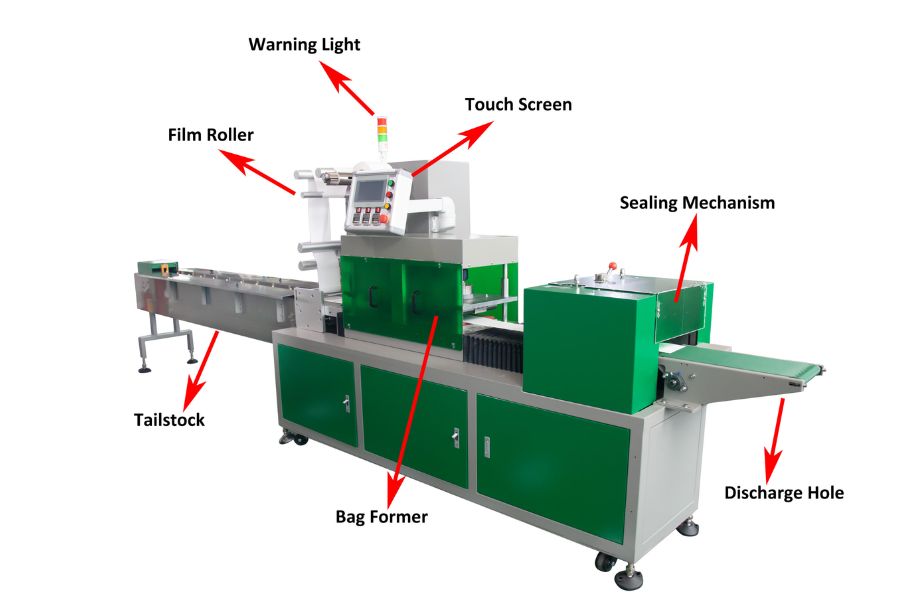
A heavy-duty side sealing machine is one option to evaluate for larger or longer products. The sealing configuration must match the product dimensions, film, and required package format.
For long or variable-length products, a side sealer may offer useful flexibility. However, buyers should confirm the specific model’s supported size range, film compatibility, and load-handling arrangement rather than assuming that every side sealer can run PE film or heavy products.
The tunnel shrinks the film around the product after sealing. Important selection factors include:
tunnel opening and usable clearance;
conveyor dimensions and load capacity;
temperature and airflow adjustment;
conveyor speed;
product heat sensitivity;
the intended film specification.
A tunnel that is physically large enough may still be the wrong choice if its conveyor or shrink performance does not suit the product.
The finished pack must leave the tunnel safely and continue to its next destination. Check whether operators, conveyors, case handling, or palletizing equipment will receive it.
Practical takeaway: Evaluate the system from infeed to outfeed. A suitable sealer paired with an unsuitable tunnel or conveyor will not deliver a reliable packaging process.

Both machine types may be used in shrink packaging, but their suitability depends on the product and the machine specification.
Selection question | L-bar sealer | Side sealer |
Is the product regular in size? | May be suitable within the model’s limits | May also be suitable |
Does product length vary significantly? | Check size limits and changeovers | Often worth evaluating |
Is the product long or oversized? | May be restricted by sealing dimensions | Often the stronger candidate |
Will the system run PE film? | Verify model-specific compatibility | Verify model-specific compatibility |
Is the product heavy? | Confirm the complete handling system | Confirm the complete handling system |
The decisive question is not the machine category alone: Can the proposed sealer, tunnel, film, and conveyors together package your heaviest and largest product to the required standard?
Film selection affects sealing, shrink performance, appearance, and operating cost. When discussing film with a machinery supplier, provide or confirm:
film type and specification;
film width;
film thickness;
roll dimensions;
required seal strength;
desired pack appearance;
whether the product has sharp edges or projections.
If you already use a particular PE film, send a sample roll or its full specification. If you have not chosen a film, ask the supplier to identify which film was used in the machine test so the demonstrated result can be reproduced in your factory.
Do not judge film suitability only by thickness. The product, sealing process, shrink behavior, and handling requirements all matter.
List the minimum and maximum length, width, height, and weight. Include difficult SKUs—not only the easiest sample to package.
Provide photos or physical samples showing your expectations. Should the pack hold several products together? Must barcodes remain readable? Are some wrinkles acceptable, or is a particular presentation standard required?
Assess cartons, labels, adhesives, printed graphics, and the product itself. Any heat-sensitive component should be identified before tunnel testing.
Confirm how products move across the infeed, sealing section, tunnel, and outfeed. Ask for the applicable conveyor load limits and handling arrangement in the proposed configuration.
Request an expected output for your product sizes and workflow, not only a general machine-speed figure. Larger products and longer spacing can reduce the number of packs produced per hour.
Testing should include the largest, heaviest, and most difficult-to-wrap products where possible. Review the seal, film condition, shrink finish, and product condition after packaging.
Before placing an order, document what a successful trial looks like. Examples include acceptable seal quality, finished-pack appearance, supported size range, and output under defined test conditions.
Clear acceptance criteria help both the buyer and supplier evaluate the same result.
Observed issue | Factors to investigate |
Loose film or uneven shrink | Film sizing, tunnel settings, airflow, product shape, and conveyor speed |
Weak or inconsistent seals | Film specification, sealing settings, product position, and maintenance |
Film damage near corners | Sharp edges, film selection, wrap allowance, and heat exposure |
Product shifting during packaging | Infeed control, conveyor stability, product orientation, and spacing |
Pack looks good but product is damaged | Tunnel heat exposure, carton strength, labels, and product sensitivity |
Higher-than-expected film usage | Film width, package design, machine setup, and SKU variation |
These are starting points for diagnosis, not guaranteed fixes. Adjustments should be made with the specific product, film, and equipment in mind.
To obtain a useful recommendation for a large-product PE shrink wrapping project, send:
product photos or a video;
dimensions and weight for every key SKU;
photos of the desired finished pack;
the number of items per bundle, if applicable;
PE film specifications, if already selected;
target output per hour;
current packaging method;
available floor space and line layout;
local power requirements;
any upstream or downstream equipment that must be connected.
Samples are especially useful. A supplier can make a much better recommendation when it can test an actual product and proposed film rather than relying only on dimensions.
JEWSHIN lists equipment relevant to PE shrink packaging, including its Model 75 Servo Rear Side Sealing Machine, described on its product listing as a heavy-duty machine for PE film, and its 6040PE Heavy Duty Heat Shrink Tunnel, described as designed for PE film.
These pages are useful starting points, not a substitute for application testing. The final configuration should be checked against your product dimensions, weight, film, packaging goal, and expected output. For other product sizes, JEWSHIN also lists additional packaging equipment that its team can consider when reviewing an application.
JEWSHIN is a Dongguan-based manufacturer of packaging machinery and production-line solutions. Learn more about JEWSHIN or share your requirements through its contact page.
Successful PE shrink wrapping for large or heavy products depends on matching five things: the product, film, sealing machine, shrink tunnel, and handling system.
A product may fit through a tunnel but be too heavy for an unsuitable conveyor. A sealer may handle the film but not the full product width. A pack may look acceptable immediately after shrinking but fail to meet the required handling standard. These risks are best addressed through representative samples and clearly agreed test criteria.
If you are comparing machines, begin with your largest and most difficult product. Once that application is defined, it becomes much easier to select a system that also works for the rest of your range.
No. PE film is worth evaluating for many larger packs and bundles, but suitability depends on product shape, heat sensitivity, required protection, and desired appearance. Test the actual application before choosing the film and equipment.
For a typical sealed-and-shrunk PE film package, the sealing and shrinking operations both need to be addressed. The exact equipment configuration depends on how the product is wrapped and the package format you require.
It may be able to handle a defined size range. Ask the supplier to confirm the smallest and largest supported products, adjustment steps, changeover time, and results for representative SKUs.
Check more than the tunnel opening. Confirm usable clearance, conveyor size, load capacity, and whether sample testing produces an acceptable result without harming the product.
Actual output depends on product dimensions, spacing, feeding method, film, sealing cycle, tunnel settings, and downstream handling. Request an estimate or test result based on your own product and proposed line configuration.
Ask JEWSHIN to confirm the sample-testing process for your project, including which products and film to send, what will be tested, and whether the results can be documented in photos or video.
JEWSHIN presents both individual packaging equipment and production-line solutions. Share your existing line layout and describe where infeed, wrapping, shrinking, and outfeed must connect so the team can assess the appropriate scope.
Confirm the warranty terms, installation and training scope, remote support process, recommended spare parts, and any site-service arrangements in the quotation or sales agreement. These details can vary by project and destination.
Need to wrap a large product, heavy carton, or multipack with PE film? Send JEWSHIN your product dimensions and weight, packaging photos, film specification, and target output. Its team can then review suitable sealing and shrink-tunnel options for your application.


