Views: 0 Author: Wendy Liu Publish Time: 2026-11-03 Origin: Jewshin
Quick answer: Choose a food packaging machine based first on the product and packaging step. A flow wrapper may be suitable for individual bakery items or regularly spaced snacks in pillow packs. A premade pouch packing machine may suit a product intended for a specified pouch format, provided its feeding and filling configuration matches the product. For bundling already packaged food products, a sealer and shrink tunnel may be worth evaluating. In every case, confirm material compatibility, product handling, cleaning requirements, and finished-pack quality through application testing.
A machine that packages a boxed snack multipack is not necessarily suitable for wrapping an unwrapped pastry. Both may be described as “food packaging,” but they involve different product-contact conditions, films, feeding methods, and quality risks.
This guide helps food manufacturers and contract packers narrow down the right equipment before requesting a quotation.

Before comparing machine models, decide whether the equipment will create the package that directly contains the food or will package products that are already sealed in their primary packs.
Packaging task | Example | Equipment to evaluate |
Individually wrap a product | An unwrapped bakery item placed into a pillow pack | Flow wrapper with a suitable feeding system |
Fill a premade pouch | A snack product packed into a specified pouch | Premade pouch packing machine with an application-specific filling system |
Bundle finished retail packs | Several individually wrapped snacks sold together | Shrink-wrapping or other multipack system |
Pack retail units for distribution | Finished packs loaded into shipping cartons | End-of-line case handling equipment |
Why this matters: Direct food-contact applications require particular attention to the product-contact surfaces, packaging materials, cleaning method, and applicable requirements in the destination market. Secondary packaging of already sealed products presents a different set of considerations. Do not assume that suitability for one task establishes suitability for the other.
A flow wrapper, also called a pillow packaging machine, forms a package from roll film around a product and makes longitudinal and end seals. It is often considered when products can be presented to the machine consistently in a continuous process.
Potential applications to evaluate include:
individual bakery items;
regularly shaped snack products;
bars and similar portioned items;
trays containing food products;
grouped items that need a pillow-style pack.
The exact suitability depends on the food, its presentation to the machine, and the proposed equipment configuration.
Product handling: Can the infeed move the item without crushing, smearing, or displacing it?
Product spacing: Can items arrive at the wrapper with the separation needed for consistent sealing?
Film and seal: Does the proposed packaging material produce a suitable seal under defined test conditions?
Cleaning: Are the relevant areas accessible for the cleaning procedure your operation requires?
Pack quality: Does the finished pack meet your specifications for appearance, seal location, and product protection?
For a delicate bakery item, successful wrapping is not only about machine speed. A technically fast wrapper can still be unsuitable if product feeding damages the item or creates inconsistent packs.
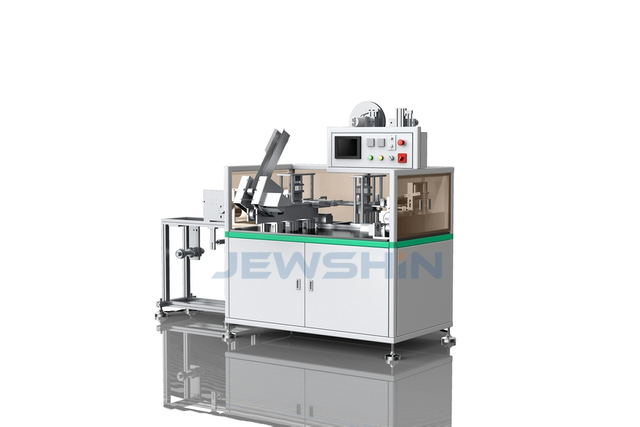
Explore JEWSHIN’s Pillow Packaging Machine as a starting point. Confirm the required food-product handling and machine configuration with its team before treating a listed model as suitable for a particular food.
If your product must be sold in a premade pouch, a pouch packing system may be the right equipment category. However, choosing the pouch format is only the beginning. The supplier must also assess how the product will be measured, transferred, filled, and sealed.
Send samples of both the product and the empty pouch. Explain:
whether the product is a solid piece, granule, powder, or another form;
the target fill quantity;
pouch width, length, and construction;
the required finished-pack appearance;
whether the pouch contains a zipper or other feature;
the expected output and number of pouch sizes.
A premade pouch machine should not be selected from the pouch dimensions alone. The filling method and the product’s behavior can have just as much impact on the final configuration.
JEWSHIN lists an Automatic Prefabricated Bag Packing Machine. For this article, “premade pouch packing machine” is used as a familiar buyer search term; buyers should confirm the specific product, pouch, and filling application supported by the quoted JEWSHIN configuration.
When the individual food items are already sealed in their own primary packages, shrink wrapping may be considered to group several retail units together.
Possible applications include:
promotional multipacks;
groups of snack cartons;
bundled, individually wrapped products;
boxed food products requiring an outer wrap.
An automatic L-bar sealer and shrink tunnel may be worth evaluating for regular, suitably sized packs. A side sealer and shrink tunnel may be worth comparing for longer packs or a wider range of pack lengths.
The right system depends on the actual dimensions, grouping pattern, film, desired appearance, and how the bundled products behave when conveyed through the line.
Important distinction: Shrink wrapping a group of already sealed food packs is not the same as creating a validated primary food package. If your project requires direct food contact or specific shelf-life performance, define those requirements separately.
Browse JEWSHIN’s Heat Shrink Packaging Machines.

Your packaging goal | First machine category to evaluate | Key question before purchase |
Make a pillow pack around an individual product | Flow wrapper | Can the complete infeed-and-wrapper setup handle the product without damage? |
Fill and seal a specified premade pouch | Premade pouch packing system | Which filling method and pouch specification are required? |
Group already sealed products into a retail multipack | Sealer + shrink tunnel | Will the bundle remain stable and shrink to the required appearance? |
Pack finished retail units into shipping cases | End-of-line equipment | Can the proposed system handle the pack arrangement and line output? |
This table identifies a starting point, not a final machine specification. Samples and a defined test are still needed for applications with difficult handling or strict quality requirements.
A soft pastry, crumbly snack, or loosely arranged tray can change shape during feeding. Send the supplier realistic samples, including products from normal production rather than only carefully selected pieces.
Share the actual film or pouch specification if one has been selected. If it has not, describe the target package and ask what materials the supplier proposes to test. Confirm food-contact material suitability with the relevant material supplier and your quality team where the package will directly contact food.
A seal should be evaluated against your product and quality requirements. Define what a successful seal means for your application and how it will be checked. Do not assume that an attractive pack has met a required seal standard.
Tell the equipment supplier about your cleaning procedure, product-contact expectations, and any site-specific hygiene requirements. Ask which parts contact the product and how those areas can be accessed. Confirm the suitability of the quoted configuration, rather than relying on a general description of a machine category.
The flow wrapper, pouch machine, or shrink sealer is only one part of the process. Determine who—or what—will portion, orient, count, group, and feed products into it.
Ask for expected output under stated conditions using your product range. Include stops, product variation, and downstream handling in your planning. An advertised maximum machine speed is not the same as acceptable packs produced across a shift.
List the smallest and largest products or pouches you plan to run. Confirm required adjustments, change parts, material changes, and expected changeover procedure.
A machine trial can help assess product handling, package appearance, sealing behavior, and output under specified conditions. It does not automatically establish a finished food product’s shelf life or compliance with all applicable food-packaging requirements.
If your project has shelf-life, barrier, or food-safety requirements, involve your quality team and appropriate material specialists. Define the required validation before approving the final packaging format.
The same principle applies to optional processes such as modified atmosphere packaging: do not assume a machine offers a particular function, or that the resulting package achieves a target shelf life, unless the quoted configuration and validation plan explicitly address it.
What you observe | What to investigate |
Product is crushed or displaced | Infeed design, guides, transfer points, and product spacing |
Food pieces interfere with the seal | Product placement, portion control, package length, and feeding consistency |
Pack appearance varies | Film behavior, product dimensions, machine settings, and input consistency |
Multipack shifts before shrinking | Grouping method, conveyor transfer, film allowance, and pack stability |
Output is below target | Feeding rate, stops, inspection steps, and downstream capacity |
Changeovers take too long | SKU range, adjustment points, material changes, and operator procedure |
These are prompts for a controlled test—not guaranteed fixes. Ask the supplier to document the product, material, setup, and conditions used to produce the sample packs.
A useful inquiry should include:
photos or a short video of the product;
product dimensions and weight, including normal variation;
whether the food is unwrapped or already in a sealed primary pack;
the desired finished-package photo or sample;
film or premade pouch samples, if available;
units per pack or multipack grouping pattern;
target good packs per hour;
number of SKUs and changeover frequency;
current production process and line layout;
cleaning, product-contact, or site requirements that the supplier should consider;
destination country and electrical requirements.
If possible, send the most difficult product as well as a standard product. This gives the supplier a better basis for recommending equipment and planning a test.
JEWSHIN’s published product range includes Pillow Packaging Machines, an Automatic Prefabricated Bag Packing Machine, Heat Shrink Packaging Machines, and End-of-Line Packaging Equipment.
These categories cover different packaging tasks. When contacting JEWSHIN, identify whether you need primary packaging, a retail multipack, or downstream case handling. Ask its team to confirm the proposed configuration, application-specific materials and handling, sample-testing scope, and service terms in its quotation.
Learn more about JEWSHIN or view the full product range.

A flow wrapper is one option when the desired package is a pillow pack. Its suitability depends on the bakery item’s shape, fragility, feeding method, film, and required seal. Test representative products before selecting a model.
No. The product’s form, filling method, pouch design, and target output all affect suitability. Share product and pouch samples so the supplier can evaluate the complete application.
It may be suitable for bundling already packaged food products. The grouping arrangement, film, pack stability, and finished appearance should be tested with your actual retail units.
A shrink tunnel is used as part of certain shrink-packaging processes. Whether a proposed process is suitable for a direct food-contact application cannot be determined from the equipment category alone; material, machine design, and your quality requirements must all be reviewed.
Request a test or an estimate tied to your product, film or pouch, feeding method, and finished-pack criteria. Evaluate expected good packs per hour, not only the machine’s advertised maximum speed.
Do not assume so. Shelf life depends on the product, packaging material, seal performance, storage conditions, and validation. A machinery supplier’s pack test does not replace your product-specific shelf-life assessment.
JEWSHIN presents both individual machines and production-line solutions. Share your process flow, existing equipment, and desired automation scope so its team can clarify what a proposed system would include.
Ask JEWSHIN to specify installation, operator training, warranty, technical support, and spare-parts arrangements for the quoted project and destination country. These details should be included in the quotation or sales agreement.
The right machine depends on your product, desired pack, packaging material, and complete production process. Start by sending JEWSHIN photos or samples, your SKU range, target good-pack output, and a brief description of the packaging step you want to automate.
Its team can then discuss suitable equipment categories and what must be confirmed through testing before you place an order.