

Treat flow wrapper infeed handling as a handling problem, not a speed figure. Agree the product data you supply, the four jobs the infeed must do (meter, support, orient, space), the damage definition you will measure against, the guarding and isolation operators need for jam clearing and cleaning, and the trial that proves the arrangement with your own products.
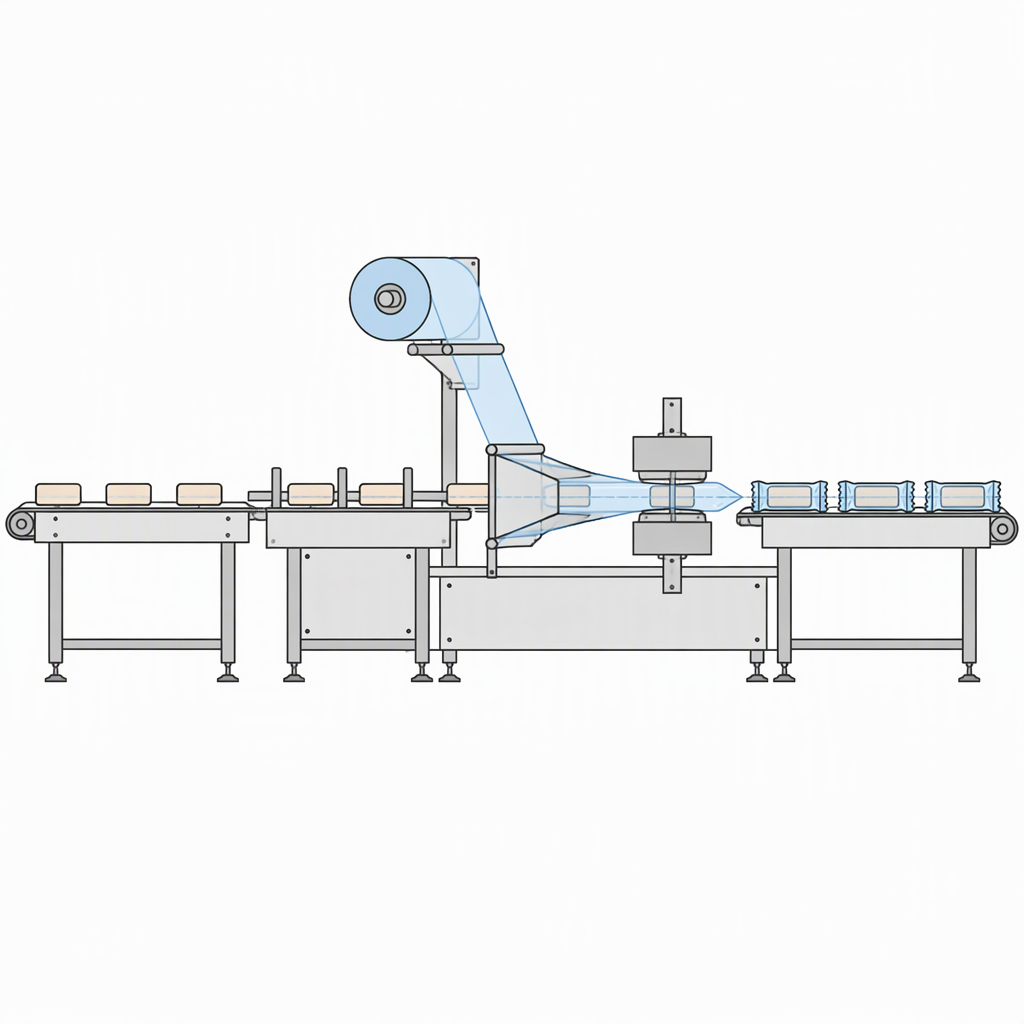
What a Flow Wrapper Infeed Must Do for Delicate or Irregular Products
An infeed turns the product supply you already have into a single, evenly spaced stream that reaches the film former at a defined orientation and pitch without changing the product. For delicate or irregular items it has to carry each product across its own base and hold its position, instead of assuming the product is robust enough to survive general conveying.
- Receive and accumulate. Product arrives from a loader, feeder or upstream machine, and a queue pressing against a stop is itself a source of crushing and scuffing.
- Meter into a single stream. The infeed sets the pitch, the gap between one product and the next, and pitch has to match the wrapping cycle.
- Support the product. Each item needs enough support to stay level and undamaged between metering and the film; for soft or top-heavy products this decides whether the infeed works at all.
- Orient the product. Where the pack needs a defined face up, a label facing the film or a set seam position, the orientation has to be created and held.
- Space and transfer into the film. Position, timing and film meet at the former and between the sealing jaws, and product that drifts here produces mis-wraps and seal contamination.
- Detect and divert misfeeds. A doubled, skewed or missing product should stop the machine rather than damage product or jaws.
Write these functions into the requirement and agree who owns each one; the divide between your conveying and the supplier's scope causes arguments at commissioning.
The Product Data to Measure Before You Specify an Infeed
Measure the extremes of your range, not the average: smallest and largest, lightest and heaviest, most awkward shape. An infeed sized around a typical product usually fails on the extremes, and those extremes are what the acceptance trial must run.
- Dimensions of the smallest, largest and most typical item, including which face has to meet the film.
- Weight range and weight distribution, and whether the product is top-heavy or base-heavy.
- Shape family: flat and rigid, round and rolling, tapered, multi-piece or nested, and whether items may travel touching one another.
- Surface and condition: sticky, powdery, oily, wet, frozen with condensation, printed or frosted, and whether contact marks are visible to the customer.
- Structural limits: the greatest load the product takes before it deforms, and the edges and corners that chip first.
- Batch variability: how much size, weight and shape change between batches, and what the worst case looks like.
- Damage definition: what counts as unacceptable, at which inspection point, and judged by whom.
- Line context: how product arrives, how often the mix changes, who adjusts the machine, and the environment, including washdown, dust and temperature.
Where Delicate Products Get Marked, Crushed or Scuffed at the Infeed
Delicate products are mostly damaged by pressure and dwell rather than by falling: guide rails set too tight, product accumulating against a stop, a step or gap at a transfer, and belts that grip harder than the product can take.
Marking and compression
Mechanism: contact pressure, sliding friction and accumulated load where product waits against a stop.
Where it shows first: printed or frosted surfaces, soft edges and corners, and the face that slides along a guide.
What to require: adjustable, documented guide and belt pressure; transfers without steps or gaps; accumulation that does not press products together; contact materials agreed in advance.
Stability and orientation loss
Mechanism: too little support, a mismatch between conveyor speed and the wrapping cycle, and a product that cannot hold its own shape.
Where it shows first: the transfer into the film, where the product is briefly unsupported or handed over between two surfaces.
What to require: support on more than one axis; a defined orientation with a means of holding it; a transfer matched to the cycle; the same behaviour at slow speed and at production speed.
Irregular Shapes: Orientation, Stability and Spacing
An irregular product is a positioning problem: the infeed has to hold a shape that does not sit still, so orientation, support and spacing have to be defined and then demonstrated rather than assumed.
Three requirements change when the shape is irregular. Orientation needs a reference: state which face rests on the conveyor, which meets the film, and how much rotation you can accept. Support becomes product-specific, because cradles, pockets, or a top hold-down may be needed where a flat product would sit on a flat surface. Spacing may vary: a product that measures differently from piece to piece may need a sensor-set pitch.
What paper cannot settle: a shape that looks stable on a bench can rotate on a moving belt, and batch-to-batch variation changes the answer again. Treat any proposed configuration as provisional until it has run the full range of your product, including the worst case; the interface between the infeed and the sealing area proves the arrangement. If the pack style requires the product to lie flat and yours cannot, settle the pack format before quoting.
Matching Infeed Configuration to Your Product Range
Match the configuration to the weakest handling property in your range: cut contact pressure and sliding if the surface is weak; add support and orientation control if the shape is; build in adjustment, recorded settings and a way to verify them where variability is.

Use the table below in the first supplier conversation: each row ends with something you can watch during a trial rather than accept as an answer.
| Product condition | Function under pressure | Write into the specification | Ask the supplier to demonstrate |
|---|---|---|---|
| Light and easily marked | Support and metering | Adjustable, documented guide and belt pressure | A run on your product at production settings, with damage counted against your definition |
| Tall, narrow or top-heavy | Stability | Support on more than one axis from metering to the film | Orientation held through the transfer at production speed |
| Round or rolling | Orientation and spacing | A defined orientation, a means of holding it and a defined pitch | The same orientation arriving at the film, item after item |
| Multi-piece, nested or irregular stack | Support and spacing | Whether pieces travel touching or separated, and how | The pack pattern you asked for, repeated |
| Sticky, powdery or wet surface | Metering | Surfaces and a cleaning method that do not build up product | A run long enough to show build-up stays manageable |
| Mix that changes often | Changeover | Which settings change, how they are set and how they are recorded | A changeover between two of your products, from last good pack to first good pack |
Guarding, Isolation and Cleaning Access to Write Into the Specification
Require guards that prevent access to the drawing-in and trapping points where product passes into the film and between the sealing jaws, an interlocked guard or protective device for any opening operators use routinely, and a lockable means of isolating every energy source, including compressed air and stored energy. Require the equipment to suit the products and conditions you run, and to arrive with written jam-clearing and cleaning instructions.
Before any manual access inside the infeed or the seal area, switch the machine off and disconnect it from its power supply, release compressed air and any other stored energy, and lock off the isolation where the machine could otherwise be reconnected. Operators should use only the access the manufacturer's manual permits, with the tools and methods it describes, and maintenance work should be done by competent people following those instructions. Outside Great Britain, ask the supplier for the documents and instructions required at your destination, in the language your operators read. HSE's guidance on maintenance of work equipment sets out this isolation sequence.
HSE's introduction to machinery safety explains that moving machinery injures people when body parts are drawn in or trapped between rollers, belts and pulley drives, and it sets an order of control for the infeed transfer: fixed guards wherever practical, then interlocked guards, then trip systems, with information, training and supervision covering whatever risk remains.
HSE's machinery FAQs add that new machinery must be designed and built to prevent contact risks and fitted with guards or protective devices where risks remain, and that lesser measures such as adjustable guards, jigs or push sticks are acceptable only where the risk cannot be designed out or permanently controlled. The same guidance places the duty on the manufacturer to supply a safe, compliant product with user instructions in the end user's language.
What to Verify at Factory and Site Acceptance
Acceptance has two halves: a factory run with your products before shipment, and a documented inspection plus a production trial after installation and before first use. Agree the products, settings, measurements and damage limits before either takes place, otherwise both become demonstrations rather than tests.
HSE's inspection guidance says that equipment whose safety depends on how it is installed should be inspected after installation and before first use, and again after reassembly at a new site, with the need for inspection and its frequency set by risk assessment and records kept. Apply the same discipline to the infeed: a signed inspection before the first production run, and a written record of the settings and checks.
- Written acceptance criteria: which products, which rate and shift pattern, how long each run lasts and the maximum acceptable damage.
- Factory trial with the smallest, largest and most awkward item in the range, at production settings, run long enough to show metering, orientation and sealing are stable.
- Recorded results: packs produced, rejects and the reason for each, damage counted against your definition, orientation errors and the settings used.
- Jam recovery: how an operator isolates the machine and clears a jam using only the access the manufacturer's instructions permit, and how long recovery takes.
- Guard and interlock checks: every guard fitted, every interlock stopping the machine, and the isolation point reachable and usable.
- Changeover between two of your products, with the new settings recorded.
- Site acceptance: the signed inspection before first use, then a production trial compared against the factory results.
- Documents and training: manual, drawings, spare parts list, maintenance instructions, the conformity documents your market requires, and the training your operators need.
The Specification Pack to Send With Your RFQ
Send one pack in one format and ask every supplier to answer the same questions in the same order. Comparable answers come from structured questions and named acceptance criteria, not brochures, and this pack becomes the basis of the acceptance tests.
- Product data: your measurements and observations of the range extremes, with photographs or short video and a physical sample for the supplier to handle.
- Damage definition and the acceptance criteria you will measure at both trials.
- Output requirement stated as a range tied to your product mix and shift pattern, not a single best-case number.
- Pack format and film: pack style, the film you intend to use, and which faces of the product must stay clean and dry at the seal.
- Line interface: how product arrives, transfer height and direction, available space, and downstream equipment.
- Utilities and environment: electrical supply, air supply, washdown, dust and ambient temperature.
- Destination and documents: the country of installation decides which conformity documents you need. In Great Britain, HSE's summary of the supply and use rules notes that new work equipment must carry conformity marking, a declaration of conformity and instructions in English before it is used; for any other destination, ask the supplier which documents apply and confirm the requirement locally.
- Machine format: suppliers' catalogues commonly list a horizontal flow wrapper (flow pack machine) and a pillow packaging machine as separate categories, so name the format and pack style you are specifying rather than relying on the trade term alone.
- Commercial items in writing: scope of supply, installation and commissioning responsibility, training, documentation, warranty terms and the supplier's committed delivery date.
Conclusion: Specify the Handling Question, Not Just the Machine
The infeed specification that works states the handling problem: the product data you supply, the four functions the infeed must perform, the damage definition you will measure, the guarding and isolation operators need, and the trial that proves the arrangement. Anything you cannot settle on paper becomes a trial question, answered in writing before you approve the machine.
Frequently Asked Questions
These are the questions buyers raise most often when a flow wrapper has to handle products that cannot be treated as simple rigid boxes.
Can one infeed handle both delicate and irregular products from the same range?
Often it can, but only when the arrangement is chosen for the most difficult item rather than the average. Delicate products need low contact pressure and controlled transfers; irregular products need support and a defined orientation. Specify the combination of the most delicate and the most unstable item as the reference case and require a trial on both.
Do I have to define product orientation, or can the supplier decide?
Define the outcome you need, such as which face rests on the conveyor, where the label should sit and where the seam should fall, and let the supplier propose the mechanism. Orientation is a pack requirement rather than a preference, and a machine cannot hold a position nobody has stated.
What must operators do before clearing a jam or cleaning the infeed?
Switch the machine off and disconnect it from its power supply, release compressed air and any other stored energy, and lock off the isolation where the machine could otherwise be reconnected. Clear the jam and clean only through the access the manufacturer's manual permits, using the tools and methods described there, and write that sequence into the operator instructions.
How should I state an output rate I can actually test?
State the rate as a range for your product mix, name the item that represents the hardest case, and require the rate to be demonstrated on that item during a witnessed run of an agreed length. A rate quoted for one easy product does not settle the line.
How much changeover time should the infeed allow?
Specify changeover as the time from the last good pack of one product to the first good pack of the next, and ask which settings change, whether they are adjusted by hand or recalled from the control system, and who is expected to do it. Watch one changeover between two of your products and record the settings.
Is a supplier's assurance that the machine runs my product enough?
No. Ask for a witnessed trial with your own products, including the smallest, largest and most awkward item, and agree the acceptance criteria and the definition of damage in writing before the trial takes place.


