

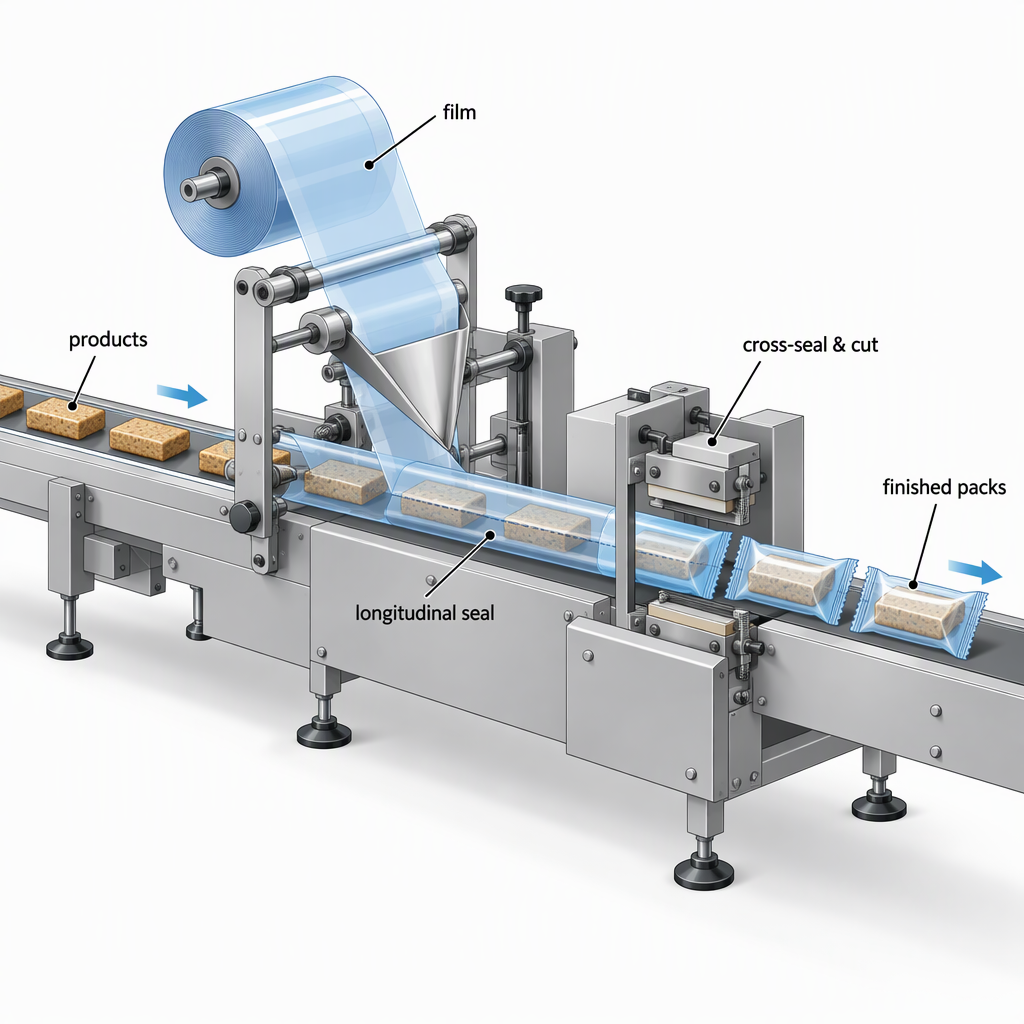
A horizontal flow wrapper is selected for products that can be fed horizontally into film, formed into a pack, sealed and discharged as part of a packaging line. The buying decision should begin with the application conditions, not with a brochure speed or a machine-width comparison.
Start with product fit before choosing a model
Product fit comes first because dimensions, shape, surface condition, grouping and fragility determine whether the wrapper can feed, form, seal and discharge the pack consistently.
For horizontal flow wrapper selection, define the actual saleable unit: single piece, multipack, tray-supported product, stack, irregular item or fragile product. Then describe product length, width, height, weight range, surface friction, tendency to roll, temperature at packing, crumbs or residue, and whether orientation matters.
| Product condition | Why it matters for selection | Buyer check before RFQ |
|---|---|---|
| Stable, regular pieces | Usually easier to space, guide and transfer into the wrapping section. | Provide product size range and required pack orientation. |
| Fragile or deformable products | Handling pressure, transfer gaps and sealing-area clearance become critical. | Ask for product trials with actual samples and reject limits. |
| Grouped or variable products | Spacing, counting and infeed control can decide whether the line runs steadily. | Define the grouping pattern, acceptable misfeed rate and inspection method. |
Translate output into line-balance requirements
Specify output as stable packs per minute with your real product, film, infeed and downstream equipment, rather than treating maximum mechanical speed as the purchasing target.
A wrapper that can cycle quickly may still be limited by manual loading, upstream production rhythm, film registration, seal dwell time, cooling, checkweighing, labelling, cartoning or case packing. Engineers should define the required average output, peak demand, shift pattern, changeover frequency and acceptable scrap during start-up.
| Output question | Selection implication | Practical decision |
|---|---|---|
| Is output limited by product feeding? | The infeed method may matter more than wrapper top speed. | Prioritize spacing control and product transfer trials. |
| Does film or seal require slower running? | Sealing stability can set the real production speed. | Validate seal quality at the intended operating speed. |
| Can downstream equipment receive packs steadily? | Accumulation and discharge design affect total line output. | Confirm discharge height, pack spacing and line-control interface. |
Verify film, package style and sealing needs
Film and sealing choices affect forming, tracking, printed-film registration, sealing temperature, cutting and the final pack appearance.
Before selecting a wrapper, decide whether the package needs center sealing, end sealing, printed film registration, easy-open features, product protection, barrier performance or a specific visual presentation. Do not assume that a film sample that runs on one product will automatically run at the same output on another product.
- Confirm film material, thickness range, roll width, core size and roll outside diameter.
- Define the package style, seal position, bag length range and print-registration requirement.
- Test sealing temperature, pressure, dwell time and cut quality with actual film and product samples.
- Set acceptance criteria for seal strength, appearance, leakage risk, product damage and reject handling.
Match the infeed and handling method to the product
The infeed should be chosen around how the product arrives, how it must be spaced and how much handling it can tolerate before wrapping.
Infeed design is often the difference between a machine that looks correct on paper and a line that runs consistently. Manual placement, conveyor feeding, automatic product transfer and synchronized upstream equipment each create different spacing, guarding and line-control needs.
- Map how the product leaves the upstream process, including orientation, spacing, temperature and accumulation.
- Define whether operators, conveyors or automatic feeders will place the product into the wrapper.
- Check whether guides, pushers, lug chains or timing belts could mark, crush or misalign the product.
- Run sample tests for jams, miscuts, product movement inside the film and damage at transfer points.
- Record changeover requirements if the same line will run multiple product sizes or pack formats.
Check integration with upstream and downstream equipment
A horizontal flow wrapper should be specified as part of the line, including upstream supply, discharge, inspection, coding, counting, cartoning and operator access.
Line integration affects floor layout, conveyor height, electrical interface, pack spacing, reject handling and changeover time. Procurement should ask how the wrapper will communicate with upstream and downstream machines and how stoppages will be handled without damaging products or creating excessive scrap.
- Measure available floor space, access space and the required product-flow direction.
- Confirm upstream supply stability and whether accumulation is needed before the wrapper.
- Define downstream equipment such as printers, labelers, metal detectors, checkweighers, cartoners or case packers.
- Specify pack discharge height, orientation, spacing and reject-handling expectations.
- Ask how recipe changes, film changes and product-size changes will be managed.
Include safety, guarding and acceptance criteria
Safety review should cover guarding, conveyors, access points, blockage-clearing procedures, maintenance access and the acceptance test conditions that prove the line can run safely with the real product.
The UK Health and Safety Executive warns that injuries involving packaging machinery can be severe or fatal and gives examples involving conveyors, guarding, safe systems of work and clearing blockages; buyers can use the HSE packaging machinery guidance as a safety due-diligence reference.
BSI identifies BS EN 415 as a safety-of-packaging-machines series that includes parts for wrapping machines and general requirements, but buyers should confirm the current applicable edition with their safety, compliance or local regulatory team before using any dated edition in a purchase specification.
Prepare the RFQ data checklist
A useful RFQ should give the supplier product samples, film information, output targets, feeding method, package style, line layout, safety expectations and acceptance-test criteria.
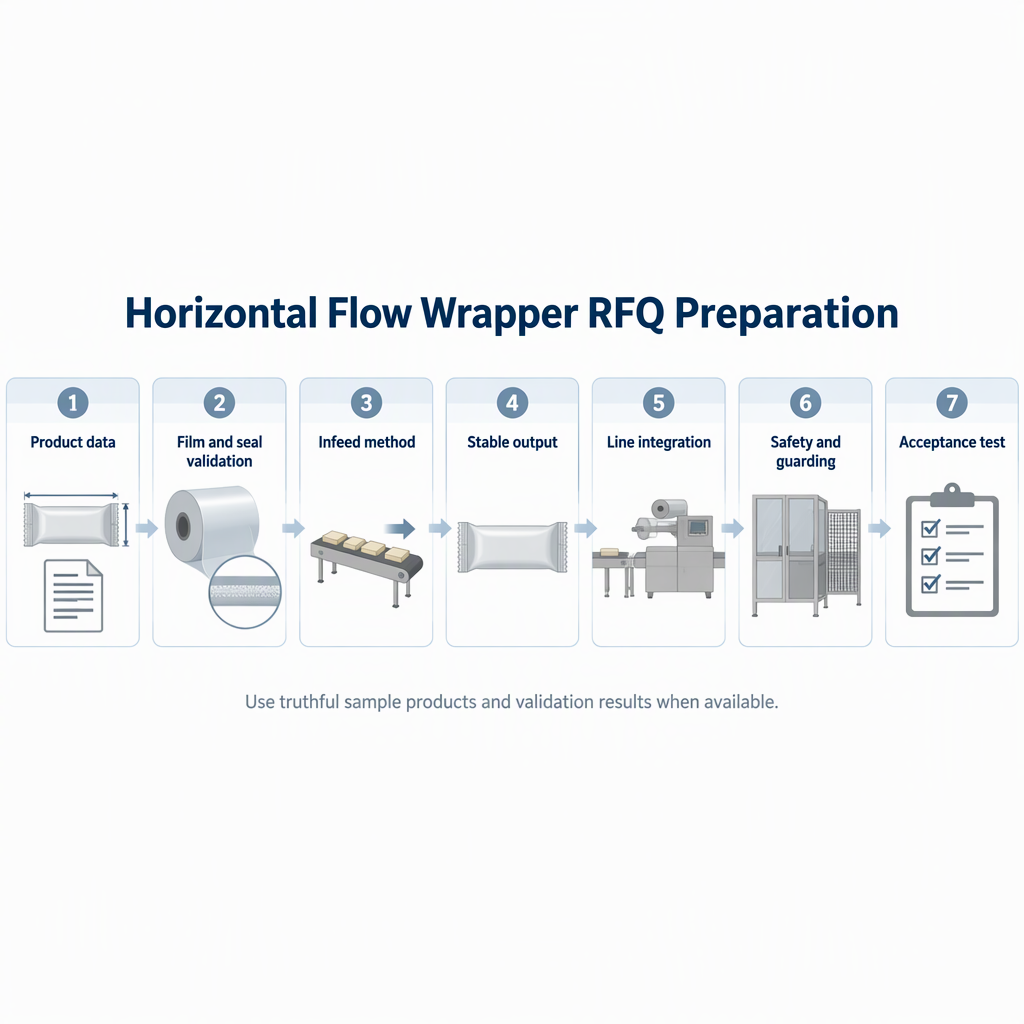
Packaging engineers and procurement teams should send enough information for the supplier to recommend a configuration and identify test risks before pricing discussions. If exact values are not yet fixed, state the range and the decision still open.
- Product list with dimensions, weight range, fragility, surface condition, temperature and orientation requirements.
- Target output in stable packs per minute, shift pattern, changeover frequency and expected product mix.
- Film specification, roll details, printed-film registration needs, seal style and pack appearance requirements.
- Infeed description, upstream equipment, downstream equipment, floor layout and utility constraints.
- Safety requirements, guarding expectations, access limits and procedures for clearing blockages or maintenance access.
- Applicable standards or customer specifications, with current editions confirmed by the buyer’s compliance team.
Avoid common selection mistakes
Most poor selection decisions come from comparing headline machine claims before confirming product handling, film behavior, stable output and line integration.
- Do not choose by maximum speed alone; test stable output with the actual product and film.
- Do not treat film as a late purchasing item; film and sealing conditions affect the machine decision.
- Do not underestimate infeed design, especially for fragile, irregular, sticky or grouped products.
- Do not ignore downstream equipment; the wrapper must discharge packs in a form the next process can accept.
- Do not leave guarding, access and blockage-clearing procedures until installation; include them in selection and acceptance planning.
Conclusion
The right horizontal flow wrapper is the one that proves product fit, stable output, film and seal compatibility, safe operation and line integration under your real production conditions.
Before comparing suppliers, build a short technical brief from samples, drawings, film data, output targets, layout constraints and acceptance criteria. Use quotations to compare how each supplier solves the same application, not just how each brochure describes speed, width or options.
FAQ
These questions help engineering and procurement teams turn horizontal flow wrapper selection into a clearer RFQ and acceptance discussion.
What products are good candidates for a horizontal flow wrapper?
Products that can be fed horizontally, spaced consistently, wrapped in film and sealed without unacceptable damage are typical candidates. Confirm this with real samples, especially when products are fragile, irregular, sticky or grouped.
How should I define output for a quotation?
State the required stable packs per minute, product mix, shift pattern, film type, infeed method and downstream equipment. This is more useful than asking only for maximum machine speed.
Should film be selected before the machine?
Film and machine selection should be checked together because film material, roll format, seal behavior and printed-film registration can affect forming, cutting, sealing and stable output.
Why are sample trials important?
Sample trials help reveal feeding problems, product movement, seal quality, cutting accuracy and discharge issues before a final configuration is agreed.
What safety points should be reviewed before purchase?
Review guarding, conveyor access, sealing and cutting areas, blockage-clearing procedures, maintenance access and energy-isolation requirements. Manual access should occur only after the relevant power or stored energy is disconnected and the approved procedure permits access.
Can I specify BS EN 415 in my purchasing document?
You can use BS EN 415 as a standards-series reference for safety-of-packaging-machines discussions, but confirm the current applicable part and edition with your compliance team, customer specification and local regulatory requirements before placing it in a contract.
What should I send to a supplier before requesting a recommendation?
Send product samples or drawings, film details, pack style, target stable output, infeed conditions, downstream equipment, layout constraints, safety expectations and acceptance-test criteria.


