Views: 0 Author: Wendy Liu Publish Time: 2026-03-13 Origin: Jewshin
Hi, I am Wendy Liu, CEO of Dongguan Jewshin Intelligent Machinery Co., Ltd. When scaling your production line, the labeling process is often the most critical bottleneck. A single mislabeled batch can result in costly recalls, ruined brand reputation, or compliance failures.
For growing businesses, transitioning from manual or semi-automatic processes to a fully automatic labeling machine is a game-changer. Today, sourcing these systems from China offers an unbeatable combination of advanced servo-driven precision and rapid ROI. However, navigating cross-border procurement requires technical know-how. In this guide, I will share insider advice on how to choose the right automatic labeling system, vet reliable Chinese manufacturers, and seamlessly integrate the equipment into your existing conveyor lines.

The demand for automatic labeling machines has surged globally due to rising labor costs and stricter regulatory standards for traceability. While European brands traditionally dominated high-speed labeling, top-tier Chinese manufacturers have completely closed the technological gap.
Sourcing your automatic labeler from China provides several distinct advantages:
Lower Total Cost of Ownership: You can acquire high-performance machines for 30% to 50% less than Western equivalents, allowing you to achieve ROI in months rather than years.
World-Class Components: Reputable Chinese factories build machines using globally standardized parts, such as Siemens programmable logic controllers (PLCs) and Omron sensors. This ensures you can easily source replacement parts locally.
Unmatched Customization: Whether you need a multi-head system for complex cosmetic jars or a high-speed wrap-around labeler for beverage bottles, Chinese engineers excel at customizing machinery to fit your exact floor plan.
Understanding the different variants is crucial for matching the machine to your container shapes and throughput demands.
Designed for cylindrical containers like glass jars, PET bottles, and vials. These machines use rotating belts or star wheels to spin the container while the labeling head applies a full-wrap or partial label.
Best For: Beverages, pharmaceuticals, and cosmetics.
Jewshin Insight: Our JX-T212 Automatic Round Bottle Labeling Machine features adjustable separating wheels, eliminating the need for complex changeover parts when switching between different bottle diameters. It comfortably achieves speeds of up to 200 bottles per minute.
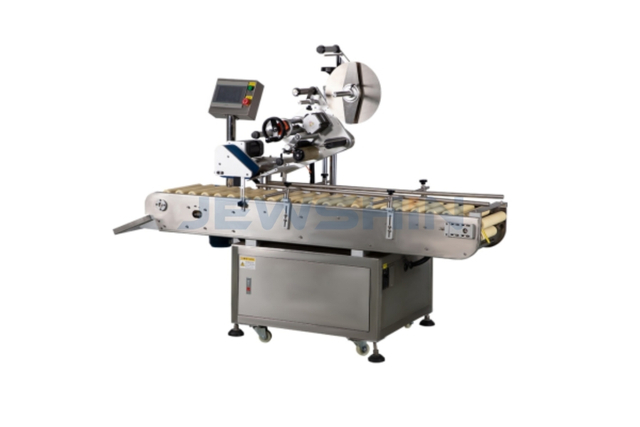
Used for boxes, flat pouches, folded cartons, or lids. These systems apply labels to top or bottom surfaces using tamp-blow or wipe-on mechanisms as the product moves down the conveyor.
Best For: E-commerce fulfillment, food packaging, and electronics.
Jewshin Insight: For high-speed flat labeling, our JX-T115 Automatic Paging & Flat Labeling Machine integrates a friction-feed paging system that automatically separates stacked bags or cards before labeling them with pinpoint accuracy.
These advanced units feature multiple independent labeling stations capable of applying front, back, and neck labels simultaneously in a single pass.
Best For: Shampoo bottles, motor oil containers, and irregularly shaped household goods.
To avoid integration bottlenecks, assess these technical parameters carefully when discussing your project with a supplier:
Labeling Speed (PPM/BPM): Match the machine's speed to your upstream filling machines. An automatic labeler running at 100–300 units per minute is standard for mid-sized operations.
Motor Type: Always insist on servo-driven labeling heads rather than stepper motors. Servo motors provide the high-speed torque required for continuous, ±1.0mm accuracy.
Control System Interface: Look for an English-language Touchscreen HMI. This allows your operators to save "product recipes," reducing changeover times from hours to mere minutes.
Material Construction: Ensure the main frame is constructed from 304 stainless steel and anodized aluminum to meet CE, UL, and FDA compliance standards.

The biggest risk in importing machinery is partnering with a trading company instead of a direct manufacturer, which often leads to terrible after-sales support. Here is how to protect your investment:
Verify Their Factory Status: Look for verified credentials. Jewshin is a proud 4-Year Verified Supplier on Alibaba. This guarantees that independent auditors have verified our manufacturing facilities in Dongguan.
Request Factory Acceptance Testing (FAT): A legitimate manufacturer will ask you to ship your empty containers and label rolls to their facility. We always conduct a live video FAT to prove the machine runs flawlessly with your specific materials before shipping.
Check Spare Parts Availability: Ask your supplier about lead times for wear-and-tear parts like peel plates, belts, and optical sensors. Ensure they provide detailed electrical schematics in English.
Pricing varies based on speed, automation level, and the complexity of the labeling heads. Here is a realistic market breakdown for reliable Chinese-built equipment:
Entry-Level Automatic Round/Flat Labelers: $4,000 – $8,000 (Speeds up to 100 ppm, great for SMEs).
High-Speed Servo-Driven Labelers: $8,000 – $18,000 (Speeds up to 300 ppm, touchscreen PLC, high accuracy).
Complex Multi-Head / Front & Back Systems: $15,000 – $30,000+ (Ideal for asymmetrical bottles or double-sided application).
Choosing the right automatic labeling machine requires balancing performance, integration capabilities, and operational budget. By prioritizing machines with proven servo-driven accuracy and partnering with a manufacturer that offers robust English-speaking support, you can secure an enterprise-grade system that scales with your business.
At Jewshin, we specialize in designing inline automatic labeling systems that eliminate bottlenecks and reduce labor costs. From high-speed round bottle labelers to fully customized double-sided applicators, our engineering team ensures seamless integration into your existing conveyors.
Stop letting manual labeling slow down your growth.
Visit www.jewshin.com to explore our full range of automated solutions, or email me directly at wendy@jewshin.com. Send us your container specifications today, and my team will provide a free technical consultation and machine blueprint tailored to your production line!
Q: Can an automatic labeling machine handle transparent labels?
A: Yes, but standard optical sensors cannot detect clear labels on a clear liner. You must specify this requirement so we can equip your machine with a specialized ultrasonic label sensor.
Q: Will an automatic labeler connect to my existing conveyor belt?
A: Absolutely. Our machines are designed with adjustable heights and standard I/O communication protocols, allowing them to dock seamlessly with your existing fillers, cappers, or packaging conveyors.
Q: What maintenance is required for these machines?
A: Daily maintenance involves simply wiping down the sensors and traction rollers with alcohol to remove adhesive residue. Moving parts require standard lubrication every few months.
Q: Do you provide installation and training for overseas buyers?
A: Yes. We provide comprehensive English-language manuals, setup videos, and one-on-one video call support with our engineers to guide your local technicians through the installation process.
Q: How do I prevent labels from wrinkling on curved surfaces?
A: Wrinkling is usually caused by poor label tension or the wrong wipe-down mechanism. We mitigate this by using high-quality servo motors for consistent tension and customizing the secondary pressing brushes/belts to match your exact bottle contour.