Views: 0 Author: Wendy Liu Publish Time: 2026-03-22 Origin: Jewshin
If you are planning to buy a Flat Labeling Machine from China, you are looking for a practical way to improve labeling accuracy, increase production speed, reduce manual labor, and create a more professional, consistent product appearance. In many packaging operations, labeling is not simply a finishing step—it is a core part of product identification, regulatory compliance, branding, and traceability.
A Flat Labeling Machine applies self-adhesive labels to the top or flat surface of products including boxes, trays, pouches, cards, books, lids, and many other flat or semi-flat items. But the right machine depends on far more than label size. The key factors are your product shape, production speed, required placement accuracy, feeding method, and whether your application demands millimeter-level precision or high-speed throughput. In this buyer's guide, I will explain how to choose the best Flat Labeling Machine, what technical factors really matter, and how to compare suppliers from China more effectively.

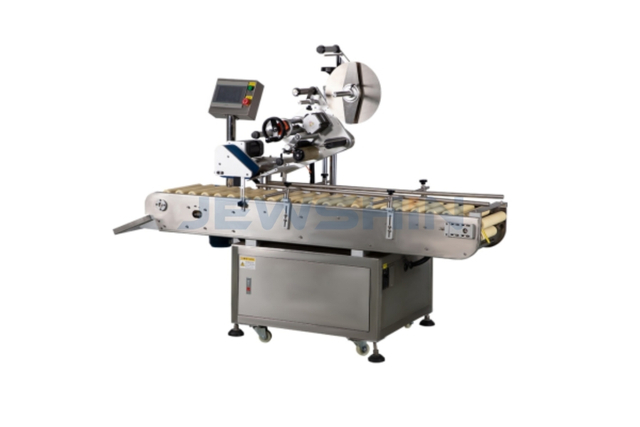
A Flat Labeling Machine applies self-adhesive labels to the top or flat surface of products as they move through—or are manually presented to—a labeling station. Depending on the application, the label may be applied by a roll-on conveyor method (for continuous automatic production) or a suction pick-and-place method (for precision applications where exact label position is critical).
Typical machine functions include product conveying or manual presentation, product separation, label feeding and dispensing, label application and pressing, optional coding integration, and missing-label detection. These machines are widely used for cartons, paper boxes, food trays, flat pouches, cosmetic boxes, medicine boxes, stationery, electronics packaging, blister packs, and printed cards.
At Jewshin, our Flat Labeling Machine lineup covers three distinct labeling architectures—each engineered for a different accuracy level, product type, and production scale. Choosing the right model depends on your product, label, and precision requirements.
Best for: High-speed automatic labeling of stackable flat items
The JX-T115 Automatic Paging & Flat Labeling Machine (For Cards & Cartons) is our flagship automatic flat labeler, designed to eliminate manual feeding entirely. Simply load a stack of cards, unfolded cartons, plastic bags, or tags, and the machine's Reverse Wheel Paging Technology separates them one by one onto the conveyor for bubble-free label application.
Key technical specifications:
Parameter | Details |
Labeling Accuracy | ±1.0 mm |
Standard Speed | 30–70 pcs/min (up to 200+ pcs/min for specific applications) |
Product Size Range | L: 40–280mm / W: 40–200mm |
Product Thickness | 0.2mm – 2.0mm (cards and sheets) |
Label Size | L: 20–130mm / W: 20–280mm |
Control System | Panasonic PLC + Touchscreen |
Dimensions | 2200 × 700 × 1450 mm |
Weight | ~250 KG |
Core components: Panasonic PLC (Japan), Leuze Sensors (Germany), Kunlun Tongtai Touchscreen.
Why choose the JX-T115?
Anti-double-feed Reverse Wheel Paging: Prevents two items sticking together during separation—eliminating the most common jam cause in flat labeling of thin items.
200+ pcs/min capability for pharmaceutical carton coding, small card labeling, and high-volume stationery operations.
No-Object-No-Label and automatic label length calibration protect against wasted labels and empty cycles.
Top pressing roller flattens warped or curling items during transport, ensuring consistent bubble-free label adhesion.
6-DOF (6 Degrees of Freedom) adjustment mechanism allows fast size changeover between different card and carton formats in minutes.
Replaces 3–5 manual workers in a single shift.
Ideal applications: Pharmaceutical flat carton coding, scratch cards, greeting cards, postcards, notebook covers, phone screen protectors, PE bags, PCB boards, clothing hang tags, apparel packaging bags.

Best for: Small, high-value items where ±0.2mm accuracy is non-negotiable
The JX-T303 High-Precision Semi-Auto Flat Labeling Machine (±0.2mm) is the "Pro" version of flat labeling—engineered specifically for applications where standard ±0.5mm accuracy is not acceptable. Using a suction pick-and-place method with German Leuze sensors and a Delta PLC + Leadshine micro-stepping motor combination, the JX-T303 achieves an industry-leading ±0.2mm placement accuracy.
Key technical specifications:
Parameter | Details |
Labeling Accuracy | ±0.2 mm (Ultra-Precision) |
Labeling Speed | 10–20 pcs/min |
Applicable Product Size | L: 20–200mm |
Applicable Label Width | 10–65mm |
Control System | Delta PLC + Delta Touchscreen |
Machine Dimensions | 550 × 430 × 830 mm (Compact tabletop) |
Voltage | AC 220V / 50–60Hz |
Core components:
Component | Brand | Origin |
Label Sensor (Electric Eye) | Leuze | Germany |
PLC Controller | Delta | Taiwan |
Touchscreen | Delta | Taiwan |
Stepper Motor & Driver | Leadshine | High-Performance |
Cylinders | CHELIC / Stars | Taiwan |
Why choose the JX-T303?
±0.2mm suction pick-and-place accuracy—far beyond what roll-on labelers can deliver—is essential for electronics, cosmetics, and precision hardware.
The vacuum suction head picks the label and places it exactly on the product. Unlike roll-on application, this method also works on concave, recessed, or curved surfaces by changing the custom jig.
Circuit separation keeps electrical and pneumatic circuits isolated, preventing moisture-induced damage in humid factory environments.
Brake function maintains perfect label tape tension, ensuring every label gap is detected accurately.
Custom jigs can be designed for irregularly shaped products.
Ideal applications: SD/TF cards, USB drives, phone batteries, PCB boards, chargers, lipstick bottoms, mascara caps, small compact powder cases, precision tools, bearing seals, small gift jewelry boxes.
Best for: Small-to-medium production requiring high precision at an accessible investment
The Semi-Automatic Flat Surface Labeling Machine (JX-T301) delivers ±0.5mm precision using the same suction pick-and-place principle as the JX-T303, but in a compact tabletop format with manual product loading—making it the ideal entry point for smaller operations that need reliable precision without full automation cost.
Key technical specifications:
Parameter | Details |
Labeling Accuracy | ±0.5 mm |
Labeling Speed | 10–25 pcs/min (dependent on manual loading) |
Applicable Product Size | L: 20–200mm |
Applicable Label Length | 10–100mm |
Control System | Delta PLC + Delta Touchscreen |
Motor System | Leadshine Stepper Motor & Driver |
Machine Dimensions | 850 × 430 × 770 mm |
Label Sensor | DataSensor (High sensitivity) |
Why choose the JX-T301?
Dual operation modes: Sensor Mode (automatic detection) or Pedal Mode (manual foot switch)—operators choose based on workflow preference.
Adjustable stroke height allows the machine to switch between tall and short products without complex fixture changes.
Air purification in the pneumatic system removes moisture before it reaches internal components—significantly extending machine service life in humid manufacturing environments.
Optional ribbon coder or inkjet printer integration for printing batch numbers and expiry dates directly onto the label before application.
Supports concave, arc, and irregular surfaces by changing jigs—making one machine versatile across multiple product lines.
Ideal applications: Cosmetic compact cases, flat shampoo bottles, cream jar lids, phone batteries, SD cards, power adapters, food and pharma box packaging, blister packs, square tin cans, notebooks, folders.
The single most important selection criterion is your required labeling accuracy:
Required Accuracy | Recommended Model |
±1.0 mm — Standard retail/consumer cartons, cards | JX-T115 (Automatic, high-speed) |
±0.5 mm — Cosmetics, food packaging, small boxes | JX-T301 (Semi-auto, precision) |
±0.2 mm — Electronics, chips, precision components | JX-T303 (Ultra-precision, semi-auto) |
For retail cartons and printed cards, ±1.0mm is acceptable and the JX-T115's automatic paging feeding adds major productivity. For electronics where even 0.5mm of label offset looks wrong on a small surface, only the JX-T303's ±0.2mm suction method will meet brand standards.
Stackable flat items (cards, flat cartons, hang tags, PCB boards): The JX-T115's Reverse Wheel Paging Technology is specifically built for this product category—eliminating manual one-by-one feeding entirely.
Small individual items (electronics, cosmetics caps, compact cases): The JX-T303 and JX-T301's suction pick-and-place method handles these precisely.
Concave, curved, or irregular surfaces: The JX-T303 and JX-T301 both support custom jig changes for non-flat application surfaces.
Never select a labeler based on product category name alone. Provide product samples to your supplier for a physical test.
Define label length, width, shape, label material, backing paper specification, required placement position, and acceptable tolerance. For applications requiring label registration with printed graphics (e.g., aligning a label within a pre-printed border), the JX-T303's German Leuze sensor provides the most reliable detection performance for transparent or very small labels.
The JX-T115 reaches 30–70 pcs/min standard, with up to 200+ pcs/min for thin card applications. The JX-T303 and JX-T301 operate at 10–25 pcs/min due to their precision suction mechanics. Higher throughput and ultra-high accuracy operate on a trade-off—define which is more critical for your application before selecting a machine.
In many operations, labeling must connect with date coding, batch printing, or downstream inspection. The JX-T301 supports optional ribbon coder or inkjet printer integration for printing batch and expiry information directly onto the label before placement. For complete packaging line integration, Jewshin's labelers connect naturally with our Flat Labeling Machine, Automatic Carton Sealers, and Palletizing Systems.
Machine price is only one part of the investment. Consider: installation, spare parts, label waste, reject rate, downtime risk, and future upgrade flexibility. A machine that produces consistent ±0.2mm placement accuracy on every cycle eliminates the rework cost and brand damage that comes from misaligned labels on high-value products.
Choosing only by speed: High speed is operationally worthless if label placement is inconsistent or product feeding jams frequently.
Ignoring surface type: Concave, curved, or irregular surfaces require a suction pick-and-place machine (JX-T303 or JX-T301) with a custom jig—not a standard roll-on labeler.
Underestimating label quality influence: Inconsistent backing paper or poor label roll quality directly affects sensor detection and placement consistency regardless of machine quality.
Not requesting a sample test: All three Jewshin flat labeling machines can be tested with your actual product and label. Never purchase a labeling machine without this verification step.
Forgetting coding integration: If batch number or expiry date printing is required, confirm integration capability before finalizing the purchase.
Product details: Photos, dimensions (L × W × H), weight, material, surface condition (flat, concave, curved, irregular), product rigidity.
Label details: Label size, shape, material, backing paper specification, placement position, tolerance, roll direction.
Production details: Target speed, daily output, number of SKUs, manual or automatic feeding preference, current line structure.
Additional requirements: Coding integration, vision inspection, rejection system, conveyor connection, downstream packaging line expansion.
What is the difference between the JX-T115, JX-T303, and JX-T301?
The JX-T115 is fully automatic with Reverse Wheel Paging for stackable items—best for high-speed card and carton labeling. The JX-T303 is a semi-auto ultra-precision labeler at ±0.2mm using suction pick-and-place—best for electronics and small high-value items. The JX-T301 is a semi-auto ±0.5mm suction labeler—best for small-to-medium operations needing reliable precision at an accessible investment.
Can these machines label products with irregular or concave surfaces?
Yes. The JX-T303 and JX-T301 both use a suction pick-and-place method that, combined with a custom-designed jig, can label concave, arc, and irregular surfaces accurately.
How fast can the JX-T115 run?
Standard operation is 30–70 pcs/min, with up to 200+ pcs/min achievable for specific applications such as pharmaceutical carton coding or small thin card labeling.
Can the JX-T301 print batch numbers and expiry dates on labels?
Yes. The JX-T301 supports optional ribbon coder or inkjet printer integration, allowing batch and expiry information to be printed on the label immediately before application.
Why do the JX-T303 and JX-T301 use separated electrical and pneumatic circuits?
This design prevents moisture in the compressed air system from migrating into the electrical cabinet—a common cause of premature component failure in humid factory environments. It significantly extends machine service life.
If you are looking for the right Flat Labeling Machine for your packaging operation, our team at Jewshin is ready to help you identify the ideal solution based on your product, label, and accuracy requirements.
Jewshin — Dongguan Jewshin Intelligent Machinery Co., Ltd.
Website: www.jewshin.com
Email: wendy@jewshin.com
WhatsApp: +86-13128136672
Send us your product samples and label specifications—we will test the labeling effect and confirm the right model for your application before you make any commitment.