Views: 0 Author: Wendy Liu Publish Time: 2026-03-22 Origin: Jewshin
For skincare and personal care manufacturers, packaging is far more than a production step. It is a direct expression of brand value, product positioning, and customer experience. A cream jar with inconsistent fill levels signals poor quality control. A lotion bottle with a leaking or crooked cap undermines consumer confidence. A premium skincare box with a misaligned label damages brand image before the customer even opens the product.
This is why experienced buyers search for a complete cosmetic filling and packaging line solution—not just a single filling machine or labeler. In real cosmetic production, packaging involves multiple linked processes: container feeding, filling, cap placing, capping, sealing, labeling, coding, cartoning, case packing, and palletizing. Getting any one of those steps wrong creates a quality or efficiency problem that affects the entire line. In this guide, I will walk through the most common packaging challenges for skincare products, the recommended line configuration, and the key factors buyers should evaluate before selecting a supplier.

This type of packaging line is most directly relevant to:
Facial cream, moisturizer, and body cream manufacturers
Lotion, serum, and essence producers
Skincare OEM and ODM contract factories
Private label cosmetic manufacturers
Personal care packaging companies
Beauty brands transitioning from semi-manual to automatic production
Cosmetic gift set and skincare set packers
It is especially useful for companies packaging products such as: face cream, body butter, moisturizing cream, lotion, serum, essence, skin gel, toner in bottle format, and multi-product skincare sets with secondary carton presentation.
If your production currently experiences inconsistent fill levels, cap alignment issues, poor label positioning, or labor-intensive manual cartoning, this solution addresses those specific pain points.
Before specifying any machine, it is worth understanding why cosmetic products create unique packaging challenges that standard liquid or food packaging lines cannot always solve.
For cream jars and transparent serum bottles, the fill level is visible to the consumer. An inconsistent fill level—even one that is technically within regulatory weight tolerance—creates a poor impression in a product category where perceived premium quality is everything. Stable, repeatable volumetric accuracy is not optional in cosmetic filling—it is a brand requirement.
Different skincare products behave very differently during filling:
Thick creams and body butters are dense and semi-solid—they require filling mechanisms that can displace high-viscosity product without entrapping air
Lotions flow more freely but still require controlled dosing and clean nozzle shut-off
Serums and essences are low-viscosity, low-volume, and high-value—they require higher volumetric precision at small fill amounts
Gels can trap bubbles during filling, creating visible surface defects in clear containers
A single machine configuration cannot optimally fill all four product types. This is why the filling method must always be selected based on the actual product sample.
Cosmetic packaging demands cleanliness at every station. Product residue on jar edges, bottle shoulders, or outer surfaces affects cap sealing integrity, label adhesion quality, and retail presentation—and creates a hygiene standard issue in professional cosmetic manufacturing environments.
In the cosmetic category, consumers and retail buyers judge packaging quality immediately and visually. Buyers should specify:
Label placement accuracy and alignment tolerance
Cap alignment and tightening consistency
Scratch-free container handling throughout the line
Carton presentation quality for retail shelf display
A machine that meets mechanical performance standards but produces inconsistent labeling or cap alignment will still fail cosmetic brand requirements.
Cosmetic OEM and ODM factories typically handle multiple brands, seasonal ranges, limited editions, and trial sizes simultaneously. The packaging line must handle multiple container shapes, cap types, label formats, and carton sizes—with fast, practical changeover between them. Flexibility is not a bonus feature in cosmetic production. It is a core operational requirement.
Standard cosmetic closures include screw caps, pump caps, disc caps, dropper assemblies, inner plugs, and decorative outer caps. Each type requires a completely different cap feeding, assembly, and tightening mechanism. Pump caps and dropper assemblies, in particular, add significant complexity that buyers should plan for explicitly—not discover after installation.
Most retail skincare products require not only a labeled bottle or jar, but also a printed carton (with leaflet insertion), outer case packing for logistics, and palletized shipping preparation. If the line is not designed for integration across primary and secondary packaging, manual cartoning typically becomes the new bottleneck immediately after filling automation is added.
A complete automatic cosmetic packaging line typically includes the following modules, scaled and configured based on production volume, product type, and automation level.
The line begins with container orientation and infeed. Options include:
Automatic bottle or jar unscrambler for high-volume continuous production from bulk containers
Semi-automatic rotary collecting table for smaller operations or when containers require careful manual feeding (e.g., delicate glass jars or acrylic luxury packaging)
Conveyor system with adjustable guide rails for smooth product flow and stable container spacing through all downstream stations
For premium cosmetic packaging with glass or high-end acrylic containers, container handling design must prioritize surface protection to prevent scratches or contact marks that would devalue the product before it reaches the consumer.
The filling machine is the most critical station in the line, and the correct selection depends entirely on the specific product.
For viscous products — creams, body butters, thick lotions, dense gel:
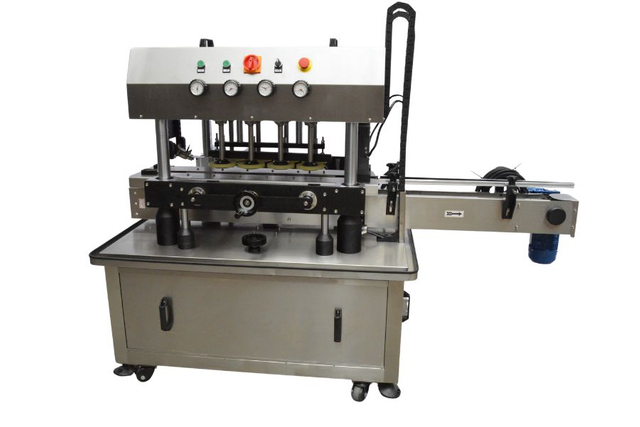
A piston filling machine is the preferred method because it uses controlled volume displacement—drawing a precise measured volume into the piston cylinder and dispensing it accurately into the container. This mechanism handles high-viscosity products reliably without air entrainment and maintains consistent fill accuracy regardless of product density variation.

The RF-GZ6T Automatic Piston Liquid & Paste Filling Machine is Jewshin's filling solution for viscous cosmetic products, with the following key capabilities relevant to skincare applications:
Parameter | RF-GZ6T Details |
Filling Accuracy | < ±1% |
Filling Range | 100–1,000 ml (customizable) |
Anti-Drip Nozzles | Yes — with wire-drawing prevention |
No-Jar-No-Fill | Yes — Keyence sensor protection |
Quick-Strip Design | Tool-free disassembly for hygienic cleaning |
Volume Adjustment | One-touch via Weinview touchscreen |
Nozzle Configurations | 2, 4, 6, 8, or 12 heads |
PLC | Mitsubishi (Japan) |
For lower-viscosity products — thin lotions, toners, serums, liquid essences:
Pump filling or peristaltic filling systems may provide better accuracy at small fill volumes typical of serum and essence packaging. The correct method for low-viscosity, high-value products should always be confirmed with actual product samples rather than assumed by product name.
After filling, containers move to cap handling. The capping system must be specifically matched to your closure type:
Standard screw caps: Automatic cap feeder with rotary or in-line screw capper and adjustable torque control
Pump caps: Pump cap assembly and press-down tightening system—requires specific cap orientation and seating mechanism
Disc caps and snap caps: Pressing mechanism with controlled force application
Dropper assemblies: Requires dropper insertion before outer cap tightening—more complex feeding and assembly logic
For cosmetic packaging, cap tightening torque must be precisely controlled—too loose creates leakage risk during shipping; too tight damages decorative caps or creates consumer difficulty opening the product. Always provide actual cap and bottle samples for torque testing before finalizing capper specifications.
For products requiring additional protection, freshness preservation, or tamper-evident presentation:
Inner cap or liner insertion before outer cap assembly
Aluminum foil induction sealing for products requiring hermetic sealing against moisture, oxidation, or contamination—common in premium serums and high-value skincare
Tamper-evident structure for regulated markets or brand anti-counterfeiting requirements
Induction sealing is increasingly common in premium skincare because it signals to the consumer that the product has not been opened—an important brand trust element for higher-priced products.
Cosmetic packaging often requires two distinct types of labeling—one for the primary container (bottle or jar) and one for secondary packaging (carton top or flat outer surface). Jewshin offers specific machines for each application:
For round cosmetic bottles and lotion jars:
The JX-T212 Automatic Round Bottle Labeling Machine applies full wrap-around labels, front-and-back dual labels, and supports tapered (conical) bottle labeling via a 6-axis adjustment mechanism—making it the correct choice for the wide range of cylindrical and tapered bottle formats common in skincare.
Key features directly relevant to cosmetic labeling:
Star Wheel Separation for stable bottle feeding—critical for consistent label placement on premium branded bottles
Front & Back dual labeling in one pass: Applies brand label and ingredient/regulatory label simultaneously without repositioning
Conical bottle support: Adjustable header tilt angle handles tapered lotion bottles, serum bottles, and certain jar formats without wrinkles
Circumferential positioning (optional): Aligns labels to a specific point on the bottle—useful for bottles with embossed logos or design registration requirements
GMP construction: 304 stainless steel and aluminum alloy for cleanroom-compatible cosmetic production environments
For cream jar lids and flat secondary packaging surfaces:
The JX-T115 Automatic Paging & Flat Labeling Machine applies labels to the top surface of jar lids, folded cartons, and flat packaging materials—handling stackable flat items automatically via its Reverse Wheel Paging Technology at 30–70 pcs/min standard, up to 200+ pcs/min for high-volume applications.
For cosmetic jar lid labeling, the JX-T115's ±1.0mm accuracy and anti-double-feed paging ensure consistent, centered label placement—a visible quality signal on premium skincare jar presentation.
For precision labeling of small cosmetic accessories (lip balm tubes, mascara, compact cases, eye cream ampoules):
The JX-T303 Ultra-Precision Semi-Auto Flat Labeling Machine delivers ±0.2mm suction pick-and-place accuracy—essential for small-format luxury cosmetic items where even minimal label offset is visible and unacceptable.

Regulatory requirements across all major cosmetic markets mandate expiry date and batch number coding on finished products. Integration options include:
Inkjet coder on the bottle, jar base, or carton surface—fastest and most flexible for production line integration
Thermal transfer printer for printing onto labels before application—common for premium cosmetics requiring high-resolution batch data on labels
Serialization support for regulated markets or brand authentication applications
Most retail skincare products require secondary packaging: a printed carton that protects the primary container, communicates regulatory information, and creates the shelf display presentation.
An automatic cartoning machine integrates downstream of labeling to:
Erect flat carton blanks automatically
Insert the filled, labeled bottle or jar
Insert product leaflets or instruction cards
Close and seal the carton (tuck-in or hot melt glue format)
Apply batch code to the carton outer surface
For cosmetic OEM and ODM factories managing multiple brands with different carton formats, cartoning machine flexibility—adjustable for different carton sizes and easy carton blank changeover—is a primary purchasing criterion.
For manufacturers packing finished cosmetic cartons into shipping cases, the SAE500T Vertical Box Opening, Packing & Sealing Machine integrates case erecting, product loading, and carton sealing in a single compact vertical unit—saving approximately 50% of the floor space required by traditional modular case packing setups.
For cosmetic case packing specifically:
Handles boxed cosmetic cartons securely with fully customizable clamps designed for each product geometry
6–10 cases per minute with dual servo product feeding for stable, accurate carton placement
Accommodates multiple carton size ranges (L: 250–500mm, W: 150–400mm, H: 150–400mm) with recipe-based changeover—ideal for OEM factories packing multiple brands
INOVANCE absolute value servo control with OMRON/Leuze photoelectric detection and SKF bearings for long-term industrial reliability
12mm acrylic glass safety guarding with intelligent door interlock—meeting international machine safety standards
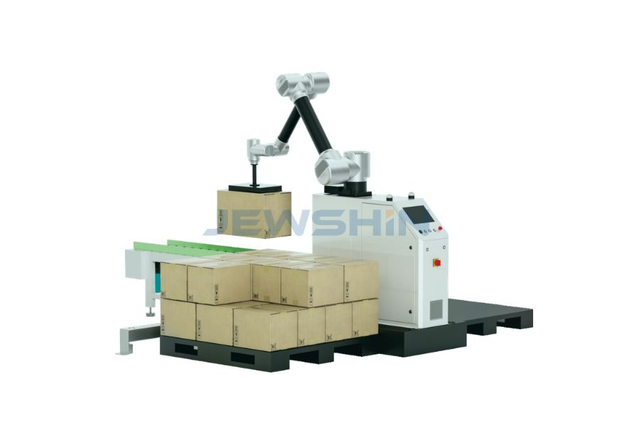
At the end of the line, the Collaborative Cobot Palletizer stacks sealed shipping cases onto pallets for warehouse storage and outbound logistics.
The Jewshin cobot palletizer series is specifically listed for Daily Chemicals & Cosmetics as a primary industry application, and offers:
Payload range: 20 KG to 60 KG across 6 models (Pro and Max series)
Minimum footprint: 1,505 × 1,716mm—deployable in most existing production areas
±0.04mm repeat positioning accuracy for consistent, stable pallet stack quality
30-minute operator mastery—graphical programming without specialist coding knowledge
TCP/IP integration for seamless connection with upstream case sealer and other line equipment
A full automatic cosmetic filling and packaging line follows this sequence:
Container Unscrambler / Infeed
         ↓
Filling Machine (Piston / Pump / Peristaltic)
         ↓
Cap Feeder + Capping Machine
         ↓
Inner Plug / Induction Sealer (if required)
         ↓
JX-T212 Round Bottle Labeler (bottles)
JX-T115 Flat Labeler (jar lids / carton top)
         ↓
Inkjet Coder / Thermal Transfer Printer
         ↓
Cap / Label / Fill Level Inspection (optional)
         ↓
Automatic Cartoning Machine
         ↓
SAE500T All-in-One Case Packer
         ↓
Cobot Palletizer
         ↓
Stretch Wrapper → Dispatch
Staged investment is common and practical in cosmetic manufacturing. Many manufacturers build the line in phases:
Stage | Modules | Primary Benefit |
Stage 1 | Filling + Capping | Accuracy and consistency over manual |
Stage 2 | + Labeling + Coding | Brand presentation and traceability |
Stage 3 | + Cartoning | Secondary packaging automation |
Stage 4 | + Case Packing + Palletizing | Full end-of-line labor reduction |
This staged approach allows cosmetic brands and OEM factories to automate where the immediate quality and labor cost pressure is highest, then expand systematically as output and margins grow.
Before any equipment specification begins, clearly define:
Is the product a cream, lotion, serum, gel, or essence? How does it flow at room temperature?
What is the fill volume range across all current SKUs?
Is the product bubble-sensitive? Does it foam during dispensing?
Does the product contain any particles (exfoliating beads, botanical particles)?
What cleaning method is required between product changeovers?
Provide: jar or bottle photos, all dimensions, material (glass, PET, PETG, acrylic), neck finish, container opening size, fill volume range, and cap or closure type with photos. Cap type is consistently the most underspecified element in cosmetic line inquiries—and incorrect cap-to-capper matching creates production problems that are expensive to resolve after installation.
Specify clearly: label placement accuracy requirement (±mm), cap alignment tolerance, acceptable surface quality standard, and carton presentation quality for retail use. In cosmetic production, appearance standards should be documented and shared with the supplier before machine selection—not assumed to be understood as a generic "premium" requirement.
For OEM and ODM factories, document the full range of container sizes, cap types, label formats, and carton formats that the line must handle. Confirm changeover time estimates for each major format transition. A line that handles 10 SKUs with 30-minute changeovers between them provides very different real daily output than a line designed for 2 SKUs only.
Clarify explicitly: Is cartoning required? Is leaflet insertion needed? What case pack format and quantity apply? Is palletizing manual or automated? Planning secondary packaging from the start prevents the common scenario where a well-functioning filling and labeling line is immediately bottlenecked by manual cartoning.
A cosmetic OEM or ODM factory rarely runs one product on one container in one format. The reality of contract manufacturing includes multiple client brands, seasonal packaging launches, promotional sets, trial sizes alongside full retail sizes, and export variants with different labeling requirements.
For this production reality, line flexibility creates direct commercial value:
Shorter changeover time means more orders can be processed per day
Compatible format range means fewer cases where a client project is declined due to equipment incompatibility
Recipe-based digital adjustment means operator changeover skill level is less critical
Modular line design means capacity can be added at specific bottleneck points without replacing the entire system
At Jewshin, we consistently find that OEM factory buyers who specify flexibility requirements upfront—with actual data on their SKU range, container size variation, and changeover frequency—end up with lines that deliver measurably better equipment utilization than those who specify only for the current highest-volume product.
Specifying the filling machine by product category alone: "Face cream" describes products ranging from very thin emulsions to dense, near-solid balms. The filling method for each is different. Always confirm with real product samples.
Ignoring appearance detail in the specification: Telling a supplier "we need premium quality" is not a specification. Provide actual label placement tolerance, cap alignment standards, and surface finish expectations in measurable terms.
Underestimating closure complexity: Pump caps, dropper assemblies, and decorative outer caps each require specific handling systems. Provide actual cap samples early in the specification process.
Optimizing only the filling station: A poorly specified labeling station, capping system, or cartoning machine will limit the entire line to its weakest step—regardless of how well the filling machine performs.
Not planning for cartoning from the start: Manual cartoning is typically the first bottleneck that appears after filling and labeling are automated. Designing the line to accept a cartoning machine later—even if not purchased initially—avoids expensive layout modifications.
Product information: Product type (cream/lotion/serum/gel), viscosity description, fill volume range, bubble sensitivity, cleaning method, sample availability.
Container information: Jar or bottle photos, dimensions (H × diameter or H × L × W for non-round), material, neck finish, opening size, fill volume.
Closure information: Cap or pump photos, cap dimensions and type, thread specification, inner plug or induction sealing requirement, decorative outer cap structure.
Production requirements: Target speed (containers per minute), daily output target, number of SKUs and container formats, changeover frequency, available factory floor space.
Additional requirements: Labeling type and accuracy requirement, coding format, inspection system, cartoning with or without leaflet, case packing format, palletizing, preferred automation level and investment staging plan.
Can one line handle both cream jars and cosmetic bottles?
In many cases, yes—but the practical answer depends on the container size range, cap type differences, label format variation, and required speed across both formats. A well-designed flexible line can handle both, but the configuration must be specified with the full range of containers and closures in mind from the start. A supplier who asks to see your complete container and SKU range before answering this question is giving you a more honest and useful answer.
What filling method is best for face cream and body cream?
Piston filling is most commonly used for semi-viscous and viscous cream products because it handles high-viscosity materials reliably and delivers stable volumetric accuracy. The specific piston filler configuration—nozzle diameter, cylinder size, valve design—must be matched to the actual product viscosity and fill volume. Always confirm with actual product samples.
How important is labeling accuracy in cosmetic packaging?
Extremely important. In cosmetic retail, label alignment is a direct visual quality indicator that consumers and retail buyers evaluate immediately. The JX-T212 Round Bottle Labeler delivers consistent label placement with Star Wheel bottle separation for inline automatic production, while the JX-T303 delivers ±0.2mm suction pick-and-place accuracy for small precision cosmetic accessories where even 0.5mm of offset is visually apparent.
Is this solution suitable for cosmetic OEM/ODM factories?
Yes—and OEM and ODM factories often benefit most from a well-designed flexible line because they handle the widest range of product types, container formats, and brand requirements. The key is specifying the complete range of formats the line must handle upfront, not optimizing only for the current highest-volume SKU.
What after-sales support is available for international buyers?
Jewshin provides English technical documentation, remote video commissioning support, operator training guidance, and international spare parts supply. The RF-GZ6T's Mitsubishi PLC, Keyence sensors, and AirTac pneumatics are globally available standard components, minimizing spare parts procurement difficulty in any market. The JX-T212 and JX-T115 labelers are similarly built on globally sourced standard electrical components.
If you are building or upgrading a cosmetic filling and packaging line for cream jars, lotion bottles, serum containers, or skincare sets, our team at Jewshin is ready to help you design the right configuration from filling through palletizing—matched to your actual products, containers, and brand standards.
Jewshin — Dongguan Jewshin Intelligent Machinery Co., Ltd.
Website: www.jewshin.com
Email: wendy@jewshin.com
WhatsApp: +86-13128136672
Send us your product samples, container photos, cap specifications, and production requirements—and we will provide a free customized cosmetic packaging line configuration proposal based on your actual application needs.