Views: 0 Author: Wendy Liu Publish Time: 2026-03-22 Origin: Jewshin
If you are planning to buy a Palletizing Machine from China, you are looking for a more efficient way to automate end-of-line handling, reduce manual labor, improve stacking consistency, and increase overall packaging line productivity. In many factories, palletizing is one of the most labor-intensive and repetitive operations—and it frequently becomes the throughput bottleneck when upstream production output grows but end-of-line handling remains manual.
A well-selected Palletizing Machine arranges finished products such as cartons, bags, cases, trays, or bundles onto pallets in a defined stacking pattern—improving workplace safety, stabilizing shipping quality, and supporting faster, more reliable logistics operations. However, the best palletizer is not simply the fastest robot or cheapest machine. The right solution depends on your product type, pack stability, stacking pattern, line speed, pallet size, floor layout, and future automation plan. In this buyer's guide, I will explain how to choose the best Palletizing Machine, what technical and commercial factors matter most, and how to compare suppliers from China more effectively.

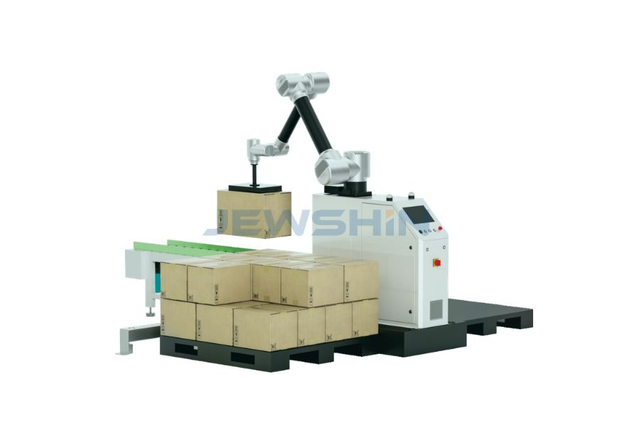
A Palletizing Machine is an automated system that arranges packaged products onto pallets according to a programmed stacking pattern. It may be a conventional mechanical palletizer, a robotic palletizer, or a collaborative palletizer (cobot palletizer)—each suited to different output volumes, flexibility requirements, and floor space constraints.
Typical palletizing functions include product infeed, product orientation, layer formation or pick-and-place handling, pallet positioning, stack building, slip sheet insertion, full pallet discharge, and optional stretch wrapping integration. These systems serve food and beverage, household chemicals, pharmaceuticals, 3C electronics, cosmetics, printing and post-press, agriculture, and consumer goods manufacturing.
At Jewshin, our palletizing solution is the High-Efficiency Collaborative Palletizing Machine (Cobot Palletizer)—a flexible, compact, easy-to-program cobot palletizing system engineered for modern production facilities that need real automation without the cost, complexity, or footprint of traditional industrial robot cells.
We offer six models across two series—Pro and Max—covering payload capacities from 20 KG to 60 KG and working radii from 1,600mm to 1,900mm:
Model | Robot Load | Working Radius | Palletizing Speed | Power | Equipment Height |
JX-GD20pro | 20 KG | 1,900 mm | < 12 pcs/min | 2.3 KW | 3.0 m |
JX-GD30pro | 30 KG | 1,900 mm | < 12 pcs/min | 3.3 KW | 3.0 m |
JX-GD40pro | 40 KG | 1,900 mm | < 9 pcs/min | 3.6 KW | 3.5 m |
JX-GD30Max | 30 KG | 1,600 mm | < 9 pcs/min | 3.6 KW | 3.2 m |
JX-GD40Max | 40 KG | 1,700 mm | < 6 pcs/min | 3.6 KW | 3.5 m |
JX-GD60Max | 60 KG | 1,700 mm | < 6 pcs/min | 4.8 KW | 3.5 m |
30-Minute Operator Mastery — No Programming Experience Required
The machine features graphical programming specifically designed for non-technical factory operators. Operators can learn the basic programming method in just 30 minutes and complete a simple task setup within 1 hour. No knowledge of programming languages is required. This eliminates the specialist robot programming cost that makes traditional industrial palletizers expensive to deploy and maintain.
Minimal Footprint of Just 1,505 × 1,716 mm
The integrated, lightweight design requires a minimum floor space of only 1,505 × 1,716 mm—small enough to deploy in most existing production areas without restructuring the factory layout. For manufacturers who cannot afford to dedicate a large section of their floor to end-of-line automation, this compact footprint is a decisive practical advantage.
±0.04mm Repeat Positioning Accuracy
The cobot achieves a repeat positioning accuracy of ±0.04mm—precision that exceeds many traditional industrial palletizers—ensuring that every carton is placed with consistent, exact stack alignment across every pallet, every shift.
Universal Grippers for Carton and Pallet Handling
The machine is equipped with universal grippers that reliably handle both carton stacking and pallet positioning tasks. Gripper design can be further customized per product type—from rigid cartons to flexible bags to bundled shrink packs.
TCP/IP Communication for Seamless Line Integration
The cobot operates on standard TCP/IP communication protocol, allowing it to integrate directly with automatic carton sealers, sheet feeders, shrink wrapping machines, and other packaging line equipment—without custom hardware interfaces or proprietary communication modules.
The Jewshin cobot palletizer handles a wide range of product categories across its 6-model range:
Cartons and cases: Corrugated shipping cartons, retail-ready boxes, consumer goods cases, pharmaceutical cases, electronics packaging.
Bags and sacks: Flour bags, feed bags, chemical sacks, fertilizer bags, sugar and rice bags.
Trays and bundles: Shrink-wrapped bottle packs, can trays, bundled cartons, wrapped consumer packs.
Rigid containers: Pails, jerrycans, crates, tubs, paint cans.
Product stability, surface friction, weight, compressive strength, and shape regularity all affect gripper selection and system configuration. Always provide product photos and actual samples when requesting a palletizer proposal.
Specify: product type, outer pack dimensions (L × W × H), pack weight, pack stability, rigid or flexible packaging, surface condition, and whether the pack can be vacuum picked, clamped, or fork-gripped. For example, rigid cartons are easy to stack in regular interlocked patterns. Flexible bags may need compression control. Shrink bundles may be slippery. The product and pack characteristics determine both the correct cobot model and the right gripper design.
This is the most critical specification decision when choosing between models. Payload rating refers to the maximum combined weight of the product and the gripper end-of-arm tool—not just the product alone. If your carton weighs 18 KG and your gripper weighs 5 KG, you need at minimum a 23 KG payload model. Always specify your actual pack weight and let the supplier confirm the correct model:
JX-GD20pro (20 KG): Lighter cartons, smaller format packs, 3C electronics, pharmaceutical boxes
JX-GD30pro / JX-GD30Max (30 KG): Mid-weight cartons, standard food and beverage cases
JX-GD40pro / JX-GD40Max (40 KG): Heavier cartons, bottled goods, household chemical cases
JX-GD60Max (60 KG): Heavy industrial, large format bags, heavy consumer goods
Working radius determines how far the cobot arm can reach from its base—which directly affects whether it can service the infeed conveyor, the pallet position, and the empty pallet stack from a single fixed installation point:
1,900mm reach (Pro series): Greater reach for larger pallet formats or wider infeed-to-pallet distances
1,600–1,700mm reach (Max series): Optimized for tighter layouts, smaller pallet formats, and compact workstation configurations
Before finalizing the model, provide your factory layout drawing showing the infeed conveyor position, pallet position, and empty pallet storage location.
Palletizing is not only about moving products—it is about building a stable, transport-safe pallet load. Define: pallet length and width (standard EUR, US, or custom), maximum pallet height, stacking pattern (column, brick, pinwheel, or interlocked), number of layers, slip sheet requirements, and target full pallet weight. The Jewshin cobot's graphical programming stores multiple pallet pattern recipes—operators switch between different stacking configurations without reprogramming from scratch.
The Jewshin series delivers up to 12 pcs/min (Pro series) and up to 9 pcs/min or 6 pcs/min (Max series depending on payload). Before evaluating whether this meets your requirements, calculate your actual need: How many packs per minute does your upstream line produce? Does the palletizer need a buffer conveyor? How long does pallet exchange take? A stable 9–12 pcs/min with near-zero stoppages consistently outperforms a higher-rated machine that requires frequent operator intervention.
The Jewshin cobot palletizer belongs to the collaborative (cobot) category—which differs from traditional industrial robot palletizers in several important ways:
Factor | Traditional Industrial Palletizer | Jewshin Collaborative Palletizer |
Safety Fencing | Large perimeter cage required | Compact safety zone, smaller footprint |
Programming | Specialist programmer required | 30-min graphical programming |
Floor Space | Large footprint | Min. 1,505 × 1,716mm |
Flexibility | Fixed patterns, slow changeover | Multi-recipe, fast pattern switching |
Deployment Speed | Weeks to months | Days to 1 week |
Best For | Very high-volume, single-product lines | Multi-SKU, flexible, growing operations |
For most small-to-medium factories, growing consumer goods producers, and multi-SKU operations, the collaborative palletizer provides a faster path to real automation with a much lower total implementation cost.
The Jewshin cobot communicates via TCP/IP and connects directly with: automatic carton sealers, sheet feeders, shrink wrappers, stretch wrappers, and downstream warehouse conveyors. At Jewshin, our palletizing systems connect naturally with our SAE500T All-in-One Case Packer, Automatic Carton Sealers, and Labeling Machines for complete end-of-line automation. Confirm communication protocols and conveyor interface design with your supplier before finalizing machine selection.
The cobot's 1,505 × 1,716mm base footprint is one of its most important practical advantages—but total space planning must also account for: infeed conveyor approach direction, full pallet outfeed path and forklift access, empty pallet supply position, and maintenance clearance around the machine. Provide your supplier with a factory layout drawing. A technically capable machine that creates a forklift access problem or a maintenance bottleneck creates operational problems that are expensive to fix after installation.
The standard universal gripper handles most carton and pallet handling applications. For products with special handling requirements—flexible bags, bundled shrink packs, irregularly shaped containers, or products requiring vacuum pick—Jewshin customizes the end-of-arm tool design accordingly. Always confirm gripper suitability with your actual product samples before ordering.
The real investment cost includes: machine price, shipping, installation, operator training time (30 minutes for the cobot vs. weeks for traditional systems), spare parts, energy consumption (2.3–4.8 KW depending on model), downtime risk, and future expansion capability. The Jewshin cobot's low energy consumption, compact footprint, and graphical programming significantly reduce total operating cost over the machine's lifetime compared to traditional industrial robot cells requiring specialist programmers and large safety installations.
Technical depth: Do they ask about pack weight (including gripper), pack dimensions, pallet size, and stacking pattern before recommending a model? Do they discuss working radius in relation to your specific factory layout?
Customization capability: Can they design custom grippers for your product geometry? Can they support non-standard pallet sizes and stacking patterns?
Integration experience: Do they understand TCP/IP line communication? Can they support connection with your existing carton sealer, stretch wrapper, or warehouse conveyor?
After-sales support: Do they provide remote technical assistance, detailed installation guidance, and rapid spare parts delivery? Is the programming system genuinely operator-friendly—or does it require a specialist?
Choosing payload without accounting for gripper weight: The gripper is part of the total payload. Always add estimated gripper weight to product weight before selecting a model.
Ignoring working radius relative to factory layout: A model with insufficient reach cannot service both the infeed and the pallet position from one installation point—forcing an expensive repositioning after delivery.
Underestimating the value of easy programming: A palletizer that requires a specialist programmer to change pallet patterns creates an ongoing operational dependency. The Jewshin cobot's 30-minute learning curve eliminates this problem permanently.
Forgetting pallet exchange time in throughput calculations: Real effective throughput includes the time the machine waits during full pallet removal and empty pallet placement. Plan for a pallet dispenser or buffer if this is a concern.
Focusing only on the palletizer, not the complete end-of-line flow: Upstream case sealing, labeling, and conveying speeds must be synchronized with palletizer capacity for the line to perform as a system.
Product details: Pack photos, dimensions (L × W × H), weight per pack, material, surface condition, rigid or flexible, special handling requirements.
Pallet details: Pallet size, target stacking pattern, target stack height, slip sheet requirement, full pallet weight, pallet exchange method (manual forklift or AGV).
Production details: Packs per minute from upstream, target pallets per hour, number of SKUs, number of infeed lines, current end-of-line setup.
Additional requirements: Stretch wrapper integration, barcode scanning on full pallet, empty pallet dispenser, TCP/IP connection to upstream equipment, factory layout drawing.
How do I choose between the Pro and Max series?
The Pro series (JX-GD20pro through JX-GD40pro) offers a longer working radius of 1,900mm—suitable for larger pallet formats or wider infeed-to-pallet distances. The Max series (JX-GD30Max through JX-GD60Max) is optimized for tighter, more compact workstation layouts with shorter reaches, and extends payload capacity up to 60 KG.
Can operators without robot programming experience use this machine?
Yes. The graphical programming interface is specifically designed for factory operators without coding knowledge. Most operators master basic operation in 30 minutes and can set up a new palletizing task within 1 hour.
What is the repeat positioning accuracy?
The Jewshin cobot palletizer achieves a repeat positioning accuracy of ±0.04mm—ensuring precise, consistent carton placement on every pallet across every production shift.
Can the machine handle multiple pallet patterns without reprogramming?
Yes. Multiple stacking pattern recipes can be stored in the graphical controller. Operators switch between patterns without specialist reprogramming.
How does the cobot integrate with my existing packaging line?
The machine uses standard TCP/IP communication and connects directly with automatic carton sealers, sheet feeders, wrapping machines, and other packaging equipment without custom hardware interfaces.
What after-sales support does Jewshin provide for international buyers?
Jewshin provides remote technical assistance, detailed installation guidance, operator training support, and rapid spare parts delivery through our international trade department.
If you are looking for the right Palletizing Machine for your end-of-line packaging operation, our team at Jewshin is ready to help you select the correct cobot model, gripper design, and line integration configuration for your specific product and factory layout.
Jewshin — Dongguan Jewshin Intelligent Machinery Co., Ltd.
Website: www.jewshin.com
Email: wendy@jewshin.com
WhatsApp: +86-13128136672
Send us your product dimensions, pack weight, pallet format, throughput target, and factory layout drawing—and we will provide a free customized palletizing system proposal with the right model, gripper specification, and line integration design for your operation.