Views: 0 Author: Wendy Liu Publish Time: 2026-03-22 Origin: Jewshin
Packaging chili sauce, honey, jam, ketchup, peanut butter, or any viscous cooking paste is fundamentally different from packaging water-like liquids. These products are thick, sticky, sometimes particle-laden, and prone to dripping, stringing, and inconsistent dosing. A filling machine that works perfectly for shampoo may fail completely on a dense fruit jam. A capping system that handles mineral water bottles may struggle with the heavier, more rigid jar formats that most sauce manufacturers use.
This is why experienced buyers search for a complete sauce and paste filling packaging line solution—not just a single filling machine. In real production, filling is only one station in a multi-step process that includes bottle feeding, filling, capping, sealing, labeling, coding, case packing, and palletizing. Getting any one of those steps wrong creates a bottleneck that limits the entire line. In this guide, I will walk through the core packaging challenges for viscous food products, the recommended line configuration, and the key factors buyers should evaluate before choosing a supplier.

This type of packaging line is most directly relevant to:
Chili sauce, hot sauce, and garlic sauce manufacturers
Honey packers and apiary product processors
Jam, fruit spread, and marmalade producers
Ketchup and tomato sauce factories
Seasoning paste and cooking paste manufacturers
Peanut butter and nut paste producers
Curry paste and bean paste manufacturers
Food OEM and ODM contract packers
Private label food brands upgrading from semi-automatic to fully automatic production
If your product is thick, sticky, viscous, or contains visible particles, and you currently experience dripping, inaccurate fills, messy production, or labor-intensive downstream packing—this solution is built for your production reality.
Before recommending equipment, it is worth understanding why sauce and paste products create challenges that standard liquid packaging lines cannot solve.
Viscous products continue to flow slightly after the fill cycle ends. Even a fraction of a second of post-fill drip contaminates the bottle neck, fouls the conveyor, reduces label adhesion quality, and creates an ongoing cleaning burden. A properly engineered filling system must actively control nozzle shut-off—not just stop the flow passively.
Honey, thick chili sauce, and high-sugar pastes form visible strings when the filling nozzle lifts away from the bottle. If this is not mechanically prevented, the strings deposit across bottle surfaces and machine components—creating a hygiene and appearance problem that compounds with every production hour.
Many sauces contain chili flakes, fruit chunks, seeds, garlic pieces, or spice granules. Standard ball-valve or gravity filling systems jam immediately on these products. The filling system must be specifically designed with rotary valves and appropriately sized flow paths to handle particles without blockage.
Viscous products often experience batch-to-batch density variation—especially natural food products like honey or seasonal fruit pastes. A system that calibrates accurately on a cold-morning batch may over-fill when the product warms up. Stable volumetric accuracy requires a filling mechanism that works by controlled displacement, not gravity or time-pressure.
Sticky food products accumulate on every contact surface—hoppers, nozzles, valves, conveyors, and machine frames. For food-grade production, the entire line must be designed for fast, complete, hygienic cleaning between product changeovers. Inaccessible dead corners are not just a maintenance inconvenience—they are a food safety risk.
If bottles arrive at the labeling station with sauce residue on the neck or body surface, labels will not adhere consistently. This means that filling quality directly affects labeling quality—the two cannot be optimized in isolation.

A complete automatic sauce bottle packaging line typically includes the following modules, deployed sequentially based on production scale and automation level.
For factories receiving empty containers in bulk bags or bins, an automatic bottle unscrambler orients and singulates bottles onto the infeed conveyor—eliminating the labor of manual bottle placement and enabling continuous uninterrupted production. For glass bottles or heavier jars, a semi-automatic rotary collecting table provides a practical and lower-investment starting point.
A stable, cleanable conveyor system connects all stations. For sauce and paste lines, conveyor surface material and drainage design matter—sticky product spillage must not accumulate under belts or in conveyor joints. Washdown-practical construction is a non-negotiable hygiene requirement in food applications.
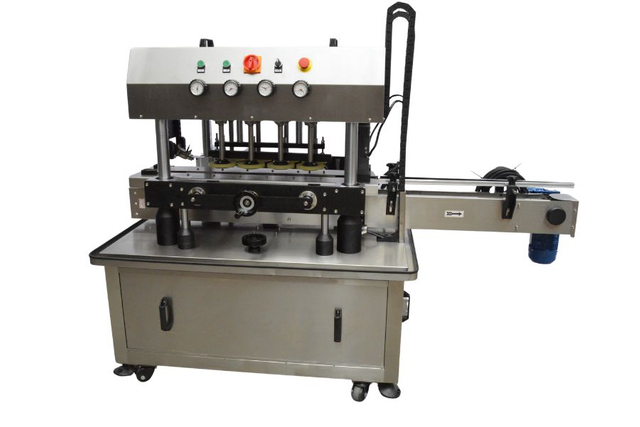
This is the core of the entire line. For viscous food products, the RF-GZ6T Automatic Piston Liquid & Paste Filling Machine is Jewshin's purpose-built solution—engineered as an all-in-one filling answer for every challenging viscous product from thin sauces to high-viscosity pastes and particle-laden condiments.
Why piston filling is the correct method for sauces and pastes:
Unlike gravity fillers or time-pressure systems, a piston filler works by controlled volume displacement—drawing a precise, measured volume of product into the cylinder and dispensing it into the bottle. This mechanism handles thick products reliably, maintains accuracy regardless of viscosity variation, and can be engineered with the rotary valves needed for particle-containing products.
What makes the RF-GZ6T specifically suited for food applications:
Rotary valve design for particle-containing products: Handles chili flakes, fruit chunks, seeds, and sauce granules without clogging—a capability standard piston fillers cannot deliver
Anti-drip nozzles with wire-drawing prevention: The specialized nozzle shut-off mechanism prevents both dripping and string formation after each fill cycle, keeping bottles and conveyors clean
< ±1% filling accuracy: Precise volumetric control with Mitsubishi PLC (Japan) logic and Keyence sensor (Japan) bottle detection
No-Bottle-No-Fill intelligence: Keyence sensors detect bottle presence before each cycle—no wasted product, no conveyor contamination from missed fills
GMP-compliant stainless steel frame with tool-free quick-strip design: Key product-contact components disassemble without tools for fast, hygienic cleaning between products or at shift end
Weinview touchscreen (Taiwan) one-touch adjustment: Fill volume and speed set digitally—no mechanical adjustments required when changing bottle sizes
2 to 12 nozzle configurations: Scalable from compact single-line operations to high-output multi-head industrial production
Parameter | RF-GZ6T Specification |
Filling Principle | Piston (Volumetric) |
Filling Range | 100 – 1,000 ml (customizable) |
Filling Accuracy | < ±1% |
Power | 3 KW / 220V / 50Hz |
PLC | Mitsubishi (Japan) |
Sensor | Keyence (Japan) |
Nozzle Options | 2 / 4 / 6 / 8 / 12 heads |
After filling, bottles move to the capping station. The capping system must be matched to your specific cap type: screw caps (most common for sauce bottles), lug caps (for wide-mouth jars), flip-top caps, or pump caps. Key requirements include stable cap placement, consistent and adjustable torque, compatibility with the bottle neck finish, and practical changeover between different cap sizes.
For products requiring tamper-evident presentation, extended shelf life, or vacuum-sealed packaging—common in premium food retail—an aluminum foil induction sealer applies a hermetic foil seal to the bottle opening after capping. Water-cooled induction sealers maintain consistent sealing temperature across high-speed production without thermal drift.

Most sauce and condiment products are packaged in cylindrical glass or PET bottles—making a Round Bottle Labeling Machine the correct labeling architecture for this line.
For sauce bottle labeling applications, Jewshin offers several configurations:
JX-T212 Automatic Round Bottle Labeling Machine: Full wrap-around and front-and-back dual labeling for cylindrical and tapered sauce bottles—ideal for high-volume automatic inline operation with Star Wheel bottle separation for stable feeding
JX-T413 Semi-Automatic Round Bottle Labeler: Single and dual label modes with taper bottle support and optional date coder integration—best for small-to-medium sauce operations
For sauce bottle labeling, the most common application is full wrap-around labeling (one label covering the full bottle circumference) or front-and-back labeling (two labels: a primary brand label and a back nutritional information label). Both modes are supported across the Jewshin round bottle labeling range.
Important note for sauce lines: Because sauce bottles pass through a wet, sticky filling environment, bottle surface cleanliness at the labeling station directly affects label adhesion. Ensure the filling station's anti-drip performance is confirmed before finalizing the labeling machine configuration.
Regulatory requirements in virtually every food market mandate lot number and expiry date coding on finished sauce products. Inkjet coders or thermal transfer printers integrate directly with the labeling station or as a standalone coding station—printing batch and date information on the label or directly onto the bottle surface before labeling.
For higher-output lines and brands with stronger quality consistency requirements, optional inline inspection modules include: cap presence detection, label detection, checkweigher for fill weight verification, and metal detector for food safety compliance. These modules reduce the risk of non-conforming product reaching retail shelves.

For manufacturers packing finished sauce bottles into shipping cartons, the SAE500T Vertical Box Opening, Packing & Sealing Machine integrates case erecting, product loading, and carton sealing in a single compact vertical unit—saving approximately 50% of the floor space required by traditional modular case packing setups.
Key capabilities relevant to sauce bottle case packing:
Handles bottled products securely with fully customizable clamps designed for your specific bottle geometry
Operates at 6–10 cases per minute with dual servo product feeding for accurate, stable bottle placement
Supports both tape and spray adhesive carton sealing
INOVANCE absolute value servo control (China) with OMRON/Leuze photoelectric detection (Japan/Germany) and SKF bearings
Intelligent safety interlock with 12mm acrylic glass guarding throughout
For sauce manufacturers running 3–5 bottle SKUs across different container sizes, the SAE500T's adjustable carton size range (L: 250–500mm, W: 150–400mm, H: 150–400mm) with recipe-based changeover handles multiple formats from one machine installation.
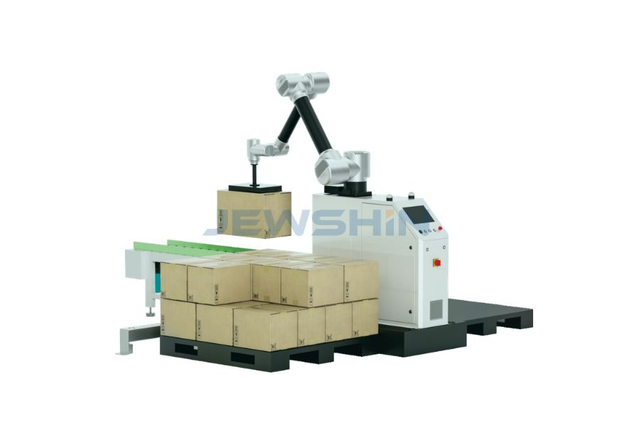
At the end of the line, a Collaborative Cobot Palletizer stacks sealed cartons onto pallets for warehouse storage and outbound logistics. The Jewshin cobot palletizer series covers payload capacities from 20 KG to 60 KG—suitable for most sauce carton weights—with a minimum floor footprint of 1,505 × 1,716mm and graphical programming that any factory operator can master in 30 minutes.
A full automatic sauce bottle packaging line follows this sequence:
Bottle Unscrambler
       ↓
Infeed Conveyor
       ↓
RF-GZ6T Piston Filling Machine
       ↓
Cap Feeder + Capping Machine
       ↓
Induction Sealer (if required)
       ↓
JX-T212 Round Bottle Labeling Machine
       ↓
Inkjet Coder / Date Printer
       ↓
Checkweigher / Inspection (optional)
       ↓
SAE500T All-in-One Case Packer
       ↓
Cobot Palletizer
       ↓
Stretch Wrapper → Dispatch
Not every factory needs the full line from day one. A practical staged approach is:
Stage 1 (Core): RF-GZ6T Filling + Capping Machine
Stage 2 (Brand): + JX-T212 Round Bottle Labeler + Inkjet Coder
Stage 3 (Scale): + SAE500T Case Packer + Cobot Palletizer
This staged investment path allows manufacturers to automate immediately where the labor cost and quality risk are highest, then expand end-of-line automation as output grows.
Before any equipment is specified, clearly define:
Viscosity and flow behavior (pourable sauce, thick paste, or near-solid spread?)
Presence and maximum size of particles (chili flakes, fruit pieces, seeds)
Sugar and oil content (affects valve and nozzle design)
Product temperature during filling (ambient or hot-fill?)
Foaming tendency during dispensing
Cleaning method (manual washdown, CIP, or batch-change teardown?)
Provide: bottle or jar photos, dimensions, material (glass or PET), neck finish details, filling volume range, and cap type with photos. Cap type is one of the most commonly underspecified items in sauce line inquiries—and an incompatible capping torque setting on glass jars can create production rejects at scale.
Calculate your actual daily requirement before specifying speed: How many bottles per shift? How many working days per year? What upstream production capacity feeds the line? A stable line at 40 bottles per minute with near-zero stoppages produces more actual daily output than a 60 BPM line that requires frequent operator intervention for drips, cap jams, or label rejects.
Confirm stainless steel grade requirements, food-contact material certifications, cleaning method, and any market-specific compliance requirements (FDA, EU food contact, etc.) before finalizing machine specifications.
Specify: wrap-around or front-and-back labeling, label size, label material (paper or PP film), batch number and expiry date coding format, and whether any orientation-based label placement is required (for bottles with handles or specific brand alignment points).
Specifying filling machine by product name alone: "Chili sauce" describes dozens of different viscosities and particle levels. Two products both called chili sauce may require completely different nozzle and valve designs. Always confirm with a real product sample.
Ignoring the drip problem at specification stage: Post-fill dripping is a systemic problem that affects not just cleanliness but also downstream labeling adhesion and operator safety. Confirm anti-drip performance with a live product demonstration before ordering.
Underestimating cap compatibility complexity: Glass jar caps, plastic squeeze bottle caps, and metal lug caps each require fundamentally different capping mechanisms, torque profiles, and cap feeding designs. Provide actual cap samples to your supplier.
Optimizing only the filling station: A line performs at the speed of its slowest station. If filling is well-specified but capping is unreliable or labeling creates rejects, the net line output is limited by the weakest point.
Not planning for future SKU expansion: Sauce manufacturers frequently add new flavors, sizes, or export formats. A line specified for only one bottle size may require expensive hardware modifications when the product range grows. Confirm size range and changeover method at specification time.
Product information: Product name, viscosity description, particle content and size, product photos or video of flow behavior, filling temperature, sample availability.
Container information: Bottle or jar photos, dimensions (H × diameter), material, neck finish, required fill volume range.
Cap information: Cap photos, cap size and type, thread specification, sealing method (screw, lug, induction foil, vacuum).
Production requirements: Target speed (bottles per minute), daily output, number of container sizes or SKUs, current packaging process description, available factory floor space.
Additional requirements: Labeling type (wrap-around, front/back, top), coding requirements, inspection system, case packing format, palletizing requirements, preferred automation level, future expansion plan.
What products can this packaging line handle?
The line handles a wide range of viscous and semi-viscous food products including chili sauce, ketchup, honey, jam, peanut butter, curry paste, bean paste, sesame paste, salad dressing, and cooking paste—depending on product characteristics and machine configuration.
What filling method is recommended for sauce and paste products?
Piston filling is the most widely used method for viscous food products because it works by controlled volume displacement, handles thick and particle-containing products reliably, and delivers stable accuracy regardless of viscosity variation. The RF-GZ6T's rotary valve design specifically addresses particle-containing sauces that clog standard filling systems.
Can the filling machine handle products that contain visible particles?
Yes. The RF-GZ6T uses specially designed rotary valves that allow products containing soft particles—such as chili flakes, fruit chunks, or seeds—to pass through filling nozzles without clogging. The particle size range the machine can handle should always be confirmed with actual product samples before final machine specification.
Can one line handle multiple bottle sizes?
Yes. The RF-GZ6T supports a filling range of 100–1,000 ml with one-touch volume adjustment via the Weinview touchscreen. The JX-T212 and JX-T413 labelers support adjustable bottle diameter ranges. The SAE500T case packer accommodates multiple carton sizes. Changeover time and method should be confirmed with your supplier based on the specific size range you require.
Do I need to invest in the full line at once?
No. A staged investment approach is often more practical. Many manufacturers start with filling and capping, then add labeling and coding as output grows, and finally add case packing and palletizing when end-of-line labor becomes the bottleneck. Jewshin can design each stage so that upstream and downstream additions integrate cleanly without requiring hardware modifications to existing machines.
What after-sales support is available for international buyers?
Jewshin provides English technical documentation, remote video commissioning support, operator training guidance, and international spare parts supply. Because the RF-GZ6T's core components—Mitsubishi PLC, Keyence sensors, AirTac pneumatics, Omron relays—are globally available standard brands, spare parts procurement is straightforward from local industrial suppliers in most markets.
If you are sourcing a sauce and paste filling packaging line for chili sauce, honey, jam, ketchup, or any other viscous food product, our team at Jewshin is ready to help you design the right configuration from filling through palletizing.
Jewshin — Dongguan Jewshin Intelligent Machinery Co., Ltd.
Website: www.jewshin.com
Email: wendy@jewshin.com
WhatsApp: +86-13128136672
Send us your product sample details, container dimensions, target speed, and current production situation—and we will provide a free customized line configuration proposal based on your actual application requirements.