Views: 0 Author: Wendy Liu Publish Time: 2026-03-25 Origin: Jewshin
For many manufacturers, palletizing is the last packaging step before warehousing and shipment—and it is, consistently, the most labor-intensive station remaining in factories that have already automated everything before it. The filling machine runs automatically. The labeler applies labels at 80 bottles per minute. The case packer seals 8 cartons per minute. And at the end of the conveyor, two or three workers stand in a row, lifting sealed cases and stacking them onto pallets by hand—eight hours a day, five or six days a week.
Manual palletizing is repetitive, physically punishing, and increasingly difficult to staff. Workers fatigue across a shift, creating inconsistent pallet patterns in the afternoon that were stable in the morning. Stacking accuracy degrades. Cases shift during transport because the pallet was built unevenly. And labor turnover at the palletizing station is typically higher than at any other packaging position in the building—because the work is the hardest.
This is why experienced buyers search for a robotic and collaborative palletizing solution as part of their end-of-line automation strategy. The question is no longer whether to automate palletizing. The question is: Which type of palletizer—industrial robotic or collaborative cobot—is the right fit for my products, my production speed, my floor space, and my budget?
In this guide, I will walk through the core end-of-line palletizing challenges, the Jewshin collaborative palletizer range that addresses them, how collaborative palletizers compare with traditional industrial robotic systems, and the practical factors buyers should evaluate before selecting a palletizing solution.

This palletizing solution is most directly relevant to:
Food and beverage manufacturers palletizing sealed shipping cartons
Household chemical and daily chemical producers with high-volume case output
Cosmetic and personal care factories palletizing retail and wholesale cases
Pharmaceutical and healthcare product packers in suitable applications
Printing, stationery, and post-press companies palletizing finished goods
3C electronics manufacturers palletizing boxed products
E-commerce fulfillment operations palletizing mixed-format shipments
OEM and ODM factories handling multiple client packaging formats
Any factory where manual palletizing is the last remaining manual station
If your factory has already automated filling, labeling, and case packing—but still employs 2–4 workers per shift for manual pallet stacking—this solution eliminates that final manual bottleneck and completes the end-of-line automation chain.
Manual palletizing has a unique cost profile that makes it disproportionately expensive relative to other manual packaging stations:
Physical intensity creates higher turnover. Palletizing workers lift 10–25 KG cases repeatedly for full 8-hour shifts. This is the most physically demanding position in the packaging area, and it produces the highest injury risk, the highest absenteeism rate, and the highest worker turnover rate. Replacing and retraining palletizing workers is a recurring cost that does not appear in most machine ROI calculations—but it should.
Fatigue creates quality degradation across a shift. A palletizing worker builds consistent, square pallet stacks at the start of a shift. By hour six, stacking accuracy measurably declines—cases are placed less precisely, layers are less flat, and the completed pallet is less stable for transport. This fatigue-driven quality degradation is invisible in real-time but becomes visible when pallets shift, collapse, or arrive at their destination with damaged products.
Palletizing labor scales linearly with output. If production volume doubles, you need roughly twice as many palletizing workers—or you need workers to work twice as fast, which is physically unsustainable. Unlike upstream automation where a machine handles increased volume with the same headcount, manual palletizing cannot absorb output growth without proportional labor addition.
Palletizing is the last station before shipping—so every pallet quality problem becomes a customer-visible problem. An unstable pallet that shifts during transport, a collapsed stack that damages product, or an inconsistent pallet pattern that fails a retail distribution center audit creates customer complaints that trace directly back to the palletizing station.
Once case packing is automated—for example, with an SAE500T All-in-One Case Packer running at 6–10 cases per minute—sealed cases arrive at the palletizing station at a consistent, relentless pace. Manual workers cannot sustain that pace across a full shift. The result is either: cases accumulate on the outfeed conveyor creating a backup that eventually forces the case packer to stop, or an excessive number of workers are assigned to palletizing to maintain pace. Both outcomes are expensive.
Factories running multiple SKUs produce different carton sizes—and each carton size requires a different pallet stacking pattern for optimal stability and space utilization. Manual workers must remember the correct pattern for each carton format and execute it consistently across every layer. In practice, pattern errors are common—especially during format transitions and during late-shift fatigue periods.
The palletizing station is typically the last station added to an existing production line—and the available floor space at the end of the line is typically the smallest remaining area in the production floor. Traditional industrial palletizer cells with full safety fencing, external controller cabinets, and wide robot reach envelopes may simply not fit in the available space without restructuring the factory layout.
In many production environments, workers need to access the palletizing area for pallet removal, slip sheet loading, or quality checks. Traditional industrial robots require full perimeter safety fencing with interlocked gates—creating a physical barrier that complicates operator access and pallet handling logistics. The alternative is a system designed for safe human-machine coexistence without full fencing.
Traditional industrial palletizing robots require specialist programmers to create, modify, and optimize pallet stacking programs. For factories running 5–10 different carton formats with different pallet patterns, this creates an ongoing dependency on programming specialists—either internal staff with specialized training or external service visits from the robot integrator. Every new SKU requires a programming session; every pallet pattern change requires technical support.
Not all cases are identical in handling characteristics. Lightweight cartons may require gentle vacuum gripping. Heavy cases require high-payload mechanical clamping. Bags require flexible gripper geometry. Shrink-wrapped bundles require surface-conforming contact. The gripper (end effector) design must match the actual product handling requirements—not just the weight specification.

This is the most common buyer question—and the answer depends on matching the right technology to the actual production requirement, not on choosing the "better" technology in abstract terms.
Evaluation Factor | Traditional Industrial Robotic Palletizer | Collaborative (Cobot) Palletizer |
Typical Payload | 40–300+ KG | 20–60 KG |
Typical Speed | 6–20+ cycles/min | 6–12 cycles/min |
Working Radius | 2,000–3,500mm | 1,600–1,900mm |
Floor Footprint | Large — requires full safety fencing perimeter | Compact — minimum 1,505 × 1,716mm, no full fencing required |
Safety Architecture | Full perimeter fencing with interlocked gates | Collaborative design for human-machine coexistence |
Programming | Specialist programmer required (teach pendant, offline programming) | Graphical programming — operator mastery in 30 minutes |
New SKU Setup | Requires programmer or integrator visit | Operator creates new pattern via graphical interface in ~1 hour |
Deployment Time | Weeks to months (civil works, fencing, programming) | Days to weeks (compact installation, minimal infrastructure) |
Best For | Very high speed, very heavy loads, high-volume single-format lines | Moderate speed, lighter-to-medium loads, multi-SKU flexibility, space-constrained layouts |
Typical Investment | Higher (robot + fencing + controller + integration + programming) | Lower total system cost for comparable payload range |
Case weight consistently exceeds 40–60 KG
Required palletizing speed exceeds 12 cycles per minute
Production runs single-format or low-SKU-count at very high volume
Factory has dedicated floor space for a fenced palletizer cell
Specialist programming resources are available in-house or from a local integrator
Case weight is within 20–60 KG range
Required speed is 6–12 cycles per minute
Factory runs multiple SKUs with frequent pallet pattern changes
Available floor space is limited or constrained by existing equipment
Workers need to access the palletizing area without full fencing barriers
Factory does not have (or want) specialist robot programming staff
The goal is practical, rapid-deployment end-of-line automation—not a major civil engineering project
For the majority of food, beverage, cosmetic, household chemical, and consumer goods manufacturers—where case weights range from 5–30 KG, production speeds require 6–12 palletizing cycles per minute, and multi-SKU flexibility is commercially important—a collaborative palletizer delivers the optimal balance of capability, flexibility, footprint, and total cost of ownership.
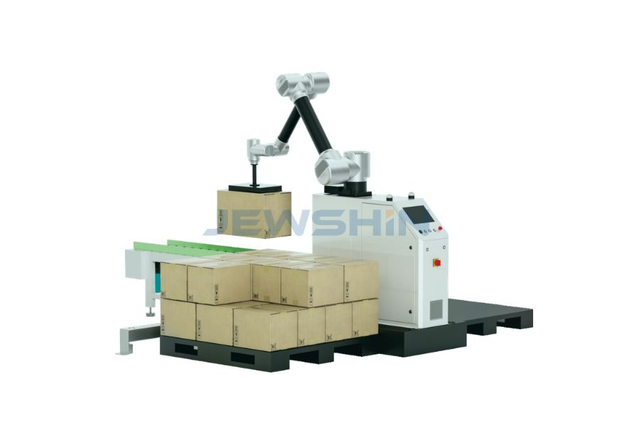
The Jewshin Collaborative Palletizing Machine series is purpose-built for end-of-line packaging automation across food, medicine, 3C electronics, daily chemicals and cosmetics, and printing and post-press industries.
Model | Payload | Working Radius | Palletizing Speed | Power | Equipment Height | Best Application |
JX-GD20pro | 20 KG | 1,900mm | <12 pcs/min | 2.3 KW | 3.0m | Light retail cartons, cosmetics cases |
JX-GD30pro | 30 KG | 1,900mm | <12 pcs/min | 3.3 KW | 3.0m | Standard shipping cartons, food cases |
JX-GD40pro | 40 KG | 1,900mm | <9 pcs/min | 3.6 KW | 3.5m | Heavier cases, wider pallet reach |
JX-GD30Max | 30 KG | 1,600mm | <9 pcs/min | 3.6 KW | 3.2m | Standard weight, compact layout |
JX-GD40Max | 40 KG | 1,700mm | <6 pcs/min | 3.6 KW | 3.5m | Heavy cases, tight floor space |
JX-GD60Max | 60 KG | 1,700mm | <6 pcs/min | 4.8 KW | 3.5m | Heavy industrial cases, bulk format |
Pro Series (JX-GD20pro / JX-GD30pro / JX-GD40pro):
Optimized for speed and reach. The 1,900mm working radius provides full coverage of standard pallet dimensions with comfortable clearance—ideal for standard pallet patterns where the robot needs to reach all four corners of the pallet without repositioning. Speed ratings up to 12 pcs/min sustain output pace for most medium-to-high-volume packaging lines. Choose the Pro series when speed and pallet reach are the primary requirements.
Max Series (JX-GD30Max / JX-GD40Max / JX-GD60Max):
Optimized for payload capacity and compact installation. The shorter 1,600–1,700mm radius fits tighter end-of-line spaces while still covering standard pallet dimensions. Payload extends to 60 KG for heavy cases. Choose the Max series when case weight is the primary constraint, floor space is particularly limited, or the production runs at moderate speeds with heavier products.
Graphical Programming — The Single Most Important Operational Advantage
Traditional palletizing robots require specialists who understand robot programming languages, coordinate systems, and motion path optimization. The Jewshin cobot palletizer replaces all of that with a graphical programming interface that production operators—not programmers—use to create and modify pallet stacking patterns.
30-minute basic mastery: An operator with no prior robot experience can learn the programming interface and understand the system logic in 30 minutes
1-hour new task setup: Creating a complete new pallet stacking pattern for a new carton format takes approximately 1 hour via the graphical interface
Recipe-based pattern storage: Multiple pallet patterns are stored as named recipes and recalled via touchscreen—switching between SKUs takes seconds, not programming sessions
For factories running 5–10 different carton formats, this programming accessibility eliminates the specialist dependency that makes traditional robotic palletizers operationally expensive to maintain across a multi-SKU production environment.
±0.04mm Repeat Positioning Accuracy
Every case placement on every layer of every pallet is positioned with ±0.04mm repeatability. This precision produces:
Perfectly aligned layers that maximize pallet stability
Consistent case-to-case contact across the full pallet height
Stable pallet structures that withstand transport vibration and forklift handling
Pallet presentation quality that passes retail distribution center audits
Universal Grippers — Customizable Per Application
The Jewshin cobot palletizer uses universal grippers that are customized to the specific product being palletized. For sealed corrugated cartons, clamp-style grippers provide secure mechanical engagement. For lightweight cases or bags, vacuum-assisted grippers provide gentle, non-damaging pickup. For specific product geometries, combined gripper designs integrate multiple handling methods. Gripper design is specified based on actual product samples submitted during the quotation process.
Seamless Equipment Integration via TCP/IP
The cobot palletizer communicates with upstream equipment—including the SAE500T Case Packer, carton sealers, conveyors, and stretch wrappers—via standard TCP/IP communication. This enables coordinated line operation: the palletizer knows when the next case is arriving, the case packer knows when the palletizer is ready for the next case, and the stretch wrapper knows when a pallet is complete. This real-time coordination eliminates the conveyor backup and line stoppages that occur when disconnected machines operate independently.
Minimum Footprint: 1,505 × 1,716mm
The complete cobot palletizer system—including the robot, base frame, and control system—occupies a minimum floor area of just 1,505 × 1,716mm. For context, this is roughly the floor area of a standard office desk. Most traditional industrial palletizer cells with safety fencing require 3–5× this floor area for equivalent functionality. This compact footprint makes the Jewshin cobot deployable at the end of virtually any existing production line without factory layout restructuring.
A full end-of-line palletizing system typically includes the following modules, scaled based on production volume and facility requirements:
Sealed cases from the upstream case packer or carton sealer are transferred via conveyor into the palletizing station. The infeed conveyor includes: speed-matched belt drive synchronized with the upstream case packer output rate, product presence sensors for pick timing coordination, and accumulation capacity to buffer brief upstream or downstream stoppages.
Some pallet patterns require cases to alternate orientation between layers (e.g., 0° on odd layers, 90° on even layers) for interlocking stability. A servo-driven turning device rotates cases to the correct orientation before pickup.
The core palletizing station—picking cases from the infeed conveyor and placing them onto the pallet in the programmed stacking pattern. Model selection follows the payload, speed, and reach requirements outlined in the specification table above.
For continuous production, an automatic pallet dispenser feeds empty pallets into the stacking position without operator intervention—eliminating the manual pallet placement step that interrupts production between pallet completions.
Certain pallet configurations require cardboard slip sheets or corrugated layer pads between product layers for additional stability. An automatic sheet feeder places these between layers as part of the palletizing cycle.
After pallet completion, a roller or chain conveyor moves the full pallet out of the palletizing station to the wrapping area or forklift pickup zone—clearing the stacking position for the next empty pallet.
A stretch wrapper applies multiple layers of stretch film around the completed pallet for load containment during storage and transport. Turntable wrappers rotate the pallet through a fixed film dispenser; rotary arm wrappers orbit the film around a stationary pallet (suitable for heavy or unstable loads).
For warehouse management and shipping traceability, a pallet label applicator prints and applies identifying labels (SSCC, GS1-128, customer-specific formats) to completed pallets before dispatch.
Sealed Cases from Case Packer / Carton Sealer
                    ↓
Infeed Conveyor (speed-matched, accumulated)
                    ↓
Orientation / Turning (if required)
                    ↓
Cobot Palletizer — Pick & Place by Pattern Recipe
                    ↓
Slip Sheet Insertion (between layers, if required)
                    ↓
Pallet Complete → Pallet Conveyor Discharge
                    ↓
Stretch Wrapper
                    ↓
Pallet Labeling (optional)
                    ↓
Forklift Pickup → Warehouse / Shipping DockUse this decision framework:
Your Situation | Recommended Model |
Light retail cartons <15 KG, high speed needed | JX-GD20pro |
Standard shipping cases 15–25 KG, general manufacturing | JX-GD30pro |
Heavier cases 25–35 KG, full pallet reach needed | JX-GD40pro |
Standard cases ~25 KG, compact floor space | JX-GD30Max |
Heavy cases 30–40 KG, tight layout | JX-GD40Max |
Very heavy cases 40–60 KG, bulk format | JX-GD60Max |
Daily chemical detergent cases, standard volume | JX-GD30pro |
Food cartons, moderate weight, high SKU count | JX-GD20pro or JX-GD30pro |
Beverage cases, heavier weight | JX-GD40pro |
If your case weight falls at the boundary between two models, select the higher-payload model. Operating a palletizer at 80% of its payload capacity produces more stable, longer-lasting performance than operating at 95%+ of capacity.
The Jewshin cobot palletizer is designed to integrate directly with the SAE500T Vertical Box Opening, Packing & Sealing Machine via TCP/IP communication —creating a complete automated end-of-line system from case erecting through palletized dispatch:
SAE500T: Case Erecting → Product Loading → Carton Sealing
                         ↓
              Outfeed Conveyor (TCP/IP coordinated)
                         ↓
       Cobot Palletizer: Pick → Place → Build Pallet
                         ↓
              Stretch Wrapper → Warehouse
Why this integrated system matters: The SAE500T outputs 6–10 sealed cases per minute. The JX-GD30pro palletizes up to 12 pieces per minute. This speed match means the palletizer absorbs the full case packer output without creating a backup—and the TCP/IP coordination ensures both machines operate in synchronized rhythm rather than independently. The result is a continuous, unattended end-of-line flow that replaces 4–8 manual workers (case packing + palletizing combined) with two coordinated machines occupying a combined footprint smaller than most manual packing areas.
Weigh your heaviest sealed shipping case. This determines the minimum payload model required. If your product range includes both light and heavy cases across different SKUs, select based on the heaviest case—not the average.
Calculate from your upstream case packer output: How many sealed cases per minute does the line produce? The palletizer must sustain at least this rate across a full shift. For lines feeding from an SAE500T at 6–10 cases/min, the JX-GD20pro or JX-GD30pro (up to 12/min) provides comfortable speed headroom.
Document how many different carton formats produce different pallet patterns, and how often the line transitions between them. The Jewshin cobot stores unlimited pattern recipes via graphical programming—but confirm that your total recipe count and daily changeover frequency are operationally practical.
Measure the actual floor area available at the end of your production line. The cobot palletizer requires a minimum of 1,505 × 1,716mm —but total system footprint depends on infeed conveyor length, pallet conveyor output direction, and stretch wrapper placement. Provide a layout drawing for a complete footprint assessment.
Standard pallet sizes (1,200 × 1,000mm, 1,200 × 800mm, 48" × 40") are all within the working radius of the Pro and Max series. Confirm maximum pallet height against the equipment height specification (3.0–3.5m depending on model) and your facility ceiling clearance.
The universal gripper is customized per application. Provide actual product samples (or exact dimensional drawings and weight data) for gripper design during the quotation process. Different products—corrugated cartons, shrink-wrapped bundles, bags, pails—require different gripper architectures.
Specify whether the project includes stretch wrapping, pallet labeling, pallet conveyor to a warehouse pickup zone, or integration with an automated guided vehicle (AGV) or warehouse management system. These downstream modules should be planned together with the palletizer—not added later as afterthoughts.
Selecting by robot brand or payload alone: The robot arm is only one component. The gripper design, infeed conveyor logic, pallet pattern programming, safety architecture, and downstream integration are equally important to system success. Evaluate the complete palletizing system, not just the robot specification sheet.
Ignoring pallet pattern stability for transport: A pallet pattern that fills the pallet surface efficiently but creates an unstable interlocking structure will cause load shifting during transport. Confirm that your pallet pattern design is validated for transport stability—not just warehouse storage.
Underestimating the value of easy programming: A system that requires a specialist programmer for every new SKU or pattern change creates an ongoing operational dependency and cost. For multi-SKU factories, the Jewshin cobot's 30-minute operator mastery and 1-hour new task setup eliminates this dependency entirely.
Not planning stretch wrapping as part of the palletizing system: An unwrapped pallet is not a finished pallet. If stretch wrapping is required for your shipping and storage requirements, include it in the palletizing system specification from the start—not as a separate project that requires additional conveyor routing.
Choosing a system that is either too small or too large for the actual requirement: An under-specified system struggles with peak loads and limits future growth. An over-specified system wastes capital and floor space on capability the factory does not need. Match the system to the actual production requirement—with reasonable headroom for the next 2–3 years of growth.
Palletizing is most effective—and most cost-efficient to implement—when it is designed as an integrated component of the complete end-of-line packaging system rather than an isolated machine added after the fact.
When palletizing is planned together with case packing:
Conveyor routing is optimized for continuous product flow from sealer to palletizer
Speed matching is confirmed between the case packer and palletizer at specification stage
TCP/IP coordination is designed into both machines from the start
Floor layout accommodates both machines plus pallet output and wrapping in one coherent footprint
A single supplier manages the integration interface between case packing and palletizing
When palletizing is added as an afterthought:
The outfeed conveyor from the existing case packer may not route to the available palletizer location
Speed mismatch between the case packer and palletizer creates backup or underutilization
No communication protocol between machines—each operates independently
Floor space compromises force suboptimal machine placement
Two different suppliers point at each other when integration problems arise
Plan the complete end-of-line architecture from case packing through palletizing as one system—even if purchasing is staged over time.
Product / Case information: Photos of all cases to be palletized, case dimensions (L × W × H), case weight (lightest and heaviest), case surface material (corrugated, shrink-wrapped, etc.), number of different case formats.
Pallet information: Pallet dimensions, maximum pallet height including product, target pallet pattern per case format, layer count, slip sheet requirement between layers.
Production requirements: Cases per minute from upstream, pallets per hour target, number of SKUs and changeover frequency, shift arrangement, current palletizing process description.
Layout information: Available floor space dimensions and layout drawing, infeed conveyor direction, pallet output direction, forklift access path, ceiling height.
System integration requirements: Upstream case packer type and model, stretch wrapping requirement, pallet labeling requirement, pallet conveyor to warehouse requirement, existing automation systems the palletizer must communicate with.
Can the Jewshin cobot palletizer handle both cartons and bags?
Yes—with the appropriate gripper configuration. For sealed corrugated cartons, clamp-style universal grippers provide secure mechanical handling. For bags, a vacuum-assisted or conforming gripper design accommodates the flexible surface. Gripper design is customized based on actual product samples submitted during the quotation process.
How long does it take to set up a new pallet pattern for a new SKU?
Approximately 1 hour using the graphical programming interface. No specialist programmer is required—production operators create new patterns by defining layer layouts, case orientations, and stacking heights through the intuitive visual interface. Once created, the pattern is stored as a named recipe and recalled instantly for future production runs.
Does the cobot palletizer require safety fencing?
The collaborative design enables human-machine coexistence without full perimeter safety fencing. However, a risk assessment should be conducted for each specific installation to determine the appropriate safety measures based on local regulations, case weight, robot speed settings, and the specific interaction scenarios in your facility.
Can the cobot palletizer integrate with our existing SAE500T case packer?
Yes. The Jewshin cobot palletizer communicates with the SAE500T via standard TCP/IP protocol, enabling coordinated operation—the palletizer receives production signals from the case packer and synchronizes pick timing with case arrival.
What is the typical payback period for a cobot palletizer?
This depends on current manual palletizing labor cost, shift arrangement, and production volume. For a factory replacing 2–3 manual palletizing workers across 2 shifts, the labor cost savings alone typically produce a payback period measured in 6–18 months—before accounting for the additional value of improved pallet consistency, reduced product damage, extended unmanned operation capability, and elimination of palletizing-related worker injury risk.
Can one cobot palletize onto two pallets alternately?
Depending on the working radius and pallet placement geometry, some configurations allow the cobot to build two pallets within its reach envelope—filling one while the other is removed and replaced. Discuss dual-pallet configurations with Jewshin during the quotation process to confirm feasibility for your specific pallet dimensions and layout.
If you are building or upgrading an end-of-line palletizing system for cartons, bags, containers, or any other secondary-packaged products—whether as a standalone palletizer or integrated with case packing, sealing, and wrapping—our team at Jewshin is ready to help you select the right configuration for your products, production speed, floor space, and automation goals.
Jewshin — Dongguan Jewshin Intelligent Machinery Co., Ltd.
Website: www.jewshin.com
Email: wendy@jewshin.com
WhatsApp: +86-13128136672
Send us your case dimensions, case weight, pallet pattern requirements, production speed, floor space layout, and upstream equipment details—and we will provide a free customized palletizing system proposal including model selection, gripper design recommendation, layout drawing, and integration planning based on your actual end-of-line production requirements.