Views: 0 Author: Wendy Liu Publish Time: 2026-04-28 Origin: Jewshin
Case erectors are the workhorses of end-of-line packaging. They take flat blanks of corrugated cardboard, fold them along pre-scored lines, and seal them into rigid, open-top cases — ready to be filled and sealed. It's a simple concept, but the difference between a well-built case erector and a poorly designed one can mean the difference between a smooth, high-speed line and constant jamming, misalignment, and downtime.
If you're in the market for an automatic case erector, this guide will walk you through everything you need to evaluate — from drive systems to carton size ranges to integration requirements. Our goal is to help you buy smart, not just buy fast.

Before we get into specs, let's address the obvious: why go automatic in the first place?
Manual case erection is labor-intensive, slow, and inconsistent. Workers get fatigued. Speed drops. Quality varies. An automatic case erector:
Increases throughput — from ~5-8 cases per minute manually to 10-30+ cases per minute automatically
Reduces labor costs — one operator can manage multiple machines or focus on higher-value tasks
Improves consistency — every case is erected to the same quality standard
Reduces workplace injuries — no repetitive folding and taping by hand
For any operation running more than a few hundred cases per shift, an automatic case erector is no longer a luxury — it's a necessity.
Powered by compressed air, these are typically more affordable and suited for lower-to-medium speed applications. They're reliable and well-suited for standard case sizes.
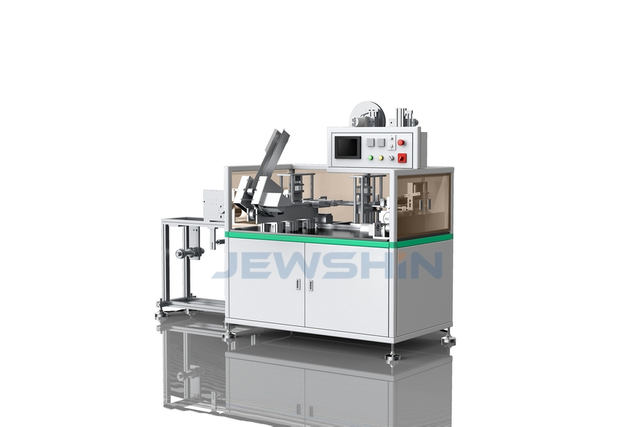
Our SDW-K20TX Pneumatic Carton Erector is designed for connecting to automatic production lines and handles a wide range of carton sizes. Pneumatic models are a solid entry point for facilities just beginning to automate their end-of-line operations.
Servo motors provide more precise, programmable control over the erection sequence. They offer faster cycle times, smoother operation, and greater flexibility for handling multiple carton sizes.
The SDW-K20TXK Servo Forming Carton Erector is Jewshin's flagship servo case erector, built for the food, medicine, beverage, tobacco, daily chemical, and electronics industries. Servo drive enables more complex forming sequences and faster changeovers between carton sizes.
For high-volume operations (think major food or beverage plants), continuous-duty machines running at 30+ cases per minute are available. These are larger investments but deliver the throughput needed for large-scale production.
This is one of the most important specifications you'll evaluate:
Factor | Pneumatic | Servo |
Cost | Lower upfront | Higher upfront |
Speed | Moderate (10-20 cpm) | Fast (15-35+ cpm) |
Precision | Good | Excellent |
Changeover flexibility | Manual adjustment | Programmable, faster |
Maintenance | Requires air compressor | Direct drive, less maintenance |
Best for | Standard sizes, lower volume | Multiple SKUs, higher speed |
If you're running one or two carton sizes at high volume, a pneumatic erector may be sufficient. If you're switching between multiple carton sizes frequently, servo-driven is the better investment.
Check the machine's minimum and maximum specifications for:
Length: The long dimension of the flat carton blank
Width: The short dimension of the flat carton blank
Height: The erected case height (this determines how tall a product can be before it enters the case)
Jewshin's case erectors handle a wide range of carton dimensions. Make sure your target carton sizes fall comfortably within the machine's range — not just barely within it. Running a carton at the extreme edge of a machine's size range often leads to reliability issues.
Case erectors can seal the bottom of the carton in different ways:
Tape sealing: Pressure-sensitive tape applied across the bottom flaps. Simple, reliable, widely used.
Hot melt glue sealing: Adhesive applied in a pattern for a cleaner, more tamper-evident seal. Common in food and pharmaceutical applications.
Stapling: Less common, primarily for heavy-duty industrial cartons.
Our JX-FC500 Automatic Flap Folding Carton Sealer combined with the FG500L Automatic Corner Sealing Machine provides a complete tape-sealing solution for H-tape packaging and carton edge sealing applications.
If you're running multiple SKUs on the same line, changeover speed directly impacts your effective production time. Look for:
Tool-free adjustments where possible
Digital parameter storage — pre-save settings for different carton sizes
Quick-release mechanisms for guides and rails
Clear labeling of adjustment points for operator efficiency
Servo-driven case erectors generally offer faster, more repeatable changeovers since most adjustments are stored in the PLC system.
The blank magazine holds the flat carton blanks before they're erected. Larger capacity = fewer interruptions to reload. Consider:
Magazine depth: How many blanks can it hold?
Auto-reload capability: Can you slide new blanks in while the magazine is partially full?
Blank flatness: Some machines struggle with low-quality corrugated that has a natural curl. Better machines have anti-curl mechanisms in the magazine.
Modern case erectors use PLC control systems with touch screen HMI (Human-Machine Interface). Look for:
Touch screen interface for easy parameter setting and monitoring
Fault diagnostics — clear error messages and alarm history
Counter and batch tracking — for production reporting
Remote support capability — for troubleshooting with the manufacturer
Frame construction: Welded steel frames are standard. Check for rigidity and corrosion protection.
Shaft and bearing quality: Sealed bearings reduce maintenance. Hardened shafts handle continuous duty.
Guiding and forming blades: These wear over time. Ask about replacement schedules and part availability.
Film or tape application: Smooth, consistent tape application without wrinkles or tearing.

An automatic case erector doesn't work in isolation. Here's what you need to consider for a smooth integration:
How does the case erector receive product? (Conveyor, robot, manual)
What signaling protocol does it use? (Photoeye, proximity sensor, PLC signal)
What's the required product spacing between cases?
Where does the erected case go after it's formed? (Conveyor, case packer)
Does the case need to be oriented in a specific direction for the case packer?
Is there enough space for a case buffer between the erector and packer?
Voltage: Most industrial case erectors run on 380V 3-phase (standard in Asia and Europe) or 220V single-phase. Some machines offer dual-voltage options.
Compressed air: Pneumatic models require a stable air supply (typically 5-6 bar).
Grounding and safety circuits: Ensure your facility meets the machine's electrical safety requirements.
Requirements often include stainless steel contact surfaces, washdown compatibility, and compliance with food safety standards. Case erection speeds may need to match the bottling or canning line speed.
Strict validation requirements, batch traceability, and documentation. Servo-driven machines are preferred for their repeatable, measurable performance.
Premium retail packaging often requires clean, square cases with precise dimensions. Hot melt glue sealing is common for a cleaner appearance.
Often uses heavier double-wall corrugated. Case erectors need to handle thicker, stiffer materials without jamming.
High throughput, a wide variety of case sizes, and frequent SKU changes. Servo-driven machines with digital changeover are essential here.

When evaluating purchase price, also factor in:
Wear parts cost and availability: Blades, blades, belts, seals, and sensors all need periodic replacement
Service support: Can the manufacturer support you in your time zone and language?
Warranty terms: What's covered and for how long?
Energy consumption: Servo machines are generally more energy-efficient than pneumatic equivalents
At Jewshin, we've built case erectors for operations ranging from small artisan producers to high-volume automated plants. Here's our general guidance:
For lower-volume, single-SKU operations: Start with a pneumatic case erector to get the automation benefits at a lower entry point.
For mixed-SKU or growing operations: Invest in a servo case erector for faster changeovers and greater flexibility.
For high-speed lines: Look at the full end-of-line packaging equipment range and consider a coordinated system — erector, case packer, and palletizer — from one supplier for seamless integration.
About the Author
Wendy Liu is the CEO of Dongguan Jewshin Intelligent Machinery Co., Ltd., a manufacturer and global exporter of end-of-line packaging equipment including case erectors, case sealers, case packers, and palletizers. Jewshin serves customers in North America, Europe, Southeast Asia, the Middle East, South America, and Africa. Browse our case erector catalog or get in touch for a custom quote.