Views: 0 Author: Wendy Liu Publish Time: 2026-03-27 Origin: Jewshin
When a packaging machine earns a repeat order, it tells a clearer story than any specification sheet. This Russian customer—a cleaning products manufacturer with 26 years of industry experience and more than ten packaging lines in their facility—purchased their first JX-200 Servo Friction Feeder to solve a specific production problem: automatically placing ultra-thin product labels (0.06mm thickness) onto cleaning products before pillow wrapping. After six months of continuous production use, the customer placed a repeat order for two additional units—bringing their total to three JX-200 feeders across their packaging operation.
One machine purchased to test the concept. Two more purchased because the results proved the value. That is the strongest form of customer validation.
Detail | Information |
Country | Russia |
Industry | Cleaning products manufacturing |
Products | Industrial and household scrubbing pads, scouring pads, cleaning sponges, floor cleaning abrasive discs |
Industry Experience | 26 years |
Production Scale | 10+ packaging lines in operation |
Packaging Process | Product label placement → Pillow wrapping (flow pack) |
Label Thickness | 0.06mm (ultra-thin) |
This is not a startup experimenting with automation. This is a mature, large-scale cleaning products factory with decades of production experience and extensive packaging infrastructure. When a factory of this scale validates a machine through repeat purchase, the endorsement carries significant weight.
The customer's packaging workflow required a product label to be placed on top of each cleaning product before the product entered a pillow packaging machine (flow wrapper) for final wrapping. This label placement step had several characteristics that made it technically demanding:
The product labels were only 0.06mm thick—thinner than a standard sheet of office paper. At this thickness, labels are extremely difficult to separate and feed individually. Standard mechanical feeders either fail to pick up a single sheet (feeding zero), pick up multiple sheets simultaneously (double feeding), or crumple the label during separation. Reliable single-sheet feeding at 0.06mm thickness requires a feeding mechanism with genuine precision—not just a specification that claims thin-material compatibility.
The label had to be dispensed precisely when a product arrived at the feeding station—not before, not after. The feeder needed to detect each incoming product via sensor and immediately place one label on top of it, in real time, synchronized with the conveyor speed. Any timing error would result in labels placed between products (wasted), labels missing from products (defective packaging), or labels placed off-center (poor appearance).
With more than ten packaging lines and high production volume, this was not a low-duty application. The feeder needed to operate continuously at production speed without feeding errors accumulating across a shift. In manual label placement, workers slow down, make mistakes, and take breaks. The machine needed to maintain consistent performance from the first label to the last.
The feeder had to be installed inline with existing pillow wrapping machines without requiring significant modification to the customer's established packaging line layout. It needed to function as a drop-in automation module—receiving a trigger signal from the product sensor, dispensing one label, and returning to ready state before the next product arrived.

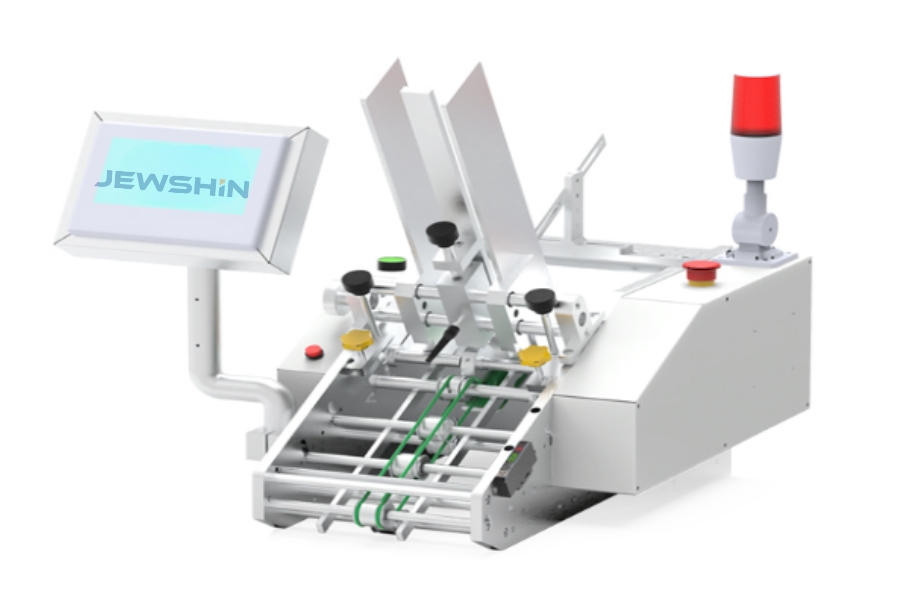
The customer discovered the JX-200 Servo Friction Feeder through the Jewshin website and recognized that its specifications matched their application requirements. After evaluation, they purchased one unit for initial production testing.
JX-200 key specifications relevant to this application:
Parameter | JX-200 Specification | Relevance to This Project |
Drive System | Servo Motor + PLC Control | Precise single-sheet separation at 0.06mm thickness |
Product Thickness Range | 0.1–3.0mm | Customer's 0.06mm labels are below standard range—validated through testing |
Max Speed | 10–160 meters/min | Matches pillow packaging line production speeds |
Card Length Range | 50–200mm | Compatible with customer's label dimensions |
Card Width Range | 30–150mm | Compatible with customer's label dimensions |
Control Interface | Touch Screen | Operator-friendly parameter adjustment |
Error Detection | Double feeding alarm, missed feeding alarm, empty hopper alarm | Ensures 100% label placement accuracy |
Sensor System | Fiber optic with millisecond response | Detects incoming product and triggers instant label dispensing |
Integration | Designed for inline connection with pillow packaging machines, conveyors, cartoning machines | |
Machine Dimensions | 612 × 500 × 597mm | Compact footprint—installs alongside existing packaging lines |
Power | 220V, 450W | Standard factory power |
Weight | ~35 KG | Easily repositioned between lines if needed |
Ultra-thin label feeding: The JX-200's reverse-friction roller system separates materials by using differential roller speeds to peel one sheet from the stack while holding the rest back. This mechanical separation principle works at thicknesses well below what gravity-based or suction-based feeders can handle. The customer's 0.06mm labels—thinner than the standard 0.1mm minimum specification—were successfully validated through production testing, confirming reliable single-sheet separation at this extreme thinness.
Synchronized product detection and label placement: The JX-200's imported fiber optic sensors detect each product arriving on the conveyor with millisecond response time. Upon detection, the servo motor instantly drives one label from the hopper onto the product surface. The Online Mode is specifically designed for this use case—connecting the feeder to a conveyor or pillow wrapper and feeding one card/label per product automatically.
Intelligent error prevention: The JX-200's three-alarm error detection system—double feeding (multi-card), missed feeding (leaky card), and empty hopper alarms—ensures that every product receives exactly one label. If the feeder detects a double-feed, missed feed, or empty hopper condition, it triggers an immediate alarm. This 100% accuracy assurance is critical for a factory running 10+ lines at production speed—because undetected feeding errors compound across thousands of products per shift.
Seamless pillow wrapper integration: The JX-200 is explicitly designed as a modular inline unit that connects directly to pillow packaging machines (flow wrappers). The customer installed the JX-200 upstream of their existing pillow wrappers—the feeder places a label on each product, and the labeled product immediately enters the pillow wrapper for film sealing. No significant line modification was required.

After installing the first JX-200 on one of their packaging lines, the customer operated the machine in continuous production for six months. During this period, the customer evaluated:
Feeding accuracy — consistent single-label dispensing at 0.06mm thickness
Speed compatibility — sustained operation at the pillow packaging line's production speed
Error rate — feeding reliability across extended production runs
Labor impact — reduction in manual label placement workers
Integration stability — reliable inline operation with the existing pillow wrapper
The customer's assessment after six months: the machine was accurate in dispensing, fast in operation, and delivered meaningful labor savings.
Based on six months of validated production performance, the customer placed a repeat order for two additional JX-200 units this year—extending the automated label placement capability to more of their 10+ packaging lines.
A repeat order from a 26-year-experienced manufacturer with 10+ production lines is the most meaningful form of machine validation. This customer has extensive experience evaluating packaging equipment. Their decision to expand from one unit to three was based on documented production results—not marketing claims.
The automated label placement process eliminated manual label handling workers from each equipped packaging line. Across the customer's operation, the JX-200 feeders replaced manual workers who previously:
Picked individual labels from stacks by hand
Placed labels onto products one at a time
Maintained pace with the pillow wrapper's production speed
Managed label orientation and positioning consistency
Each of these manual tasks is slow, fatigue-prone, and inconsistent. The JX-200 performs all of them automatically, at production speed, with zero feeding errors—across every shift, without breaks, without fatigue, and without recruitment dependency.
This Russian customer's application represents a packaging scenario that is common across the cleaning products industry—and across many other industries where a flat insert (label, card, instruction sheet, promotional insert) must be placed onto or into a product package during the packaging process.
Many factories have automated the primary packaging step (pillow wrapping, bagging, shrink wrapping) but still rely on manual labor for the insert placement step immediately before it. This creates a situation where:
The wrapping machine runs at automatic speed
But the insert placement step runs at manual speed
Manual placement becomes the rate-limiting step
Or additional workers are added to keep pace—increasing labor cost
The JX-200 eliminates this bottleneck by converting insert placement from a manual step into an automatic, sensor-synchronized, inline process.

The thinner the material, the more difficult it is to feed reliably—and the more tedious and error-prone it is to handle manually. Workers handling 0.06mm labels experience: labels sticking together, labels picked up in doubles or triples, labels dropped or crumpled, and progressive slowdown as finger dexterity decreases across a shift. Ultra-thin materials are simultaneously the hardest for machines to feed and the hardest for humans to handle—which is why automating them creates disproportionate value.
The JX-200 is explicitly designed for inline integration with pillow packaging machines. For cleaning products manufacturers—where scouring pads, sponges, and cleaning discs are commonly pillow-wrapped—the JX-200 drops into the existing packaging line upstream of the wrapper. This is not a custom integration requiring engineering design. It is a standard application that the JX-200 is purpose-built for.
This friction feeder solution is especially relevant for:
Cleaning products manufacturers packaging scouring pads, sponges, abrasive discs, and similar products with product labels or insert cards
Food manufacturers inserting promotional cards, coupons, or recipe cards into product packaging
Cosmetic and personal care manufacturers placing instruction leaflets or promotional inserts onto products before wrapping
Pharmaceutical manufacturers inserting folded instruction leaflets into product packages
Stationery and printing companies feeding cards, postcards, or notebooks into packaging lines
Any manufacturer using pillow wrappers, flow wrappers, or conveyor-based packaging where a flat insert must be placed onto or alongside each product automatically
If your packaging process currently includes a manual step where a worker places a card, label, leaflet, or insert onto each product—the JX-200 automates that step.
The JX-200 is part of Jewshin's Friction Feeder Machine range, which includes models for different insert sizes and application requirements:
Model | Card Length | Card Width | Thickness Range | Best For |
JX-100 | 30–100mm | 20–100mm | 0.1–3.0mm | Small tags, hangtags, small cards |
JX-200 | 50–200mm | 30–150mm | 0.1–3.0mm | Medium cards, postcards, brochures, labels |
JX-300 | 50–300mm | 30–200mm | 0.1–3.0mm | Larger brochures, instruction sheets, larger inserts |
All models share the same core technology: servo motor + PLC control, reverse-friction roller separation, fiber optic sensor detection, intelligent error alarms (double feed / missed feed / empty hopper), and inline integration capability with pillow wrappers, conveyors, cartoning machines, and banding machines.
Insert / Label information: Photos, dimensions (L × W), material, thickness (this is critical for feeding validation), quantity per product.
Product information: Photos of the product the insert is placed onto, product dimensions, product surface characteristics.
Packaging line information: Type of packaging machine the feeder will connect with (pillow wrapper, flow wrapper, conveyor, cartoning machine), current line speed, trigger signal type.
Production requirements: Target speed (products per minute), shift arrangement, number of lines to be equipped, current manual process description.
Can the JX-200 reliably feed materials thinner than 0.1mm?
The JX-200's standard specification lists a thickness range of 0.1–3.0mm. However, this Russian customer's 0.06mm labels were successfully validated through production testing and have been running reliably for over six months. For materials below the standard range, we recommend sending actual samples for feeding validation before purchase to confirm reliable separation performance for your specific material.
How does the JX-200 know when to dispense a label?
In Online Mode, the JX-200 connects to the packaging line and uses its imported fiber optic sensor to detect each incoming product on the conveyor. When the sensor detects a product, it triggers the servo motor to instantly dispense one label. The millisecond sensor response time ensures synchronized placement at production speed.
What happens if the feeder accidentally picks up two labels at once?
The JX-200's intelligent error detection system includes a double feeding (multi-card) alarm that immediately detects and alerts when more than one sheet is fed simultaneously. This prevents double-labeled products from continuing down the line undetected.
Can the JX-200 be installed on an existing pillow packaging line without major modification?
Yes. The JX-200 is designed as a modular inline unit specifically for connection with pillow packaging machines, flow wrappers, conveyors, and cartoning machines. Its compact dimensions (612 × 500 × 597mm) and 35 KG weight allow installation alongside existing lines with minimal footprint impact. This Russian customer installed the JX-200 on their existing pillow wrapping lines without significant line modification.
Why did the customer buy two more units after the first one?
After six months of production use, the customer confirmed that the JX-200 delivered accurate feeding, fast operation, and meaningful labor savings on the first equipped line. The repeat purchase of two additional units extended this validated performance to more of their 10+ packaging lines—a decision driven by documented production results, not by promotional claims.
If you are looking for a friction feeder to automate label, card, or insert placement on your packaging line—whether integrated with pillow wrappers, flow wrappers, conveyors, or cartoning machines—our team at Jewshin can help you select the right model and validate feeding performance for your specific material.
Jewshin — Dongguan Jewshin Intelligent Machinery Co., Ltd.
Website: www.jewshin.com
Email: wendy@jewshin.com
WhatsApp: +86-13128136672
Send us your insert dimensions, material thickness, product photos, and packaging line details—and we will provide a free machine recommendation and feeding validation plan based on your actual production requirements.