Views: 0 Author: Wendy Liu Publish Time: 2026-05-06 Origin: Dongguan Jewshin Intelligent Machinery Co., Ltd.
When manufacturers start scaling up their packaging operations, one of the first crossroads they hit is this: should I go with a horizontal flow wrapper or a vertical packaging machine?
It's a question we hear almost every day from customers across the food, cosmetics, stationery, and hardware industries. And honestly, there's no universal "right" answer — it all depends on your product shape, production speed, packaging material, and floor space.
Let's break it down together so you can make a confident decision for your facility.

A horizontal flow wrapper (sometimes called a pillow packaging machine) feeds your product through the machine in a horizontal direction. The film moves horizontally as well, wrapping around the product and sealing it on both ends to create that familiar "pillow" shape.
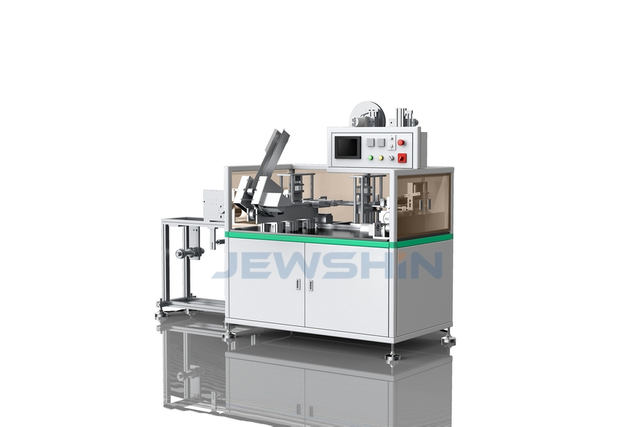
Horizontal flow wrappers are incredibly versatile. They handle a wide range of products — from solid objects like cards, books, and hardware parts to irregularly shaped or sticky items. At Jewshin, our servo horizontal packing machines (JX-250X/350X/450X/600X) are built with servo motor control for stable, reliable performance at varying speeds.
Key characteristics:
Product enters horizontally, sandwiched between two film webs
End seals create the classic pillow bag appearance
Ideal for products that can't be inverted or that need to stay flat during packaging
Great for rigid and semi-rigid products
Common in: cards, books, baked goods, hardware, cosmetics, and pharmaceuticals
A vertical packaging machine (VFFS — Vertical Form Fill Seal) works differently. The film is drawn downward from a roll, formed into a tube around a vertical filler tube, sealed at the bottom, filled with product, and sealed at the top. The packaged bag hangs vertically — hence the name.
Vertical machines are the go-to choice when you're packaging flowable products like powders, granules, liquids, or small loose items. They create pillow bags, gusset bags, or quad seal bags in a vertical orientation.
Key characteristics:
Film forms a tube vertically around the product stream
Typically used for pouches/bags that stand upright
Excellent for high-volume packaging of powders, grains, liquids, and small parts
Common in: food snacks, coffee, rice, frozen foods, liquid sauces, hardware fasteners

Let's compare the two across the most important factors for manufacturing plants:
Factor | Horizontal Flow Wrapper | Vertical Packaging Machine |
Product orientation | Horizontal feed | Vertical feed |
Best for | Rigid/semi-rigid products | Flowable products (powder, liquid, granule) |
Film type | Pre-formed film webs | Roll stock film |
Bag style | Pillow bags (horizontal) | Pillow, gusset, quad seal (vertical) |
Speed range | Medium to high speed | Very high speed |
Floor space | Moderate | Vertical footprint, saves floor space |
Ideal industries | Printing, cosmetics, hardware, pharma | Food, beverage, chemicals, agriculture |
Entry barrier | Easier to integrate for rigid goods | Better for high-volume liquid/powder lines |
If your product falls into any of these categories, horizontal is likely the better fit:
1. Rigid or irregularly shaped products
Products like playing cards, SIM cards, books, folders, cosmetic boxes, and hardware parts need to maintain their orientation. A horizontal flow wrapper feeds them through without flipping or tilting.
2. Products that can't be inverted
Some items — think wet wipes, adhesive tapes, or sticky goods — simply can't be turned upside down. Horizontal wrapping keeps them in a stable, consistent position throughout the process.
3. You're already running a cartoning or labeling line
Many of our customers pair horizontal flow wrappers with automatic cartoning machines to create a seamless secondary packaging flow. The horizontal orientation makes integration much easier.
4. You need flexibility for multiple product sizes
Our JX series horizontal flow wrappers feature PLC control with a touch screen interface storing up to 40 packaging parameters, making it quick to switch between SKUs without major retooling.
Vertical packaging makes more sense when:
1. You're packaging free-flowing products
Powders, granules, liquids, and small cut pieces are best handled by a VFFS system, which can fill and seal at high speeds continuously.
2. You need maximum production throughput
For very high-volume operations — think snack food packaging at 60-100+ bags per minute — vertical machines are built for that kind of throughput.
3. Your bags need to stand upright on store shelves
Vertical pouches have natural shelf appeal for food and beverage products. If your end customer displays bags standing up, vertical gives you a better starting shape.
4. Floor space is at a premium
Vertical machines have a relatively small footprint compared to a full horizontal line with conveyors and downstream equipment.
Here's something a lot of manufacturers overlook — you don't have to choose just one. Many of our turnkey packaging line solutions integrate both horizontal and vertical machines for different stages of production.
For example, a cosmetics manufacturer might use a vertical machine to fill cream pouches and a horizontal flow wrapper to overwrap those pouches in cardboard trays or decorative sleeves before they go into case packing equipment.
If you're unsure which configuration works best for your operation, our R&D team at Jewshin can help you design a custom line that fits your product specs, production volume, and budget. We've built integrated lines for customers across North America, Europe, Southeast Asia, the Middle East, South America, and Africa.

Both horizontal flow wrappers and vertical packaging machines are powerhouse solutions — but they're built for different jobs. The key is matching the machine to your product's physical properties and your production goals.
If you're still on the fence, ask yourself three questions:
What is my product? (Rigid/solid → horizontal. Flowable → vertical.)
What speed do I need? (High-volume powders/liquids → vertical. Medium-speed solids/cards/boxes → horizontal.)
How much floor space do I have? (Limited space → vertical. More room to integrate a full line → horizontal offers better flexibility.)
About the Author
Wendy Liu is the CEO of Dongguan Jewshin Intelligent Machinery Co., Ltd., a leading manufacturer and exporter of automated packaging equipment based in Dongguan, Guangdong, China. With years of hands-on experience helping manufacturers worldwide optimize their production lines, Wendy brings practical insights from the factory floor to every article. Learn more about our horizontal flow wrapper solutions or contact our team for a custom consultation.