Views: 0 Author: Wendy Liu Publish Time: 2026-04-30 Origin: Dongguan Jewshin Intelligent Machinery Co., Ltd.
Palletizing is the last step before your products leave the factory floor. Get it right, and you have stable, correctly stacked pallets ready for stretch wrapping, storage, and shipping. Get it wrong — or skip it entirely — and you're looking at labor bottlenecks, workplace injuries, and sky-high manual handling costs.
Over the past few years, we've seen a significant shift in the market: manufacturers who once relied entirely on traditional gantry or robotic arm palletizers are now evaluating collaborative robot (cobot) palletizers as a viable alternative. And for many operations, the math is surprisingly compelling.
In this article, I want to walk you through a practical ROI comparison between cobot palletizers and traditional palletizing solutions — so you can make the decision that's right for your facility, not the one that sounds trendiest.

When people say "traditional palletizer," they usually mean one of two things:
1. Manual Palletizing
Workers stack boxes, cartons, or bags onto pallets by hand. Slow, labor-intensive, physically demanding.
2. Automated Traditional Palletizers
Gantry palletizers: A pick-and-place head moves along X/Y/Z axes on a gantry frame. Reliable but bulky and relatively slow.
Conventional robotic palletizers: Industrial 6-axis robots mounted on a fixed base. Fast and flexible, but require safety fencing, complex programming, and significant floor space.
Both automated traditional options have been the backbone of high-volume manufacturing for decades. They work well — but they come with significant capital and operational costs.
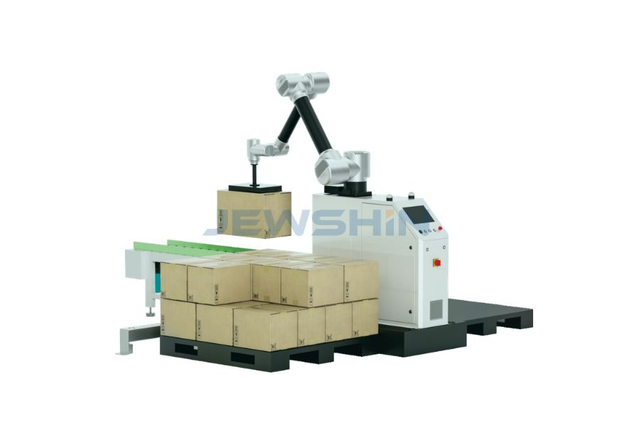
A collaborative robot palletizer is a robot designed to work alongside human workers without the need for safety fencing or cages. Cobots are smaller, lighter, and more mobile than conventional industrial robots. They use sensors and built-in safety features to detect human contact and stop or slow their motion accordingly.
Jewshin's collaborative robot palletizers are designed specifically for boxes, cartons, and pallet applications. They offer:
Fast installation and path setup — new products within minutes
Flexible stacking patterns — up to 800 stacking paths
Simultaneous stacking of 2 different products on a single pallet
Compact footprint — no safety cage required
Speed: 8-12 boxes per minute stacking speed

Factor | Cobot Palletizer | Traditional Robotic Palletizer | Manual Palletizing |
Upfront cost | Moderate ($30K-$80K range) | High ($80K-$200K+) | Near zero (labor only) |
Installation cost | Low (no safety fencing) | High (fencing, base, integration) | None |
Infrastructure requirements | Standard power outlet | 380V 3-phase, compressed air, foundation | N/A |
Winner: Cobot — for mid-sized operations that can't justify a full conventional robot installation.
Cobot palletizers: Typically 8-12 boxes per minute for standard box sizes
Conventional robotic palletizers: 10-25+ boxes per minute, depending on payload and reach
Manual palletizing: 2-5 boxes per minute (highly dependent on worker stamina)
Cobots are faster than manual labor and competitive with mid-range gantry systems. For truly high-volume lines (25+ cases per minute), conventional robots still have the speed advantage.
Winner: Traditional robot for ultra-high-speed lines; Cobot for most mid-volume operations.
This is where cobots genuinely shine.
Traditional robotic palletizers require:
Safety fencing reconfiguration for layout changes
Extensive reprogramming for new product patterns
Specialized robot programming knowledge
Significant changeover time (hours to half a day)
Cobot palletizers offer:
Hand-guided teaching — operators can physically guide the arm to teach new positions
New path setup in under 5 minutes (for our systems)
Quick-release gripper changes for different box sizes
Up to 800 stored stacking paths — no reprogramming needed for known SKUs
If you're running multiple SKUs, frequent product changes, or seasonal promotions, cobots win decisively on flexibility.
Winner: Cobot — especially for mixed-SKU operations.
Cobot: Compact base, no safety fencing, can be relocated. Typical footprint under 2 square meters.
Traditional robot: Requires safety zone (often 3-5m clearance in all directions), dedicated foundation, large base frame.
Manual: Requires human work zones, but no machine footprint.
For facilities with space constraints — and that's most plants — cobots are the clear choice.
Winner: Cobot.
Manual palletizing: High risk of musculoskeletal injuries (MSDs), especially for heavy boxes. Workers handling >15kg boxes manually face significant injury risk.
Traditional robot: Industrial robots are fast and powerful. Without proper fencing and safety systems, they're hazardous to humans.
Cobot: Designed for collaborative operation. Built-in force limiting, collision detection, and safe stopping. Workers can assist in feeding product without leaving the cell.
Cobots dramatically reduce workplace injury risk without requiring expensive safety infrastructure.
Winner: Cobot.

Let's do a quick ROI calculation on labor:
Scenario: 1,000 boxes per day, 5 days/week
Approach | Labor Required | Estimated Annual Labor Cost (USD) |
Manual | 2-3 workers per shift | $50,000 - $120,000 |
Cobot Palletizer | 0.5 operator (assists feeding) | $15,000 - $25,000 |
Traditional Robot | 0.5 operator | $15,000 - $25,000 |
Labor savings with a cobot vs. manual: $35,000 - $95,000 per year
Against a traditional robot, labor savings are similar — but cobot wins on upfront cost.
Factor | Cobot | Traditional Robot |
Maintenance complexity | Moderate (fewer parts) | High (industrial servo systems, complex kinematics) |
Spare parts availability | Good (standardized components) | Varies by manufacturer |
Service support | Remote-capable, simpler troubleshooting | Often requires on-site technician |
5-year TCO estimate | 60-70% of traditional robot | Higher due to fencing, infrastructure, maintenance |
Winner: Cobot on total cost of ownership.
Cobot palletizers make the most sense when:
You're running multiple SKUs — Frequent product and pattern changes make cobot flexibility a major advantage.
You have space constraints — No room for safety fencing and large robot bases.
You're upgrading from manual — A cobot delivers a massive productivity jump at a fraction of the cost of a conventional robot.
Production volumes are mid-range — Not high enough to justify a $150K+ conventional robot installation.
You need fast deployment — Our cobot systems can be installed and running within 2 hours. A conventional robot line can take weeks.
You're in a growing market — Southeast Asia, Africa, South America, and the Middle East are seeing rapid manufacturing growth. Cobots offer the flexibility to adapt as demand shifts.
Conventional robotic palletizers still make sense when:
You need ultra-high speed — 20+ cases per minute consistently. Some food and beverage lines run at this pace.
You're handling very heavy loads — Some cobots are limited to 10-25kg payloads. Conventional robots can handle 50kg+ per pick.
You already have a robot ecosystem — If your plant already runs ABB, Fanuc, or Kuka robots, adding another conventional unit may simplify maintenance and training.
You need extreme precision and repeatability — For highly specialized stacking patterns or cleanroom environments.

For reference, here's what our cobot palletizing systems offer:
Stacking speed: 8-12 boxes per minute
Maximum tray size: 1500mm x 1500mm
Stacking paths: Up to 800 programmable patterns
Dual product stacking: Simultaneous stacking of 2 different products
New path setup time: Under 5 minutes
Installation time: Within 2 hours
Payload: Suitable for boxes, cartons, and standard packaged goods
Integration: Works with our automatic case erector and case sealer lines
Here's the simplified math:
Cost Item | Manual | Cobot Palletizer |
Equipment cost | $0 | $45,000 - $70,000 |
Installation | $0 | $2,000 - $5,000 |
Annual labor savings | $0 | $35,000 - $95,000 |
Annual injury reduction value | $0 | $10,000 - $30,000 |
Payback period | N/A | 8-18 months |
For most mid-sized manufacturers, a cobot palletizer pays for itself within the first year — and continues delivering savings for years thereafter.
Wendy Liu is the CEO of Dongguan Jewshin Intelligent Machinery Co., Ltd., a manufacturer and exporter of collaborative robot palletizers and end-of-line packaging equipment. Jewshin serves manufacturers across North America, Europe, Southeast Asia, the Middle East, South America, and Africa. Explore our cobot palletizing solutions or contact our team for a site-specific ROI analysis.